
1. Why ‘Selling’ Trumps ‘Making’ in a Democratic Welfare State
(1) Why ‘Selling’ Matters in a Democratic Welfare State
From the perspective of small business owners and producers, there is currently only one way to resist the ruthless profit-plunder and heavy regulation of the democratic welfare state: sell more goods and accumulate more profit.
If these acquired profits are cashed out after the producer legally becomes a non-resident, they can preserve an additional net profit of approximately 30% or more (by South Korean standards), which includes savings on health insurance premiums. There is an even more innovative approach: converting assets into Bitcoin, staking them on platforms like Stacks to generate Bitcoin-denominated dividends, and then taking out collateralized loans on platforms like Zest to live off stablecoins. Under current laws, living on debt is non-taxable, and repaying debt does not constitute asset accumulation. The global elite are already utilizing this exact playbook to legally bypass taxes.
However, the focus of this book is not on tax avoidance techniques. Rather, it explores the phenomenological meaning of “selling more goods to the masses.” Why on earth has selling become more critical than making? In our youth, there was undoubtedly a time when making was considered far more important than selling.
According to Austrian economics, in an environment shaped by “hard money” (where currency value is preserved), time preference remains low, and artificial state market manipulation is absent. In such a world, rational producers naturally establish roundabout production processes centered on capital goods. Within this structure, producers focus on savings and reinvestment rather than one-time marketing expenses, dedicating themselves to making things “cheaper and better.” After all, no marketing is more powerful than undeniably lower prices or superior quality. In this type of society, production—not consumption—is the starting point of the economy. Therefore, the act of creating valuable supply inherently generates purchasing power (demand) in the market. This is the true essence of Say’s Law: “Production is the source of purchasing power.”
However, because the democratic welfare state constantly seeks to hand out free money, it inherently favors debt over savings. Consequently, when interest rates are artificially kept low and prices continuously rise, the time preference of producers is forcefully driven upward. In an inflationary environment, even if a producer expands margins through manufacturing innovation to engage in deflationary competition, the catastrophic collapse of currency value swallows those real profits whole. Thus, rational producer realizes that instead of reinvesting capital into an uncertain future profit, it is far more lucrative to exploit current debt leverage. Ultimately, rather than pursuing fundamental technological innovation, they take on debt far beyond their sustainable capital capacity, slap a logo onto a generic product, and go all-in on “selling it at a high price” through aggressive marketing. In other words, malinvestment—borrowing extensively beyond one’s true capital capacity—becomes the norm.
As a result, producers begin to bypass cumbersome processes such as saving profits, investing in human capital, building long-term customer trust, and advancing production systems. They are forced to dive straight into mainstream markets capable of absorbing high fixed costs, dump money into advertising, and bet everything on hype by establishing a shallow, outsourced white-label (rebranded) production system.
We easily witness the raw reality of this distortion all around us. In an era of inflation, it would seem logical for tangible assets like used cars or machinery to rise in value. In reality, however, they suffer brutal, rapid depreciation. Why does this happen? It is because the public’s time preference has also skyrocketed, leading them to consume nothing but the “hype” of brand-new products. Once the hype evaporates from used machinery, it serves no purpose other than as a capital good for productive ends. Yet, because even small business owners are abandoning production, there is virtually no demand for it. Consequently, it gets hit with a depreciation bomb. The stark divergence between the fake bubble of new products sustained by leverage and marketing, and the used physical goods treated like trash the moment the hype fades—this is the exact market landscape engineered by the democratic welfare state.
Returning to the main point, if we accept the reality that selling is vastly more important than making within the framework of a democratic welfare state, producers are ultimately forced to ask one fundamental question:
What do democratic citizens truly want?
An understanding of the core of this desire is a prerequisite for survival.
Someday, the democratic welfare state will inevitably face the judgment of liquidation due to the heavy cross of debt it bears. However, no one knows when that timing will come. We cannot simply sit around and wait for a utopian era where wild entrepreneurs compete purely to make great products.
(2) Democratic Citizens Place a Premium on Romantic Illusions
To state the conclusion first: modern democratic citizens desire something that is both romantic and efficient. Wanting efficiency is a given; people need something that delivers cost-effectiveness within a capitalist system. But why on earth do they crave the romantic? This is where it gets fascinating.
If you visit famous art museums across Europe—in Austria, France, or the Czech Republic—you will notice a common thread. Pre-Renaissance medieval art is grand and magnificent, yet the artists remain anonymous. The emphasis on a painter’s name, private life, and existential narrative is a phenomenon that emerged only after the Renaissance.
In the Middle Ages, no one cared who the artist was, or what they felt and thought. The only thing that mattered was how precisely they reproduced biblical or national archetypes. In that era, the precious and the sacred were reserved exclusively for the mythical, the transcendent, and the religious. An individual’s trivial emotions or romantic love were viewed as profane. The concepts modern democratic citizens hold dear—personal rights, elaborate descriptions of emotions, moral honor—held zero value compared to the absolute power and holiness of God.
However, as civilization advanced, Christianity began to lose its infrastructure-like function of providing meaning to phenomena. Historians and Enlightenment priests rushed to occupy the vacuum of meaning left by the evaporation of the sacred. Believing in human progress, they preserved the meaning of phenomena into universal formulas through scientific inquiry rooted in objective thinking. In rebellion against this, 19th-century Romanticism was born, maximizing subjective human emotion and solitude. Yet, this remained the exclusive playground of aristocrats and intellectuals. The masses began to feel a deep sense of alienation, anxiety, and boredom toward a world that progressed mechanically, completely detached from their everyday lives. This is the standard explanation offered by phenomenologists as to why humans lost the existential meaning of life in a capitalist society.
While I fundamentally agree with this diagnosis, looking solely through the lens of capitalist coldness or objective reasoning fails to explain the anomalies found in non-democratic capitalist societies like Thailand, Georgia, or Singapore. These nations certainly pursue efficiency. However, their market for high-end romantic brands—those that soothe personal existential anxiety and validate the self—is remarkably thin.
Unlike Western societies, these non-democratic capitalist countries still rely on religion to provide life meaning and validate existence. Examples include Buddhism in Thailand, Orthodox Christianity in Georgia, or widespread beliefs in Feng Shui and fortune-telling. In other words, consumption patterns that seek a “pianissimo” (subtle, quiet) form of romance to grant identity and comfort feelings of depression and anxiety are entirely independent of capitalist maturity. Instead, this is a unique historical trait of Western citizens, who targeted the power of transcendent faith and holiness as objects of democratization and dismantled them.
In the mass society that accelerated after the 19th century, citizens began to develop a sense of sovereignty rooted in the means of production. By the 20th century, universal suffrage meant that individuals gained sovereignty merely by being born, even without owning any means of production. While this may be a moral and political triumph, phenomenologically, it was a form of psychological violence that left humans in absolute solitude and anxiety. This world became a wilderness of freedom, where humans must decipher the meaning of their own existence entirely on their own.
In the medieval and feudal societies of the past, the reason for one’s birth and the tasks for the day were predetermined. One only had to obey a world created by God, certified by the Pope, and ruled by the King. The interpretation of phenomena and suffering was not a personal task; it belonged to the authorities above who held the legal right—the entitlement—to interpret.
Democratic citizens are different. Because they democratized and dismantled the sacred entities (God, priests, kings) that once gave meaning to phenomena, existence has become an exclusively individual responsibility. However, creating a mythical, archetypal aura to give meaning to existence—moving beyond childish, mundane interpretations—cannot be achieved without special rituals, spiritual discipline, or physical austerity. This was originally the weight of the crown borne by priests and kings in feudal societies. Yet, because democratic citizens are granted sovereignty at birth, they naturally believe that all life’s suffering should be resolved by the state’s welfare system. Consequently, on an individual level, mythical imagination and abstract thinking capacities have inevitably degenerated. People have begun to mistake an emotionally instant, instantly gratifying, and “hip” state of being for the attainment of true existence and autonomous living.
Thus, the modern democratic citizen cries out to the commercial market:
“Let a brand package and represent the romantic emotions of depression, love, and loneliness that I uniquely feel, in a subtle pianissimo. Direct a grand emotional fantasy to prove that my existence is special.”
In a commercial context, subjective human utility has shifted: from replicating the holiness of God on Earth to comforting and beautifully packaging the romantic emotions of the individual.
In other words, tracing the genealogy of the romantic branding that modern consumers are so obsessed with leads to this conclusion: to sell romance to the masses, a producer must first understand the mechanisms of the sacred once provided by God. If you can translate that foundation into the romance modern consumers desperately crave, you can bestow an exclusive aura upon your product and sell it at a premium.
Now, borrowing the profound insights of Mircea Eliade, a master of the anthropology of religion, we shall discuss what constitutes the true essence of the sacred.
2. What is the Sacred?
(1) The Definition of the Sacred
According to Rudolf Otto’s The Idea of the Holy and Mircea Eliade’s The Sacred and the Profane, the “sacred” is an emotion of dread experienced in the presence of a mystery that induces tremors in vulnerable human existence (mysterium tremendum), and a majesty that radiates an overwhelming superiority of power (majestas). It is a religious fear felt before the fascinating mystery (mysterium fascinans) radiated by a perfectly fulfilled being. In the face of this overwhelming experience presented by the “Wholly Other” (das ganz Andere), humans are reduced to mere “dust and ashes” (Genesis 18:27).
There is an anthropologically fascinating point here: when humans experience the reality of a prototypical, exemplary Archetype existing above them, they feel a paradoxical, profound sense of relief. This relief comes simply from voluntarily submitting to that absolute hierarchy and replicating (imitation) the gestures of that sacred entity. Particularly in primitive times—when science, technology, and state power were weak, and the forces of nature generated absolute authority—the sacred was interpreted as originating from the Creator of the universe.
We must pay close attention to this key aspect: [the non-democratic hierarchy between an overwhelming, superior being and an insignificant self] serves as the prerequisite for a Hierophany (the manifestation of the sacred) to occur on Earth. Conversely, in a society where everything has been equally democratized, there is no room for a hierophany to emerge.
This sacredness can manifest by dwelling in ordinary, functional objects like stones or trees; it can be abstract like the sky or the earth; or it can be a singular, historical event, such as Jesus being born in human form. While historical and cultural specificities exist across civilizations, the core of hierophany appearing in myths worldwide remains identical: a superior being belonging to the cosmic order ruptures into the ordinary world.
At the moment of this hierophany, humans are drawn into a phenomenological field where they perceive the trivial and fleeting elements of daily life as sacred. Within the sacred realm, a stone is no longer just a stone; it is understood as a fragment and symbol of cosmic reality. The world one inhabits ceases to be meaningless or miserable; it becomes an empire “saturated with being.”
This is an ecstasy rarely experienced by modern democratic citizens, who instinctively reject the existence of any reality superior, absolute, or transcendent to themselves. This was one of the core principles emphasized in Aura Branding and Endorphin Philosophy: the artistic sensibility that transforms the experience of an ordinary, meaningless, functional phenomenon (A) into an extraordinary, meaningful, subjective aura (B). This is essentially the exact same mechanism through which primitive humans, through mythical experience, perceived a stone not just as a rock, but as a hierophany of a god, symbolizing hardness, power, and permanence.
(2) The Hierarchy of the World
In uncivilized, wild societies, a vertical hierarchy existed not only on an existential level—such as between humans and the Creator—but also within the structure of the world itself. This was because primitive humans believed that by imposing a hierarchy on their own world in a manner homologous to the generative principles of the universe, they could replicate cosmic sacredness.
For example, to comprehend the cosmic cycle that life requires death, primitive humans structured their world as follows: Apsu, the abyssal subterranean waters symbolizing the chaos before creation, flowed beneath their feet; a massive rock sealed the entrance to that abyss; above their heads loomed the sky, symbolizing vast order, power, and eternity; and humans resided in Babylon, which served as the nexus connecting this superstructure and infrastructure.
By modern standards, this is unscientific. For them, however, the world could only be experienced as truly real when it was constructed as a metaphor for the universe’s creation principles. Because the forces of nature encountered by individuals were so sacred and occupied the upper strata of the ontological hierarchy, it was entirely meaningless for a mere human to insist on personal subjectivity or fleeting emotions.
Only when all environments and phenomena are interpreted based on cosmic order does subjective utility—that is, meaning—emerge for the human soul. Because only the sacred could bestow authentic meaning in the primitive world, a natural tendency arose to impose a hierarchy even onto living spaces. The architectural result was the erection of an Axis mundi (the center of the world) inside one’s home, connecting it to the cosmos and separating that sanctified zone from the profane space outside.
3. The Hierarchy of Space
(1) Symbolism and Homology
Before discussing how primitive humans constructed spatial hierarchies, why democratic citizens desperately crave that experience despite their inability to create it themselves, and how small business owners can leverage this gap, we must first examine the concept of symbolism.
The mythical and religious imagination that extracts transcendent meaning from ordinary objects and phenomena depends entirely on how plausibly a producer articulates a narrative interpretation of a symbol. If the interpretation of a symbol is convincing, the world is instantly saturated with being, no matter how wretched or difficult reality may be. This is precisely why the symbols we try to decipher from objects or phenomena gain the greatest power when they are homologous with the principles of cosmic creation. There is no reality older or stronger than the cosmos itself.
Homology is critical in branding because it structurally aligns the macrocosm (universe and nature) with the microcosm (humans and products). Consider the following examples:
[Example 1] Deducing Life Phenomena — The Style of the Doctrine of the Mean
- Macrocosmic Observation: The sky pours rain = The earth conceives life.
- Microcosmic Experience: A man releases semen = A woman conceives life.
- Homologous Coupling: Consequently, a formula is established: Sky = Father, Earth = Mother, Rain = Semen. Therefore, the narrative interpretation that a rainy day is the sky raping the earth to bring forth life becomes a logical conclusion.
[Example 2] Deducing Human Behavioral Principles — The Style of Laozi
- Water always flows to the lowest ground → Anything that goes against the natural order cannot endure.
- Water adapts to the shape of any vessel → One finds peace only by adapting to the world’s circumstances rather than stubbornly insisting on oneself.
- Water appears weak, but over a long period, it pierces through solid rock → If one does not give up, a path will surely open, though people usually stop before reaching that point.
According to this interpretation, the mode of existence of an object—water—is structurally identical to the principles of human behavior. Consequently, aligning one’s actions with water is perceived as natural and correct.
When these networks of connections between objects and the world intertwine, the symbolic system effectively becomes the database of the universe. Striving to find homologies between oneself and the world is a form of existential knowledge; thus, while this database may not be objective by modern standards, it was more than sufficient as a subjective meaning capable of redeeming the human soul.
Alongside exploring homologies with objects, mechanically replicating the gestures of the Creator during the cosmic creation process within daily life was paramount to primitive existence.
[Example] The Daily Life of a Primitive Tribe
- Women must sit with their legs tucked beneath their bodies to one side, and men must sit with their legs crossed in front. This is because it is passed down that the supreme deities, Changing Woman and Monster Slayer, sat in those exact postures at the beginning of time.
- Everything—from how to cook specific grains, how to hunt animals with a stick, down to the posture one must assume while urinating—must follow the precise methods taught by the Creator.
- To configure space in the same manner God created the universe, the village is divided into four quadrants, leaving the central space vacant to erect a world-axis pillar capable of communicating with the heavens.
This mechanical reenactment and repetition of the Creator’s gestures gradually evolved into institutionalized rituals. The exclusive authority to interpret these symbols was granted only to shamans and priests who had undergone rites of passage. The core of this archaic mechanism is that the individual ego does not arbitrarily interpret meaning; instead, it rigidly mirrors the cosmic order and sacred gestures established by a transcendent being. The reality that sovereignty belonged to God and his proxies, the priests—and that one merely needed to follow their interpretations and teachings—provided a profound sense of religious fulfillment and existential reassurance.
During the medieval Christian era, the premise that sovereignty belonged solely to God and the priesthood remained unchanged. Granted, Christian reformers such as Joachim of Fiore, Martin Luther, and Rudolf Bultmann gradually began shifting the locus of divinity away from God or the priesthood and onto the individual as a solitary agent. In the modern era, figures like Ahn Byung-mu and Michel de Certeau even advanced radical arguments suggesting that the masses (Minjung) themselves are Jesus, or that spirituality resides within the everyday life of the common people.
However, these progressive ideas of elites and the theological debates of conservative Christianity were mere pie-in-the-sky abstractions to the actual world people lived in. Peasants still lived according to the cyclical rhythms of nature’s four seasons. To them, nature was an entity sanctified by Christ. The Church did not suppress these primitive, archaic needs of the peasantry; it accommodated them. Rather, it helped peasants embody homologies with biblical heroes like Jesus and the Virgin Mary within their daily lives, filtering an agricultural environment governed by cosmic rhythms through Christian principles. For instance, Easter was understood as a spring planting festival, Christmas as a winter solstice festival, and during droughts, holy water was brought out to be sprinkled over the fields.
This mechanism of macro-micro structural homology is seamlessly applied today by high-resolution producers like Apple —a topic we will explore further later.
(2) The Spatial Hierarchy Built by Primitive Humans: Space as an Imago Mundi (Image of the World)
A defining characteristic of primitive spaces is the establishment of a fixed point—a central axis of the world (Axis mundi)—that connects to the heavens, the order of the cosmos.
This manifested as erecting a massive pillar in the center of a house or carving a smoke hole in the roof. Because primitive humans traced the origin of meaning exclusively to the sacred on a cosmic scale, they desired their homes to be the center of the universe, replicating the vast cosmic order on a microcosmic scale. In short, they wanted their space to be an Imago Mundi (an image of the world).
Consequently, they consistently demarcated an absolute center from a meaningless periphery, imposed a strict hierarchy on the world and space, and mirrored the gestures of the divine. For example, in India, before laying the foundation stone, an astronomer would declare exactly where the serpent that supports the world was located, and a stake would be driven directly into that spot to lay the cornerstone. Through this, the foundation stone was situated at the center of the world—repeating the mythical gesture of Lord Indra, who in the beginning of time attacked the serpent’s lair and severed its head with a thunderbolt.
Even in the Bible, space is understood as something pre-revealed by God, which humans merely replicate. On Mount Sinai, Yahweh reveals to Moses the exact pattern of the sanctuary he must build:
“Make this tabernacle and all its furnishings exactly like the pattern I will show you… See that you make them according to the pattern shown you on the mountain.” (Exodus 25:9, 40)
Hence, churches and cathedrals also seek to establish a cosmic fixed point within their architecture. Imagine opening the doors and stepping inside a Gothic cathedral built in the Middle Ages. There is a crossing where the Nave (the longitudinal axis of human movement) intersects with the Transept (the transverse axis). Directly above this crossing sits a dome or a lantern tower.
This very crossing is the axis of the world connecting to the cosmos.
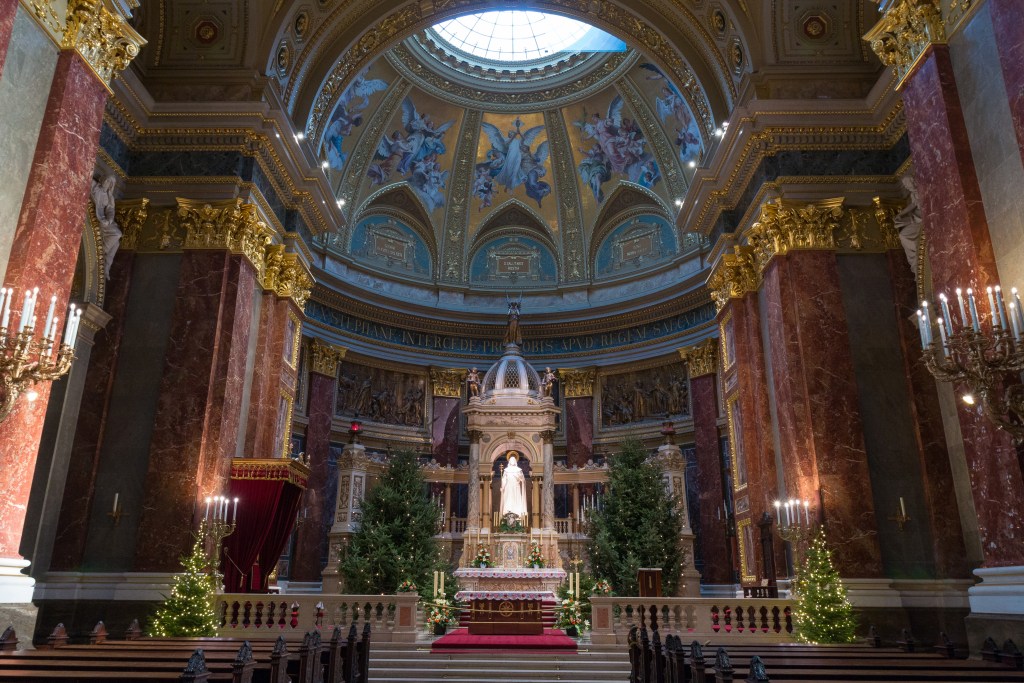
[Photo: Inside a cathedral in Budapest, Hungary, a piercing beam of light descends vertically through the oculus, striking the altar with absolute divine precision. Source: Myself]
Through the opening (Oculus) or windows at the apex of the dome, light cascades like a waterfall onto the floor of the crossing. It symbolizes a portal through which divine grace pours directly onto the Earth. The moment believers stand at this crossing, they are overwhelmed by the immense volume of the space, experiencing an existential awe toward the authority of God. Before their eyes stands the altar where Mass is celebrated. This altar serves as a vertical line piercing through a three-tiered cosmos: the underworld (the foundation), the terrestrial world (humans), and the celestial world (God).
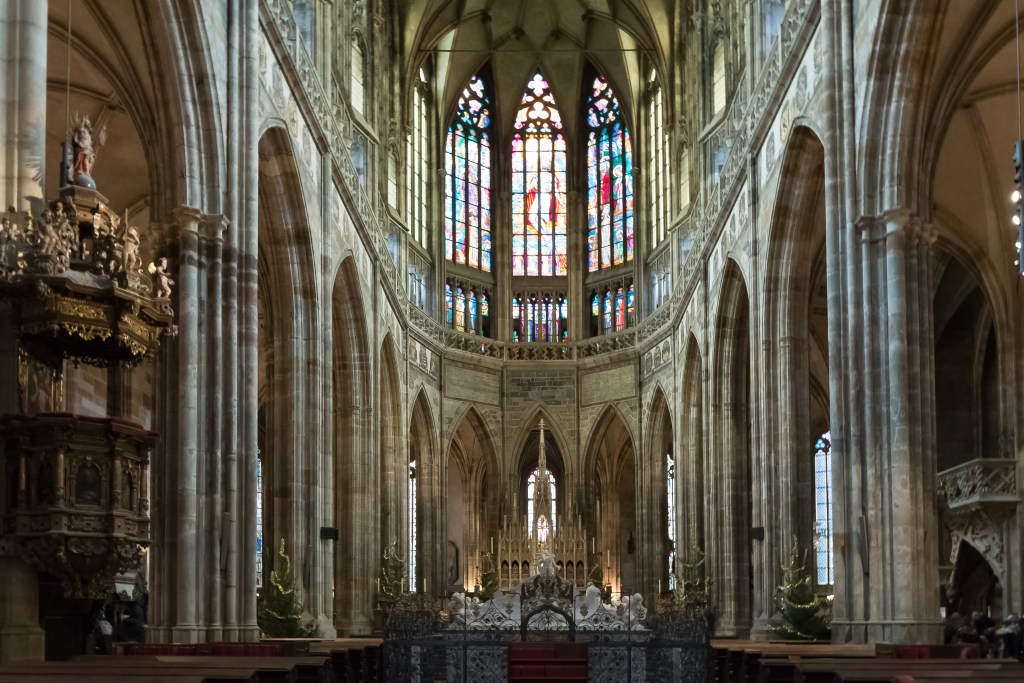
[Photo: St. Vitus Cathedral in Prague, Czech Republic, Source: Myself]
(3) The Spatial Hierarchy That Democratic Citizens Rarely Experience
If separating an absolute center—where the axis of the world is anchored—from the profane world to impose a spatial hierarchy is the core principle of how humans experience reality, then democratic citizens are structurally starved of such opportunities.
Some argue this is because modern citizens interpret space through the sterile filters of capitalism or scientific rationalism. Following that logic, producers should only be able to make money by creating highly efficient, scientifically optimized spaces. In reality, however, products and spaces in a democratic society that emphasize nothing but functionality and efficiency rarely command a premium. People dismiss them as soulless and uncharismatic. Instead, the masses willingly pay a hefty premium for spaces that may seem inefficient and inconvenient but possess a distinct aura. Therefore, mainstream logic completely fails to explain why citizens so desperately crave romantically conceptualized spaces.
At its core, the reason we fail to feel the sacred in our everyday spaces lies elsewhere. It is because the greenhouse fences erected by the modern democratic welfare state unconditionally guarantee safety—a right citizens now take for granted. Lounging in absolute physical comfort, they have zero survival incentive to look for deeper interpretations of their environment.
Indeed, when even modern democratic citizens are directly exposed to the terrifying majesty of raw nature or the mystery of the aurora borealis, they shudder at the sense of reality delivered by the “Wholly Other” and instantly transform into religious humans (homo religiosus). In other words, an Axis mundi is erected only when one humbly acknowledges the undeniable existence of a supreme, absolute space and order far above themselves, and strives to reach that heavens. However, the bloated ego of the democratic citizen—coddled by the state as a 1/n sovereign shareholder of society—narrowly misinterprets sacred spaces as merely “exclusive” or “privileged.”
Yet, just because democratic citizens live within the state’s protective enclosure, consuming everything in the world as a mere spectacle, it does not mean their deep-seated existential need for objective reality has vanished. There is exactly one chaotic frontier that the democratic welfare state desperately tries to control but ultimately cannot tame: the Market.
Liquidations such as economic recessions, stock market crashes, employment crises, layoffs, and hyperinflation force individuals to feel absolute dread (Tremendum) in front of a colossal wall of fate that neither the individual nor the state can conquer. People develop an organic awe toward the volatility of the market. Consequently, they become hyper-enthusiastic about the gestures of certain producers who anchor a central axis against this titanic force and uncontrollable order, boldly declaring, “Behold, this very space is the absolute center of the market.” To the citizens, that producer becomes nothing short of a deity. By achieving structural homology with the cosmic order of the market, a space that is heterogeneous from mundane daily life instantly becomes a “hot spot.” The commodities sold within that space are elevated to holy relics, commanding astronomical premium prices that vastly exceed their production costs. This is precisely why producers who preach techno-optimism reign as modern messiahs.
Naturally, alternative perspectives exist. Rather than my view—which posits that the democratic welfare state aggressively sanitizes the environment to eliminate non-state deities by guaranteeing absolute safety—one could reverse-engineer the scarcity of sacred spaces in modern society through a purely sociological lens.
For instance, the masses live by merely inserting their physical bodies into unsanctified spaces, such as anonymous, gray manufacturing metropolises or standardized, matchbox-style apartment complexes built on state infrastructure. Thus, one might ask: is it simply that modern humans lack the spatiotemporal window (that is, the Kairos and Topos) to symbolically manifest a world axis through autonomous human action?
The French sociologist Michel de Certeau famously championed this perspective. He argued that because the working class in a capitalist society is deprived of spatial ownership, spirituality resides in their subversive micro-gestures—such as illegal graffiti proliferating in systemic blind spots, jaywalking that mocks state traffic regulations, or the strategic renaming of places.
While this interpretation is not entirely without merit, constructing a space as a sanctuary aligned with the cosmos—an Imago Mundi—does not strictly require a specific historical window or private property ownership. As Eliade illustrated through the sacred pole of the Achilpa tribe, it can be achieved quite simply by planting a staff or a cedar pole firmly into the ground.
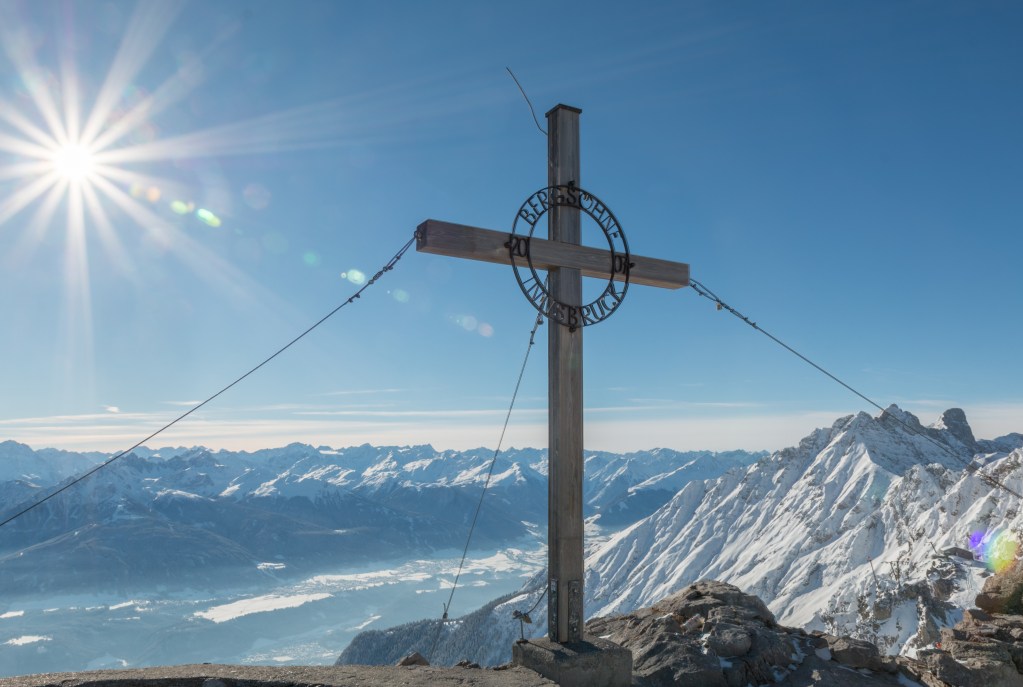
[Photo: On a peak of the Alps in Innsbruck, Austria, a massive cross is erected to consecrate and sanctify the surrounding wilderness. Source: Myself]
The crux of the matter lies elsewhere: today’s masses generally face no existential necessity to erect a sacred axis in their lives. Even when sudden market liquidations strike, the system quickly patches the wounds through artificial interventions like unlimited quantitative easing. To experience the overwhelming, raw presence radiated by the cosmic order, one must kick open the comfortable fences of the greenhouse and directly expose their naked flesh to an inconvenient, hazardous, and brutal environment.
“I am nothing but a shadow compared to the absolute order of the universe. There exists something far more transcendent above my head. I submit to the aura radiated by this superior being and I will obey its order.”
Only when this fierce hunger for objective reality exists can a sacred space that replicates the architecture of God be born. Yet, citizens sheltered by the democratic welfare state do not even comprehend the necessity of a space being sacred. To the masses, a home is merely real estate—a temporary pitstop to flip and jump up the socioeconomic ladder. As long as the property value appreciates and the couch is comfortable, it is more than enough.
(4) A Modern-Day Sanctuary: Apple Marina Bay Sands (Singapore)
Introducing Apple Marina Bay Sands as a modern-day sanctuary has nothing to do with mere minimalist aesthetics. Rather, it is because this space flawlessly executes the source codes of religious mythology, physically tattooing onto the minds of the masses exactly who rules the market and where its absolute center lies.
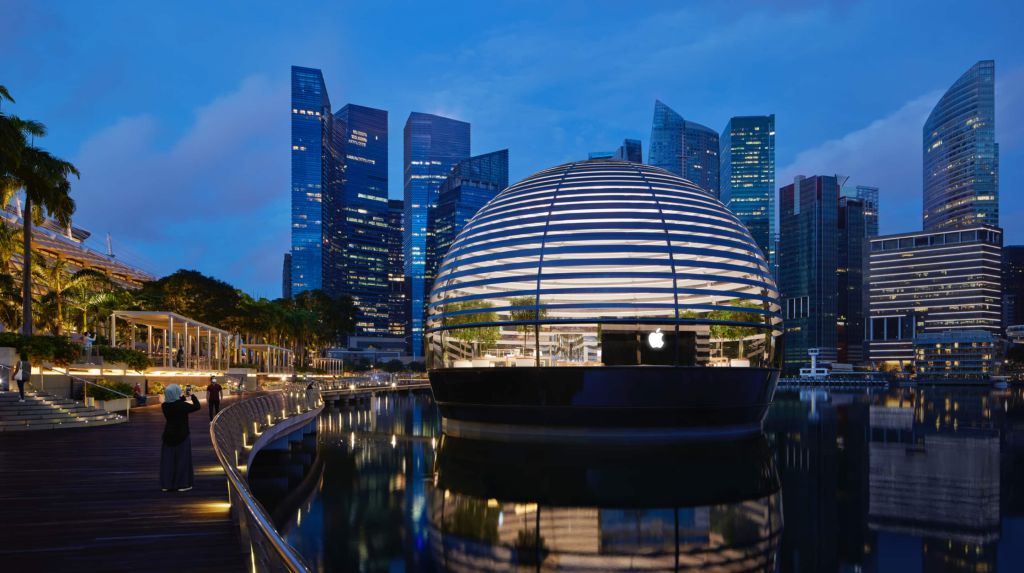
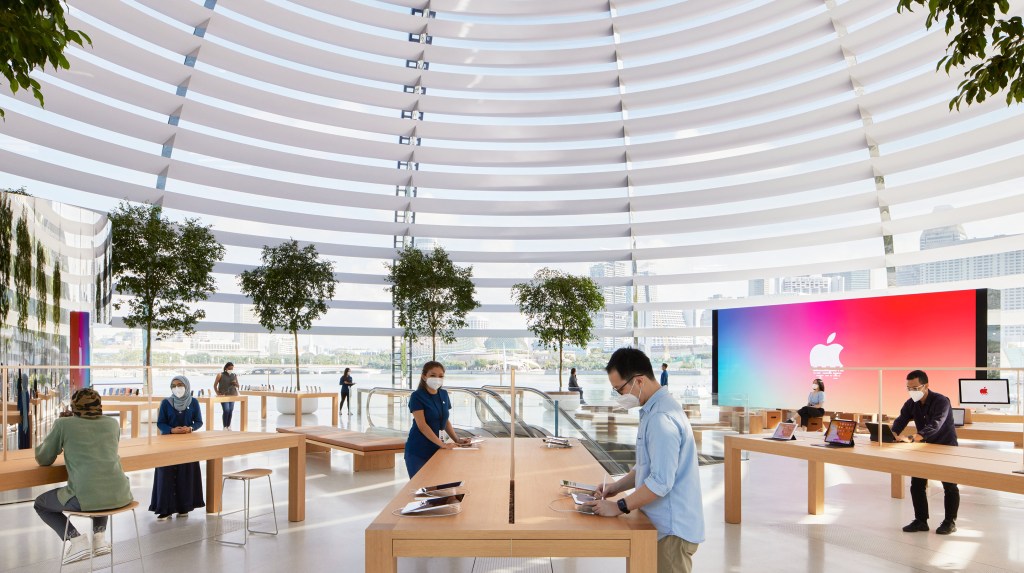
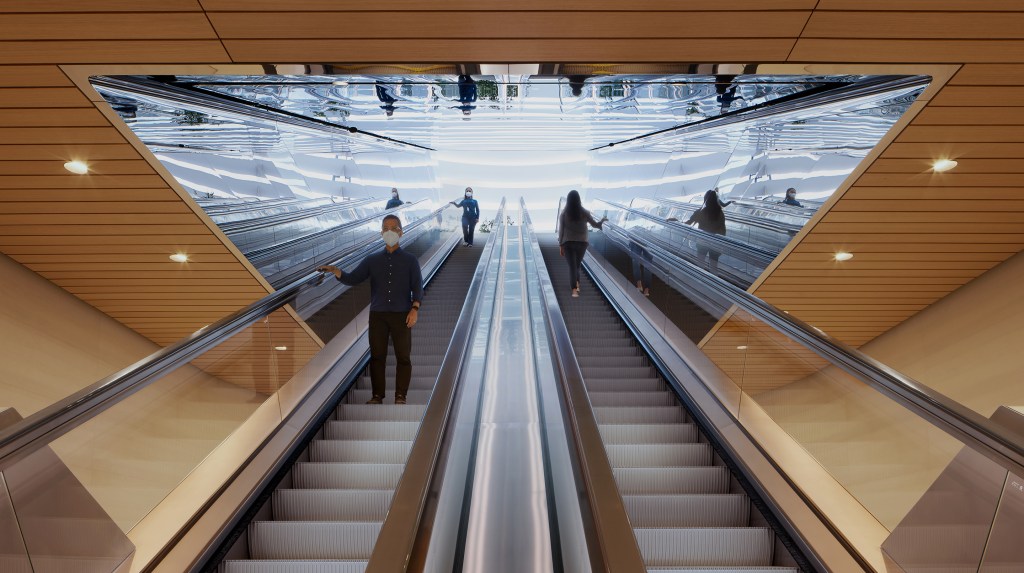
[Photo: Apple Marina Bay Sands (Singapore), Source: Apple official website]
[Cosmos Floating Upon the Waters]
In religious mythology, water symbolizes prehistoric chaos, disorder, and the primordial state of potentiality—a state where anything can materialize but nothing is yet defined. It represents the purification that washes away profane stains right before rebirth into a new order.
Rising as a perfect geometric sphere directly out of the waters of Singapore—where all sorts of global financial capital and secular desires fiercely churn—sits the Apple Store. It is a sanctuary purifying secular chaos, a steadfast pillar driven into the epicenter of a tempestuous market. Consumers entering this store escape the raw terror of a market where liquidation could strike at any moment; instead, they experience the hallucination of stepping into a pristine world of Cosmos engineered by a god who once stood at the absolute zenith of the market (Steve Jobs).
[The Portal of Resurrection: From Subterranean to Light]
The defining essence of a sacred space is its radical heterogeneity from the profane world. To reach this Apple Store, one must journey through a dark, enclosed underwater tunnel originating from the basement of the Marina Bay Sands mall. This mechanism is structurally homologous to a Catholic baptism or an ancient rite of initiation, mirroring the experience of walking through a medieval cathedral’s crypt to venerate the souls of martyrs and purge secular defilement.
The moment consumers pass through the subterranean tunnel and ascend via the escalator, bursting forth onto the water’s surface, they are hit with a baptism of light cascading from the ceiling. A dramatic, vertical elevation from pitch darkness (the underworld/profane world) to brilliant light radiating from the heavens above (the celestial world/sanctuary). This architecture perfectly replicates the spatial grammar of medieval churches and Babylonian temples. Having endured this transition, the masses shed the dizzying anxieties of the secular world and cross the threshold into the sacred realm of the Apple Empire.
[The Axis Mundi Piercing Heaven, Earth, and Underworld]
At the absolute apex of this spherical monument sits a massive Oculus (a celestial skylight) that looks as though it was lifted straight from the Roman Pantheon. The pillar of light pouring down from this oculus pierces the showroom floor (the terrestrial world) and aligns in a perfect, unbroken vertical line with the subterranean tunnel (the underworld) from which visitors just emerged.
This is the physical activation of the Axis mundi described by Eliade—locking the underworld, the human realm, and the heavens into a single vertical axis. It is a structure precisely homologous to the church dome detailed earlier. As the sunlight streaming through the oculus systematically illuminates the neatly aligned altars (premium timber display tables) and holy relics (iPhones, MacBooks) throughout the day, consumers are thoroughly overwhelmed by this cosmic order, losing both their sense of self and their objective price sensitivity.
Exiting an Apple Store that has blessed them with such overwhelming sacredness without purchasing anything triggers a profound sense of moral debt. Out of a subconscious desire to absolve this guilt, the masses offer sacrifices at the altar Apple has prepared—whether by uploading photos to Instagram to spread its gospel, or by purchasing a piece of merchandise as a token of devotion.
(5) Micro-Producer Strategy: Practical Tips Learned from Apple and the Church
By synthesizing Apple’s strategy with the spatial architecture of medieval churches, we can extract actionable staging points for independent producers who wish to declare their own establishments as the absolute center of the market.
[Verticality and Overwhelming Scale]
Churches designed in the Gothic style feature radically high ceilings. They form a vertical vector that defies terrestrial gravity, forcing the gaze upward. Immersed within a space of such overwhelming scale, a human experiences a sense of awe that borders on existential erasure. Standing within this sacred space, an archaic desire for submission awakens—a psychological impulse to discard one’s fraction of social sovereignty (1/n) and be fully absorbed into the divine.
In reality, however, the commercial properties encountered by independent small business owners do not permit the 10-meter-high ceilings of a Gothic cathedral. Most are trapped inside a square concrete box measuring a mere two to three meters in height. In this scenario, a clever producer does not attempt to increase physical height; instead, they leverage the depth of darkness to make the ceiling vanish entirely.
This is achieved by painting everything—messy wires, HVAC ducts, and structural elements that cause the brain to perceive a low ceiling—in a matte, singular dark tone. Then, a sharp, intense spotlight is driven straight down exclusively onto the “altar” (the product display table or the dining table).
Because the human eye cannot easily discern boundaries in darkness, the high contrast in illumination causes the dark ceiling to expand upward like an infinite night sky. Instantly, a low, cramped shop is transformed into a subterranean sanctuary sheltering a cosmic axis.
To enhance this effect, a producer can anchor a singular vanishing point on the ceiling, such as a minimalist pendant light or a chandelier, to consolidate the customer’s focus. The moment a consumer steps into the store and looks at this object glowing solo against a monolithic dark backdrop, they physically tilt their head upward. This physical act of throwing the neck back to look up instinctively induces a state of primitive submission and awe. Consequently, the surrounding dim space recedes into the background, generating an illusion of massive spatial expansion.
This is the exact same principle applied in historical Japanese Wabi-sabi tea culture through the Tokonoma (an elevated alcove displaying a hanging scroll or flowers). By positioning the alcove slightly above eye level, hosts forced guests to sit on their knees and gaze upward at the vanishing point of the scroll, which was inscribed with Zen Buddhist teachings.
[Segmenting Space Through Light]
Just as Apple Marina Bay Sands crafts an experience reminiscent of divine grace via light pouring from the heavens, medieval churches manufactured divine light using stained glass. When natural light passes through stained glass, it breaks and refracts, taking on unrealistic, otherworldly hues that cannot be found in mundane reality. This immediately frames the space as a heterogeneous sanctuary.


[Photo: Inside St. Vitus Cathedral in Prague, a stunning stained-glass window transforms the incoming light into divine colors. Source: Myself]
For example, suppose a craft brewery owner wants to declare their bar as the absolute standard of the beer market. First, they must eliminate the seamless glass storefronts that allow the chaotic hum of the street to bleed inside. By installing dark tinting film or stained glass on the windows, ordinary sunlight is forced to undergo a radical, heterogeneous mutation as it enters the space. To make the golden hues of the beer truly pop, the surrounding environment should be blacked out to maximize luminance contrast. This causes the beer to project an archetypal image: a divine flame burning solo in pitch darkness.
A particular establishment in Prague, Czech Republic, did exactly this. The tables were engineered with candlelight passing as a backlight directly through the beer glasses. The beer appeared to be a holy gemstone radiating its own golden light. Over the taps, a warm, high-density pin spotlight shot straight down. The bartender tilting a Pilsner Urquell glass at a precise 45-degree angle to control the foam was instantly elevated from a service worker into a medieval priest dispensing holy water from a chalice to his congregation.
Sitting in that dark, cavernous room, staring at the lone, brilliantly lit altar and its priest, I was thoroughly hypnotized into believing: “This is the fortress of Cosmos, where the absolute order of authentic beer is kept alive.” The owner had not spent a fortune on interior design; it was merely a dim, subterranean tavern tucked away in a Prague alleyway. Yet, through luminance contrast and religious ritual, it generated a sacred aura that gracefully emptied the pockets of the masses.

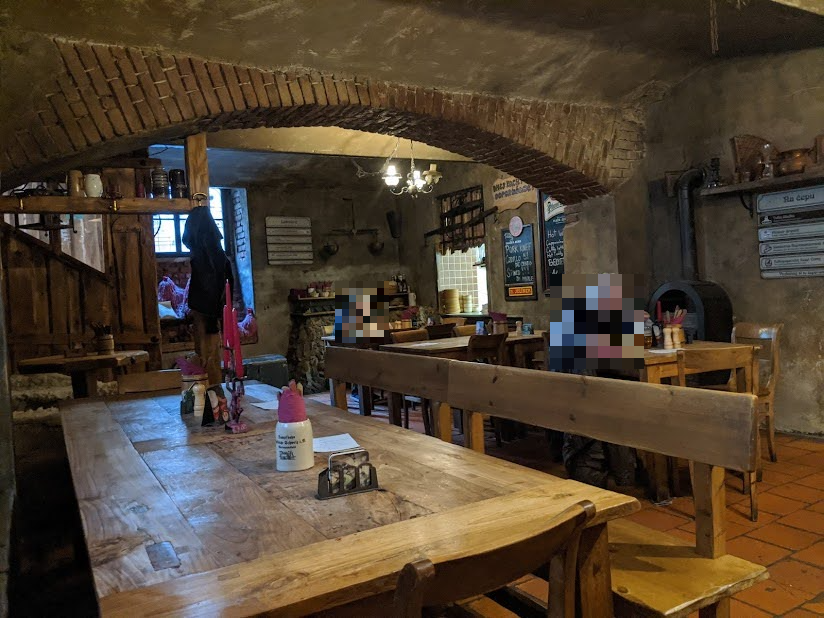
[Photo: A sacred pub in Prague, the absolute order of authentic beer is kept alive, Source: Myself]
[The Reliquary Design: Invest in Packaging and Shift Moral Debt via the Founder’s Narrative]
According to Gestalt psychology, humans possess an innate instinct to mentally complete incomplete spaces and meanings. The Church masterfully exploits this principle. For instance, if an anonymous fragment of bone is placed inside an exquisite reliquary crafted from gold, rubies, and intricate filigree, the viewer’s gaze is locked onto the overwhelming exterior.
“If the shell is this magnificent and unapproachable, the bone fragment inside must undoubtedly possess immense sacred power capable of redeeming my soul.”
Through this psychological mechanism, the masses perceive an ordinary bone as a holy relic.
The structural homology is clear in Apple’s obsession with multi-layered unboxing packaging and the precise tactile friction of peeling off protective plastic. When overwhelmed by this aesthetic aura, the consumer completely forgets the underlying cost of the contents. Greeting capitalism’s highest relic, they feel their heart race with the ecstasy of aligning perfectly with the center of the market.
Furthermore, both the Church and Apple utilize holy relics to implant a moral and psychological debt within the consumer. They aggressively market the sheer exhaustion and sacrifice required to deliver such an overwhelming experience.
“Behold, look how we ground down the souls and bodies of our priests to guide you to a new heaven! Quantify and praise the marks of our blood and sweat!”
Through this calculated showmanship, the moment the public recognizes an aura of ascetic suffering—believing that “this company never compromises, even at a loss, to fulfill its mission of delivering us to paradise”—they shoulder a profound debt, feeling almost like sinners. Ultimately, to absolve this debt, consumers have no choice but to line up before the altar and hit the purchase button.
Independent producers can readily adapt this reliquary design and ascetic narrative. The first step is to elevate product packaging from mere protection to a sacred reliquary that enshrines the commodity. Even if you are selling a financier pastry or coffee beans worth only a few dollars, never use generic plastic bags or brown kraft paper. Instead, enclose the item in a heavy, premium box that communicates ownership. Stamp it with a custom producer’s seal, wrap it in red sealing wax, and hand-number the exterior.
The consumer must endure a literal rite of passage—tactilely engaging with the rigid box and systematically breaking the robust seal. Approaching the relic through this ritual, they fall into a Gestalt romanticism: “An item encased in a reliquary this secure must undoubtedly be a holy relic meant to redeem my existence.”
The final destination of this reliquary strategy is to plant a slight sense of moral debt in the consumer. This can be achieved by enclosing a “report” that documents the grueling labor invested in crafting the item. For example, an independent leather artisan should formally slide an authentication card—resembling a gospel script—into the box, boldly stating numbers like: 432 hand-sewn stitches, 18 hours of production time.
“This artisan endured such ascetic suffering just for me; am I truly worthy of taking home this holy relic for such a modest price?”
An existential guilt is activated. This mirrors the phenomenon where Apple removed chargers under the guise of environmentalism, effectively telling consumers: “We know we will face backlash, but we choose this path for the planet. If you are dissatisfied with our philosophy, do you perhaps support environmental destruction?” Instead of alienating followers, this moral debt manipulation sent the disciples into a frenzy of adoration. An uncompromising narrative of ascetic suffering is a weapon that compels consumers to willingly hit the purchase button to liquidate their spiritual debt.
[Author’s Note]: This reliquary strategy is the playbook I intend to deploy if I ever open my own curation shop. If this strategy strikes you as cynical or repulsive, you are likely an honest producer who believes making a product properly matters more than packaging it. Frankly, you are correct; it is an intensely contrived piece of theatrical play. However, modern democratic citizens absolutely worship this theater. Having rejected transcendent reality, they suffer from chronic existential anxiety—valuing romance, a low-resolution substitute for the sacred, far more than the actual performance or quality of the physical good. And that is the thesis of this book.
4. Conclusion: Mid-Way Summary
Synthesizing our discussion thus far reveals a striking and vivid framework. Within the economic and social environment of the democratic welfare state, it becomes vastly more critical for a producer to “sell quickly at a premium” than to “make properly at a low cost.”
What, then, must be sold to the masses? To answer this, we traced the genealogy of romance, traveling back to primitive eras to look into the core of the sacred.
As Rudolf Otto and Mircea Eliade noted, the core of the sacred relies on a non-democratic hierarchy between an overwhelming, superior entity and an insignificant self. Faced with this hierarchy, humans submit, replicate, and find profound reassurance. While democratization dismantled this hierarchy, the hunger for that experience within the deep recesses of the human soul never vanished. That hunger has simply redirected its flow into the commercial marketplace.
The masses are crying out for brands to sell them a romance that can redeem their existence. The producer’s response to this cry is Hype Branding.
Spatial hierarchy, the segmentation of light, reliquary packaging design, and moral debt generated through an uncompromising narrative—all of these tactics share a singular underlying mechanism: transforming the ordinary and profane into the sacred and heterogeneous. It is the modern commercial execution of the exact mechanism through which primitive humans looked at a common stone and experienced cosmic reality.
Apple does it. The Church has done it for millennia. A dim, subterranean tavern in Prague achieved it. We must sell commercialized sacredness.
5. Related Articles
- The Digital Executioner of Small Business Owner: Profitizing “Sanctified Evil” in the Age of Mob Rule
- AI and the Death of the Labor Theory of Value in the Welfare State, and the Return of Producer Sovereignty
- The Commonality Between Left-Anarchism and Ethereum: Why Ethereum Can’t Be an Alternative for the Sovereign Individual
- The Welfare State is the Prime Culprit of Demographic Collapse: Why Birth Rates Thrive in Untaxed, Unregulated Informal Economies
- [The 51% Legal Dictatorship 1] The Death of the Producer: Why Democracy Needs You to Stay Small (Preface)
- [The 51% Legal Dictatorship 2] How Democracy Plunders the Productive Class (The Collapse of American Republicanism)
- [The 51% Legal Dictatorship 3] A Geopolitical Autopsy of the Welfare State (U.S, U.K, France, Korea)
- [The 51% Legal Dictatorship 4] From Craftsmanship to Captivity — How the Democratic Caste System Traps the Producer
- [The 51% Legal Dictatorship 5] A “Rigged Democracy” Happy for All, Save for the Growth-Oriented Entrepreneur (Beyond James C. Scott’s “Legibility”)
- [The 51% Legal Dictatorship 6] Making vs. Selling: The Solo Producer’s Exit from the Democratic Millstone
- [The 51% Legal Dictatorship 7] The Arch-Enemy of the Market: The “Legislature” Butchers Producer Sovereignty
- [The 51% Legal Dictatorship 8] Slaughtering the Moral Titans: Why Rawls, Sandel, and Piketty are the Enemies of Personal Sovereignty
- [The 51% Legal Dictatorship 9] The Fall of Truth: A 200-Year History of Capitalism as the Engineered ‘Enemy of Democracy’
- [The 51% Legal Dictatorship 10] Why Low-Quality Products Flood the Markets of Democratic Welfare States

If you enjoyed this article, you can support the project – thank you!