
In this article, we’ll discuss the core abilities a modern craftsman must have to survive today.
Previous Articles:
- Endorphin Craftsmanship (Intro): Critique of Matthew Crawford — Why romanticizing manual labor fails in the age of AI
- Endorphin Craftsmanship (Part2): Why Small Business, Creators Must Hack Systems, Show Attractiveness
- Endorphin Craftsmanship (Part3): From Invisible to Searchable – Google Killed My Blog. Here is How I’m Fighting Back
1. What Is a “Meta Ability” for the Endorphin Craftsman?
The “Meta Ability” discussed here is not woodworking, cooking, or any specific technique. It is the foundational ability beneath all techniques. It is not the ability to implement a fixed “correct answer” inside an object. It is the ability to design a structure where meaning changes with context. It’s about the capacity to instill an impressionistic touch into our products, akin to the works of Picasso, Van Gogh or Monet.
A craftsman is not someone who simply reveals the essence of an object through skill. A craftsman is a designer who leaves room for meaning to emerge—within the user’s perception, time, and rhythm of life. This section is also a phenomenological extension of Part 2, where I argued that modern craftsmen need artistic practicality, not just functional expertise.
To start with the conclusion, Meta Ability is this: Artistic practicality = Precise design + phenomenological sense. Calculating how long to sauté onions is technique. Deciding whether that flavor makes the guest cry or smile—that’s context. This artistic utility causes users to develop a deep attachment to objects and cherish them over a long period, ultimately building fierce brand loyalty.
[Table: Craftsman Who Completes Functions vs. Endorphin Craftsman Who Designs Meaning]
| Category | Traditional Craftsman | Endorphin Craftsman |
|---|---|---|
| Core Skill | Functional expertise | Phenomenological sensibility |
| Way of Thinking | Revealing the “essence” of things | Structure + interpretation + context |
| Time | Ends when production is complete | Accumulates as maker’s style overlaps with user’s life |
| Output | Finished product | Meaningful narrative |
| Goal | Perfect function | Convenient life, sustained rhythm, emotional depth |
| Replaceability | High (automation, OEM, CNC, AI) | Low |
(1) Objects Have No Fixed “Essence”
One of the biggest misunderstandings of traditional craftsmanship is the assumption that objects have an inherent essence. Because of this belief, craftsmen are portrayed as people who must endlessly train to “uncover” that essence. Modern people admire craftsmen—yet also believe, “I could never be one.” As a result, craftsmanship has drifted far away from everyday life.
This idea may trace back to Michelangelo’s famous line:
“The sculpture is already complete within the marble block… I just have to chisel away the superfluous material.”
Taken literally, this suggests that the craftsman is the one who best reveals an object’s true nature. But this statement should be read as humility, not ontology. By contrast, Zhuangzi taught that things do not contain a completed Dao.
He wrote (from Qi Wu Lun / The Equalizing of Things):
“The Great Earth exhales its breath and calls it wind. When it does not arise, nothing happens. But when it arises, all the hollows cry out wildly. Have you not heard the roaring of the wind? The hollows of great trees, holes shaped like goblets. (…) They produce all kinds of sounds. A gentle breeze brings small responses, a violent wind brings loud ones. (…) When the wind stops, all becomes quiet again. Who, then, makes them sound?”
What Zhuangzi is saying is simple: Sound does not exist on its own. It emerges only when wind meets a hollow. And the meaning of that sound depends on who hears it. So we must stop asking: “Is this the correct way?” “Is this the true essence?”
There is no such thing. Let’s go deeper.
(2) Material Constraints Exist — Meaning Does Not
Take onions as an example. Yes, onions have material constraints: acidity, sugar, moisture, fiber. But whether you deeply caramelize them or lightly sauté them depends entirely on context: the dish, the moment, the cook’s skill. For instance, onions are served raw in Jajangmyeon. In contrast, when used in stews or burgers, they are deeply caramelized—sometimes even darkened further with a splash of cola. Whether to introduce tension through a spicy kick or to evoke a sense of comfort and nostalgia with deep, sweet flavors is entirely a matter of the chef’s strategic choice. The Endorphin Craftsman is an artist who tunes meaning through context. The intention and style embedded by the craftsman are then reinterpreted by the user.
This is the original function of art: to enrich the viewer’s life from multiple angles.
- Too clear (strict realism) → no perceptual crack
- Too chaotic (extreme abstraction) → no entry point
Both fail to move us. Meaningful objects sit in between.
Material constraints exist. But they do not determine meaning. Meaning is designed by the craftsman and completed by the user.
Knowing the detailed physical properties of objects still matters. But the belief that some“absolute knowledge” or “a senior guild” can teach those properties—and that you must fight for their recognition—is a story from the past. This also means you no longer need to strive to imitate predecessors or established artisan communities just to seek their validation. From the customer’s perspective, such efforts are meaningless. What truly matters is embodying artistic sensibility right here on the front lines and providing customers with a rich, immersive experience.
Just as sound only emerges when wind meets a hollow, the true nature of an object is born when artistic sensibility encounters context. It emerges when you repeatedly throw yourself into environments that demand new meaning. Properties are not handed down. They are formed by subjective intentionality like use, pressure, timing, and interpretation. That’s where real craftsmanship begins.
2. The Three Components of Meta Ability
I call the ability to manifest this ‘artistic practicality’ a Meta Ability. Since existing concepts of ability tend to focus primarily on practicality alone, I have newly defined this term. Meta Ability consists of three elements:
- Detecting the smallest unit of change
- Designing time-depth (Anchor × Blur × Multiple Contexts)
- Reading context tied to the user’s life
Let’s go one by one.
(1) Detecting the Smallest Unit of Change
The reason why ‘Detecting the Smallest Unit of Change’ is crucial is that it directly relates to the structural transformation of an object. Just as Impressionist painters dissolved fixed outlines to capture the flickering of light, a master craftsman exquisitely seizes the critical threshold where a material’s physical properties begin to shift. That decisive moment—where patterns warp and rhythms change—is the very gap through which one can breathe a unique aura and intention into the work, transcending mere functional processing. It is at this minute boundary that the observer senses the artist’s human resolve.
For a creator or director, capturing the smallest unit of change in their objects implies the existence of an existential friction that must be resolved. That something catches your eye does not merely signify an objective state change; it points to a problematic situation. Had there been no issue, it would have gone unnoticed.
The capture of this subjective truth in a fleeting moment marks the very instant a new value is born. From the target customer’s perspective, something caught the eye because there was a functional imperfection or an aesthetically incomplete element. Penetrating this specific point with obsession is the essence of artistic utility.
In cooking, for instance, when Marco Pierre White shouted, ‘Throw away the thermometer,’ he wasn’t suggesting we abandon precision. Rather, he meant that relying on numbers binds you, preventing the free manipulation of material properties. What Marco Pierre White meant is that relying mechanically on a thermometer alone causes you to miss all the contextual variables—such as the kitchen environment, the timing of the meal, the customer’s disposition, and the paired wine. Instead, you must leverage all of this information to intuitively capture the exact micro-moment—the smallest unit of change—when the meat reaches its absolute peak of flavor. Only when you can capture the timing of change through your entire being—such as the subtle shade of color, tactile resistance, or the exact point an aroma shifts—can you truly manifest artistic sensibility.
If we recall Merleau-Ponty’s core philosophy—that the meaning of the world can only be grasped to the extent of one’s embodied skills—it becomes logically self-evident: artistic sense can only be brought to life when the threshold of change is mastered through physical sensation. Therefore, Meta Ability is not so much a matter of intelligence as it is a matter of expanding neural circuits.
More Examples:
- A physicist sees the moment a moving object’s derivative turns positive
- A composer hears a melody in the sound of a droplet shattering
- A basketball player knows the shot is in the moment the ball scrapes his fingernail
Someone who has internalized skill over a long time can discover an entire world within a single phenomenon. For people with meta ability, every day, every material feels different. And that difference turned into objects.
(2) Meta Ability: Designing Impressionistic Time-Depth
Objects that feel the same every time you see them do not thicken your life. Functional objects are especially guilty of this. “A pencil is just a pencil.” Easily replaceable. Unrelated to your life.
- Realism is too clear. It delivers the answer immediately. There’s no space for memory to enter. Time cannot accumulate.
- Pure abstraction is too empty. It creates no feeling at all. Time cannot accumulate here either.
Great works do something else. They ask a question.
“Is this sadness?” “Is this joy?”
As the user answers that question over time, their life accumulates inside the object. A craftsman does not create a one-time experience. He creates something irreplaceable. But irreplaceability is not created by the maker. It is completed when the user feels it is irreplaceable.
The reason classics continue to be read across generations is that no matter the era, readers can re-interpret them according to their own circumstances. The key is not for the author to label their own work a ‘classic’; it is the reader who must feel it to be so. This ‘time-depth’—the ability to offer fresh meaning in any age—is the hallmark of an artistic masterpiece.
Of course, since productivity also matters to a writer, some level of realistic compromise is inevitable. However, one must always keep in mind whether they are producing work that remains meaningful, regardless of the country or the era in which it is read.
Irreplaceable objects feel different each time you encounter them.
When subjective time layers again and again, the object becomes irreplaceable. A photograph looks the same after ten years. But a blurred portrait of your mother can hold both a young girl and an old woman at once. That is why modern craftsmen do not obsess over perfection. Instead, they design cracks—spaces where the user can complete their own memory. So what, exactly, does an object with impressionistic perception look like?
Let’s start with the conclusion.
Time-depth is created by: Anchor × Blur × Multiple Contexts
(3) Creating Time-Depth: Anchor
Artisans with artistic sensibility always establish a ‘persona’ for whatever work they do. This is a form of consideration from the craftsman—simulating the recipient’s predictive model in advance to allow them to experience a sense of ‘aura’ with the least amount of energy. Therefore, it is crucial to design ‘time-depth’ by embedding ‘Personal anchors’ or ‘Collective anchors’ that evoke specific impressions in that persona, making the ‘present moment’ more profound.
Scientifically speaking, humans possess a unique cognitive ability to recall past memories and simulate the future through specific material properties. For instance, when a particular scent or visual cue summons a past memory, we instantaneously ‘render’ the present into a space-time condensed with decades of depth. A master craftsman carefully selects the exact anchors that fit the persona to deliver the intended sensory experience.
Personal anchors
- Images: recognizable shapes—people, lakes, trees, houses
- Spaces: signboards in familiar fonts, worn tables, ordinary glass cups
- Food: flavors, temperatures, and textures that resemble home cooking
Collective anchors
- Images: inherited patterns, shared symbols
- Spaces: national ritual spaces, old StarCraft PC cafés
- Food: affordable, filling soul foods—tonkatsu, spicy pork, blood sausage soup
Without a realistic, universal anchor, memory cannot attach. And present time never turns into subjective meaning.
(4) Creating Time-Depth: Blur
The second technique for designing Time-Depth is intentional blurring. According to Gestalt psychology, when presented with incomplete information, the human brain has an instinct to fill in the gaps using existing knowledge. A master craftsman might stitch together scenes observed from different perspectives at their boundaries or provide only faint, hazy anchors. Consequently, the recipient fully mobilizes their own past memories and future simulations to complete the meaning on their own. This act of autonomously interpreting the world provides the recipient with immense pleasure.
The craftsman inserts intentional ambiguity to shatter the recipient’s tendency to perceive ‘A’ only as ‘A’ and to stimulate their imagination. Over time, this fosters a deep sense of attachment. As the recipient observes and interacts with the object, they may interpret it as ‘A’ at one moment, but as ‘B’ at another as time passes. They undergo a condensed experience of realizing that while the object remains the same, it is only their own emotions and circumstances that have fundamentally changed. This momentary review of one’s life makes the present feel more precious, leading them to project their will to live and subjective emotions onto the object. As dozens of emotions and past memories overlap within a single work of art, they create a powerful contrast with the immediate present, allowing one to experience this very moment with profound depth.
Let’s see Picasso’s “Weeping Woman”
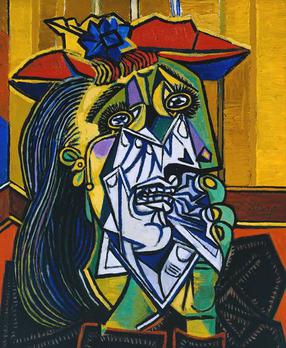
It is clearly a crying woman. That’s the initial anchor. But the details are blurred. The eyes face forward, yet the nose spreads sideways. The mouth might be tearing a handkerchief— or exhaling a sigh. The hands around the chin feel both joined and separated. The viewer reconstructs these fragments. The body, observed from various angles and perspectives, is combined in a grotesque manner. Everyone’s emotional state fluctuates over time, and consequently, this painting appears different each time I see it. For instance, when I am depressed, I feel as though I am looking at a woman suffering even more than I am; this offers a strange sense of comfort. Conversely, when I am happy, it instills a sense of unease that, ironically, calms me down. These sensations make me feel truly alive and help me reclaim my sense of agency. This is why I find myself wanting to possess this painting. 🤣 That shifting presence is what we call aura.
Blur Works the Same Way in Taverns
Dim lighting. Slightly crooked tiles. Uneven wood finishes. Rough, worn glasses. Drink there, and your partner looks better. These places may not be trendy, but they always have regulars.
Why? Because memories surface more easily. Because people talk more about the future. The space retreats into a blurred background, enriching the conversation of the night. Each visit layers another story. The place slowly becomes my place. You won’t find that in a frozen Starbucks interior. Blurring is a gravitational field that forcibly pulls the user’s soul into the object.
(5) Creating Time-Depth: Multiple Usage Contexts
This means the object’s role is not fixed. Its function shifts with the situation. Suppose there is a rectangular, rough-textured log block with neither decorations nor drawers. Someone might place it beside their bed to use as a nightstand for a lamp; another might set it next to the sofa as a stand for small decorative objects; and yet another might utilize it as an entryway bench to sit on briefly while putting on shoes.
Such an object never shouts: “This is how you must use me.” Many luxury furniture pieces do. Their ego is too strong. “I am a premium gaming desk.” Once defined that way, it can’t absorb other moments of life: watching a movie, drinking tea, or working late.
A log block, however, is fundamentally different. Because its definition is intentionally blurred, the user redefines it again and again to fit their immediate needs. If an object combines that flexibility with strong material durability, it transcends being a mere tool and becomes an irreplaceable companion through life.
The freedom of interpretation—the liberty to play with a work completely at one’s own will—is the very essence of human agency. True craftsmanship is about creating a ‘toy’ that users can fearlessly invite into their lives. As a result, every moment of daily life stacks onto it. The object quietly absorbs the owner’s life. That’s how time-depth is created.
A brand that closely aligns with this line of thought is MUJI. Kenya Hara, the brand’s design director, defines the essence of MUJI not as simplicity, but as emptiness (空). A plain rectangular MUJI box, left without a designated purpose, can become a bookshelf, a wardrobe organizer, or, when flipped upside down, a makeshift table. Because the product refuses to define itself and instead remains entirely empty, it allows users to fill that void with the unique context of their own lifestyle. This “emptiness” is precisely the ultimate multi-context structure that a modern craftsman must design.
What I wish to emphasize is a mindset that places the lived experience of the user or customer at the center. Small business owners and creators, in their pursuit of ‘artistic practicality,’ often tend to over-express their self-consciousness or seek validation from their peers through technical perfection. However, if such efforts interfere with the user’s subjective perception or fail to trigger any associations, they hold no artistic value.
For example, I once bought a ‘witch’ doll in the Czech Republic. The Czech people have a tradition of burning witch dolls, which symbolize winter, to drive away the long cold and welcome the warm spring. This functions as a collective anchor for them. However, when I displayed it in my shop, customers reportedly felt somewhat uneasy. I intended to evoke a Central European atmosphere, but since Korean lacked that specific tradition and history, they simply wondered, ‘Why is there a witch in a pub?’ This was a case where I was too immersed in my own self-consciousness and failed to consider the anchors of Seoul people.
3. Meta Ability and Presence
(1) Sense of Presence
In conclusion, Meta-ability is the sense that creates subjective meaning within the time and space a user inhabits. The core of this ability lies in layering time to be deeply experienced—using anchors, blurs, and multiple usage contexts—by capturing the smallest unit of change in objects to shift perceptions. Doing so allows the user to experience the present in a thick, multidimensional way, making meaning feel raw and vital. Ultimately, because customers seek to feel “life” through objects, you must deconstruct and unpack those objects along the temporal axis.
Meanwhile, from a spatial perspective, the space where these objects are placed is experienced as having ‘presence’. According to Heidegger, the sense of one’s presence in the world is grasped through friction with the physical world—seeing with one’s own eyes and hearing with one’s own ears. Consequently, object and space crafted by an artisan endowed with meta-ability instill in humans the conviction that ‘I am alive, here and now.’
As the synchronization between our senses and the mise-en-scène of that special world becomes more sophisticated, our neural circuits expand, making us feel as if we have been reborn in a different world.
(2) Case Study: Spaces with ‘Presence’ vs. Spaces Without
Now, go to a Japanese artisan’s sushi bar. The craftsman dismantles the tuna right there. He makes sushi. He risks failure; his survival is on the line. He explains the fish’s characteristics, size, and cut. He explains why the knife moves that way to improve taste. Because it is Context-Specific, the movement sublimates into a sacred gesture. The knife might cut his hand. Blood might flow. Customers feel that authenticity and weight. The craftsman jokes. He adjusts the slice thickness and rice grains to fit the dining situation. This is a Relational Gesture saying, “You are special.” Relational presence comes alive. People pay a premium for this.
Now, let’s compare this to a theme-park-style shop that claims to be a French bakery. While it insists on being French, there are no baguettes, and the croissants are overloaded with gaudy, colorful toppings that don’t even exist in France. A giant teddy bear sits in a designated photo zone, and the French words scribbled in chalk look cheap. Witnessing this scene, where lifestyle, mise-en-scène, and objects are completely out of sync, we experience a powerful sense of incongruity. This drastically diminishes the sense of Presence.
Furthermore, the decisive difference from an artisan’s sushi bar lies in the production site. We witness unskilled-looking staff haphazardly reheating frozen dough and merely adding decorations. Because this world is a ‘fake French bakery,’ we feel no meaningful friction. The more you know about French history and understand its society, the more these grotesque inconsistencies will stand out. Ultimately, you feel no presence in a new world; it feels exactly like a mundane space, or rather, so hallucinatory that it only evokes contempt.
4. The Lineage of Meta Ability and Presence
So who actually embodies both structural understanding and phenomenological sense?
(1) The Pro Gamer Who Sees the Kill Angle — Faker
Faker is the No.1 League of Legends pro. He reads countless data fragments on screen and detects timing shifts most people never notice. That’s how he sees the kill angle—the exact moment to win. This isn’t just fast reflexes. He attacks when the opponent doesn’t expect it. He lays bait. Even the same hit lands differently when the context breaks the opponent’s will.
How is this possible? Let’s explain without assuming you play games.
First: his screen switching is insanely fast.
- Average players fixate on their character and the enemy in front of them.
- Faker taps F1–F4 every 0.5 seconds to scan all four teammates.
It’s like Beethoven hearing every instrument in an orchestra at once. In the 0.1-second gaps while farming, he feeds other variables into his brain. For him, the opponent’s next step is already plotted.
He doesn’t passively react to the game. He designs overlapping flows of time. For most people, the “present” is a split second. For Faker, the present is thick time—the last 3 seconds (cool time of skill remembered) plus the next 3 seconds (predicted paths). This is possible because, for Faker, the mouse and keyboard is an extension of his own body. Through countless hours of practice, he has reached a level where he can sense even the most minute changes. Just as Marco Pierre White feels the resistance of the meat, Faker physically synchronizes with every pixelated shift as he processes vast streams of input and output. Consequently, for him, the present moment becomes incredibly thick. He lives in a longer now.
Second: he foresees outcomes, like a basketball player sensing a made shot at release.
In the 2023 Worlds semifinals—now a classic—everyone thought the team should retreat. Faker noticed the enemy (Ruler) step forward by a single pixel. That tiny hesitation meant vulnerability. He detected the Smallest Unit of Change. Flash. Combo. Kidnap. Elimination. Because through practice, he had burned into memory whether skills hit at that exact distance. A craftsman’s gesture is faster than an amateur’s calculation. He designs the entire game context—including the opponent’s perception and judgment.
He is an artisan who, through his play, gifts both the audience and his opponents a meaningful narrative that will forever endure in the history of esports.
Faker is someone who creates an ‘eternal present’ through gaming, rather than crafting physical objects. How, then, do fans experience Faker’s Presence? To feel it, fans visit the T1 Base Camp, the team headquarters, and major stadiums, purchasing illustrations, jerseys, special editions, and official merchandise. On match days, they gather for collective cheering, equipped with cheering gear. Inside the headquarters, numerous championship trophies—including the League of Legends World Championship (Worlds) cups—are on display. This entire journey is called the ‘Faker Pilgrimage.’ It is a way for fans to pay homage to Faker, the ‘artisan’ who has created deeply meaningful time for them.
(2) Industrial Designer — Dieter Rams
ET66 calculator (1987): The original inspiration for the iPhone calculator.
Dieter Rams, admired by Steve Jobs and Jony Ive, hated designer ego. He believed products should cling to the user’s body without friction. He designed with the mindset of a mother cooking for her child. Rams said appliances should act like an English butler:
- Always present when needed
- Invisible when not
Never intrusive. That’s why he obsessed over:
- The tactile click of buttons
- The smooth rhythm of a transparent acrylic turntable lid closing
To observe how Rams designs ‘Presence,’ one must look at the physical friction between the ET66 calculator and a specific space. Place the ET66 on an desk inside a room with a single light bulb. There is no neon branding or LED light on the machine. It remains still. The grey plastic body and the circular buttons—brown, yellow, and black—function as a ‘Collective anchor’ of 20th-century industrial design. The object recedes into the background of the workspace.
The phenomenological friction occurs when the user operates it.
First, the machine delivers the tactile feedback of the ‘Smallest Unit of Change.’ The moment your finger presses the button, you feel a fulfilling sense of manipulating the numbers. The finger encounters mechanical resistance before the ear hears a click. This tactile and auditory feedback synchronizes the user’s motor intention with the machine’s reaction. Through this physical friction, the user senses their own agency: “I am calculating my capital, here and now.”
Second, the design utilizes ‘Multiple Usage Contexts’ . The ET66 maintains the same neutral face whether the user calculates the raw food cost of a pub or balances an investment portfolio. The machine does not process emotions; it processes numbers. Because the object lacks ego, it allows the user to project their anxiety or focus onto the grey surface.
Over the years, the edges of the plastic buttons wear down from the oil of the owner’s skin. The yellow ‘=’ button fades under the sun. This change is not wear-and-tear; it is ‘Time-depth’ rendered onto the material. The user does not look at a tool; they look at a record of their daily production. Having stayed by your side throughout college years and adulthood, this calculator has become ‘personal butler,’ holding a deeply cherishable meaning. While digital applications disappear with a swipe, this physical friction remains anchored in reality. This is how Dieter Rams links the user’s life to a piece of plastic.
5. Conclusion
The core points of this article:
- Objects have no fixed essence
- Meaning emerges from context, perception, and time
- A craftsman is not a maker—but a designer of meaning
- That design capability is what I call Meta Ability
Meta Ability is the artistic capacity to read structure and create new meaning within a user’s life:
- Sensing the smallest unit of change
- Embedding Time-depth through Anchor × Blur × Multiple Contexts
- Considering how meaning lands in the user’s subjective perception
At that point, an object stops being a finished product.
It becomes an irreplaceable narrative, completed within the user’s life. The craftsman goes beyond calculation. He designs rhythm and context— and through that phenomenological sensibility, he makes people laugh, cry, and stay.

If you enjoyed this article, you can support the project – thank you!