
1. Wabi-Sabi Beyond Lifestyle Branding: The Horizon of Scarcity
To understand the personal application of Wabi-sabi, we must first dismantle the modern tendency to reduce the concept to a comfortable marketing slogan. Contemporary self-help literature frequently dilutes the philosophy into a gentle mandate: “It is acceptable to be imperfect.” They often map the philosophy onto a checklist of Japanese cultural artifacts, such as tea rituals, minimalist interiors, floral arrangements, and seasonal festivals. While this makes the concept accessible, it strips away its logic and historical severity. When compressed into a cultural label, Wabi-sabi loses its transferability, preventing its principles from being applied to art, technology, or business strategy.
Wabi-sabi did not emerge as an intellectual luxury or a form of therapy. It was forged under the extreme environmental pressures of ancient Japan—a reality characterized by recurring earthquakes, tsunamis, famines, and the constant threat of collapse. The modern understanding of Wabi-sabi as a minimalist product category masks its true utility. Superficial comfort offers no authentic solace to those enduring genuine crisis; it merely intercepts consumer attention with false consolation.
Understanding the philosophy through which past Japanese sought meaning in life—even while suffering from natural disasters, wars, and disease—can assist us in finding our own purpose. The core lies in a method of perceptual shifting: how to transcend the psychic world, which is rife with suffering, to reach the spiritual realm, and how to view this mundane existence through an entirely different lens.
2. The Modern Crisis of Meaning and the Return of the Sacred
(1) The Evolution of Spiritual Experience
Before examining how Wabi-sabi can be structured as a personal framework, we must define the parameters of a spiritual experience. A spiritual experience is not a passive adherence to a religious doctrine; it functions as an interruption of habituated awareness, perception.
Under this shift, ordinary perception breaks down, and the environment manifests through an entirely different layer of existence, moving beyond daily time and space. The observer undergoes a transition, re-emerging as a subject who recognizes a deeper order(The Sacred) within the world.
Historically, this transition was managed through institutional channels. Pre-modern societies constructed boundaries—such as churches, sacred frameworks, and ritual gestures—to serve as ‘fixed point’ between the ordinary and the extraordinary. When religion, shamans, and holy fools coexisted, spiritual experience took many forms. Life was short, but symbolically dense.
The Rational Vacuum of Modernism
Science and capitalism presuppose the existence of objective laws inherent to things themselves, operating independent of human imagination, interpretation, or meaning. This objectivism naturally bifurcates existence into two realms: the experts, who master and comprehend these laws to achieve creation, and the general public, who, lacking such capacity, discern nothing but meaninglessness in the objective world. Science and capitalism leave no room for individual participation.
Mircea Eliade conceptualized this through ‘homology’—the existential requirement for a resonance between the cosmic order and the individual life. In a hyper-rationalized world, however, the modern individual is reduced to an interchangeable, bleached cog, severed from the origins of their own creation. To reclaim existence within this vacuum of meaning, one must refuse the role of a mere consumer or worker and mutate into a sovereign producer. Meaning is not found in passive consumption; it is forged through the connoisseurship of creation—where the scientist deciphering the cosmos, the poet carving language, and the artisan engineering reality become the true aristocrats of spirit, transposing the raw & macro universe into a deeply personalized sacred order.
(2) What We Need Now: Personalized Spiritual Experience — Reframing Wabi-Sabi
Before modernity, life was undeniably harsh — hunger, cold, and the constant threat of death. The Eden or primitive communist utopia that leftists and anarchists romanticize never existed in history. But neither was the individual thrown alone into the world. The greater the anxiety people had to bear, the stronger their collective belief in a cosmic order passed down through generations. No one carried the burden of building a kingdom entirely on their own. There was a deep conviction that life continues even after death, and there were times when religious ritual filled existence with meaning.
In particular, the masses possess neither scientific knowledge nor artistic discernment, and it is equally difficult for them to become sovereign producers within the capitalist system. Given this vulnerability, it is fatal that everything that once bestowed meaning upon their lives—religions, traditions, and family—has been dismantled by the democratic welfare state. It is at this juncture that the philosophy of Wabi-Sabi offers a practical alternative.
Where Wabi-Sabi Offers an Alternative
The core lesson of the tea masters is that the sacred is not an inherent property of an expensive material; it is produced through a Perceptual Shift Device. With the proper trigger, a cracked bowl ceases to be debris and becomes a Zen object; the simple act of scooping water transforms into a profound life-and-death gesture, and a worn tool manifests as time embodied.
The task for the modern entrepreneur and independent creator is to build these perceptual switches into their daily lives and commercial spaces.
3. Case Studies of Perceptual Shift Devices Through Travel
Let’s move from theory to lived examples. Across cultures, people have built perceptual shift devices — structures that deliberately interrupt the everyday and open a different mode of experience.
(1) Istanbul, Turkey: Breaking the Everyday with the Call to Prayer

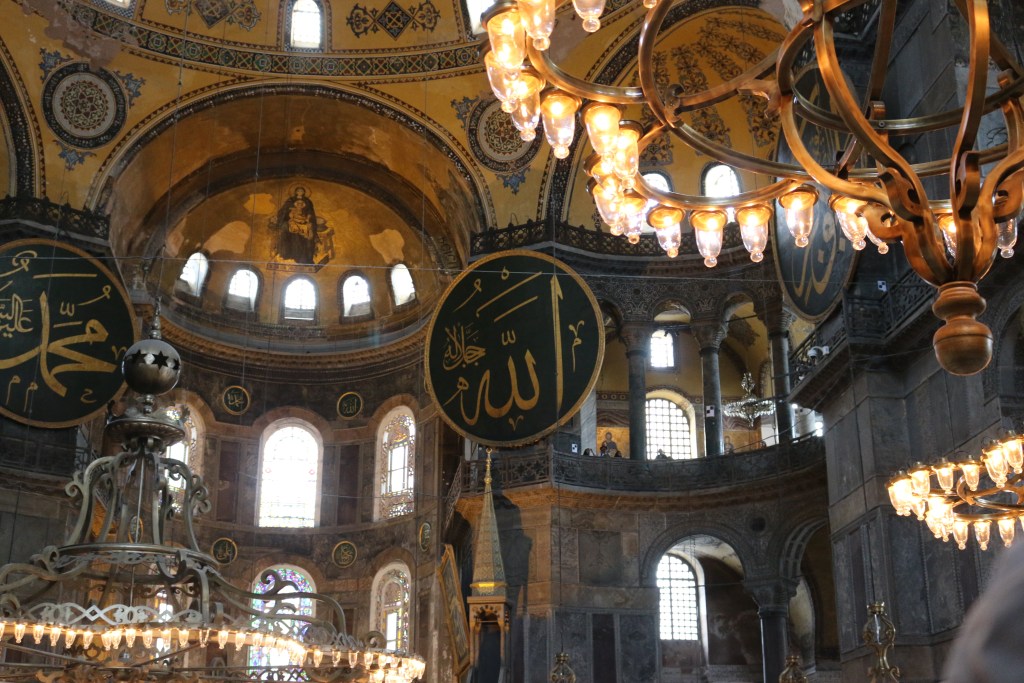
[Hagia Sophia, Istanbul, Turkey (Source: myself) ]
During a stay in Istanbul, this interruption materialized through the acoustic apparatus of the Adhan, the Islamic call to prayer. Broadcast city-wide at fixed intervals before sunrise, the sound pierces profane time. This acoustic intervention forces a pause across the city, demanding that individuals set aside daily business to engage with a sacred order before returning to the day.
Visiting the historical interior of the Hagia Sophia further highlights this dynamic, where layered Byzantine and Islamic architectures intertwine to create an exotic, high-density mise-en-scène. The effectiveness of the device relies on its enforceability: a fixed hour, a non-optional acoustic broadcast, and a bodily response. A time-based signal effectively ruptures the profane routine, resetting consumer and worker perception.
(2) Karlštejn Castle, Czech Republic: Architectural Isolation and Changing Light




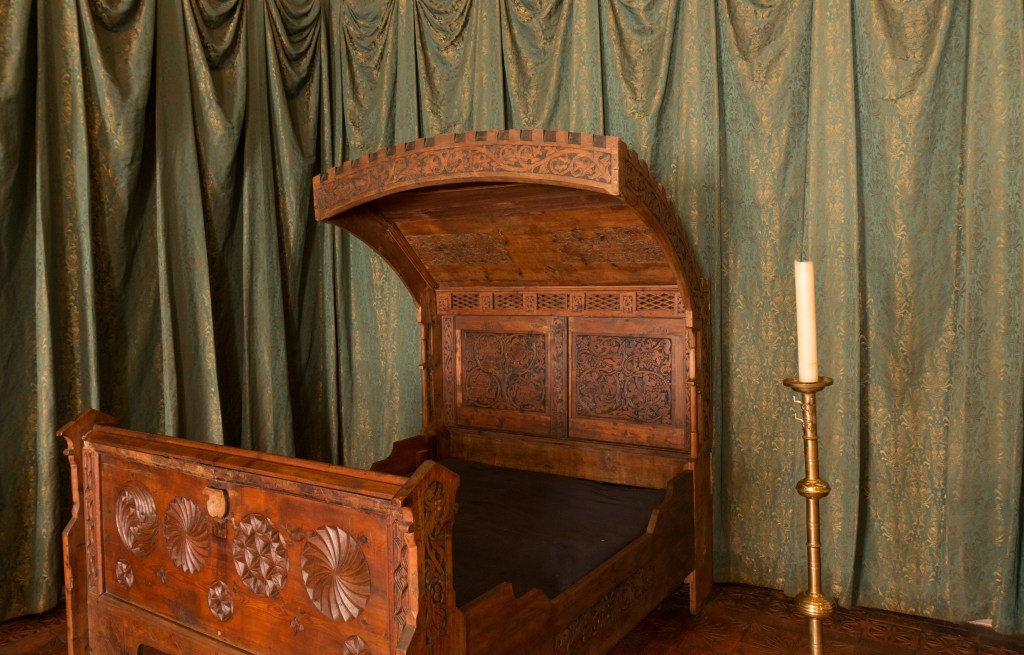
[Karlštejn Castle, Czech Republic (Source: Myself) ]
A spatial variation of this device exists within Karlštejn Castle, located outside Prague, constructed by Charles IV during the height of Bohemian imperial power. While the fortress was designed to secure royal regalia, the layout of the king’s private residential quarters reveals a sophisticated understanding of perception engineering.
The imperial bedroom remains small, featuring a simple wooden bed. Directly adjacent to the sleeping quarters sits a dedicated prayer alcove, severed from the resting space. Within this alcove, a religious figure is positioned opposite a singular window, allowing natural light to shift across the surface throughout the morning, noon, and night. Each temporal shift produces a different visual perception of the same object.
This architecture is isomorphic to the traditional Japanese tokonoma alcove, which utilizes indirect light and corner shadows to cultivate an experience of sublime depth. Both frameworks rely on architectural isolation, carving out a specialized void within a larger infrastructure to concentrate human attention away from the mundane flow of everyday business.
(3) Kyoto and Joseon: Ritual Dress and Bodily Purification

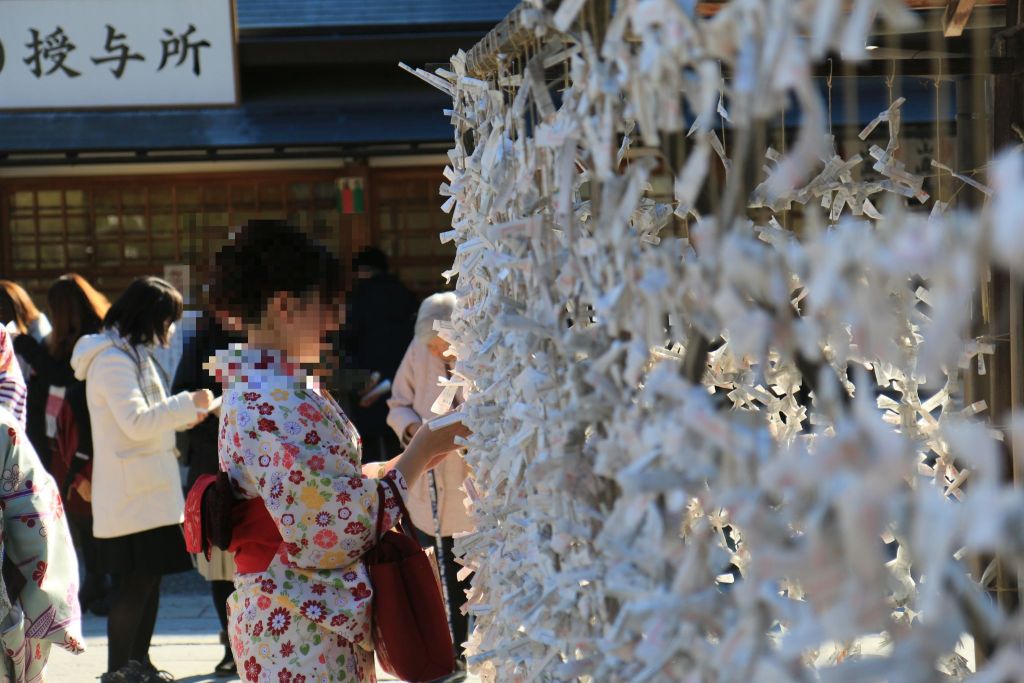

[Kyoto, Japan (Source: Myself) ]
Beyond sound and space, the body itself can be leveraged as a perceptual switch. In the historical districts of Kyoto, a significant volume of visitors to shrines choose to wear traditional kimono or formal attire. This practice extends beyond cosmetic tourism; it operates as a boundary marker.
Transitioning from casual apparel to structured ritual wear immediately alters an individual’s physical posture, constraints their movement, slows down their pace, and shifts their tone of voice. This physical friction increases perceived sincerity and self-awareness. Clothing functions as a interface that signals the body to exit ordinary behavior modes and enter a state of heightened focus.
Similarly, in pre-modern Joseon Korea, purification rituals served a deeper purpose than hygiene. Individuals engaged in a slow, deliberate bathing process prior to kneeling in nocturnal silence before a simple water jar to pray. This ritual of purification bears a resemblance to the baptism performed by John the Baptist in the Jordan River. Through this cleansing, an ordinary water was transformed into a cosmic interface. Daily economic and social anxieties were suspended, allowing new, trancendal meanings to surface. As Mircea Eliade noted, purification acts as a foundational pillar of ritual transition. What these societies could not permanently construct out of expensive marble or stone, they carried through water, clothes, and bodily action.
Across every geography, the underlying pattern remains uniform: Istanbul relies on acoustic and temporal ruptures, Karlštejn utilizes spatial isolation, Kyoto deploys dress, and Joseon uses bodily purification. Spiritual and perceptual shifts do not occur through intellectual reflection. They require body-in-context engineering: time triggers, spatial separation, and bodily rituals. The historical power of Sen no Rikyū’s tea ceremony rests on its capacity to orchestrate all three variables simultaneously.
4. Designing Wabi-Sabi in Daily Life: Time, Space, and Body
(0) The Prerequisite — Urgency to See Life Differently
Wabi-sabi begins with existential urgency. Historically, this framework was never designed for an individual living a comfortable, predictable life. It emerged from crisis, addressing a question: how can one live meaningfully when external infrastructure has collapsed? The practice belongs to those who recognize the inherent instability of their environment and seek a method to alter their perception. With this prerequisite established, the model can be translated into daily practice.
(1) Fixed Temporal Boundaries
To establish an enduring framework, you must isolate a specific, non-negotiable window of time. The early morning before daily operational routines begin, or the late evening after they terminate, serves as the optimal period. Midday must be avoided because the environment is too volatile.
In this practice, consistency is far more critical than duration. Skipping sessions breaks the continuity, causing the psychological depth to evaporate. Daily repetition builds a form of temporal thickness, connecting past, present, and future into a coherent narrative.
(2) Spatial Isolation and Anchors
The practice does not require an expensive architectural installation; it requires spatial separation. Even a small corner functions effectively, provided it is stripped of economic instability reminders, financial signals, and competitive cues. To stabilize the gaze within this space, you must install four specific anchors:
- The Text Anchor: Position a concise phrase or scroll slightly above eye level. Forcing the body to raise its gaze interrupts mental drift, preventing the mind from falling into random, repetitive thought loops.
- The Literature Anchor: Keep a single volume of ancient wisdom or classical text nearby. A daily reading resets direction, forcing a direct confrontation with the self.
- The Light Anchor: Utilize changing natural light to create perceptual movement. shitting illumination across the space deepens the experience, making a single environment appear dynamic throughout the day.
- The Imperfect Object: Place one variable, weathered object within the space—such as textured ceramics or an expressive artifact. Subjective meaning is generated through the perceptual variation of the object over time, not its market value.
(3) Apparel & Gesture
The individual must never engage in this practice while wearing common sleepwear or casual street clothing. Dress functions as a boundary marker signaling an existential transition. The apparel does not need to be expensive, but it must be reserved exclusively for the practice, creating a subtle tension that shifts the ordinary self into a state of focus.
For instance, utilizing a specific hat, headphones, or dedicated garments acts as a form of sacred armor. The moment these items touch the body, the mundane environment is severed, and attention is locked in. For example, only when I write…
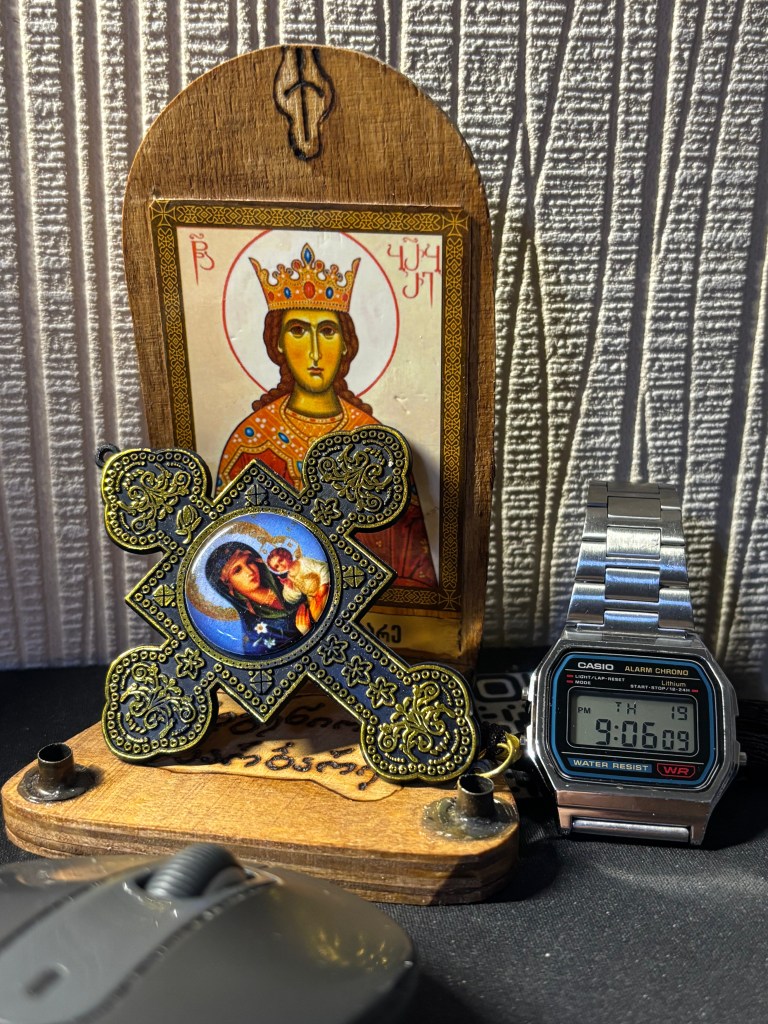
[Photo: My sacred objects for staging my own sacred space. (Picked up at a Georgian antique shop — apparently an Eastern Orthodox saint.) Something about them sharpens my focus. It’s a kind of boundary ritual.]
Entering the isolated space without washing the body induces drowsiness, whereas cleanliness sharpens the initial rupture from the everyday. Once inside, you must implement a strict, repetitive action, such as breath counting, alignment, or handwriting. The repetition of gestures is not about mimicking anything at random; rather, it yields the greatest efficacy when it involves spiritual practices known to have been performed by ancient ancestors, historical heroes, or spiritual masters. This homology of action serves as an effective method for transcending the mundane everyday life. When a gesture is repeated with gravity within a curated context, meaning begins to reside within the movement itself. This is the generative power of ritual. The chaotic chatter of the ego dissolves into bodily rhythm, allowing the individual to exit an unorganized space and enter a cosmic order.
5. My Practice of Wabi-Sabi — Meditating on Mencius
(1) Alignment with Mencius
Here is a passage I returned to again in meditation:
When Heaven is about to entrust a person with great responsibility, it first frustrates their mind, exhausts their body, starves their flesh, and places them in poverty. Their plans are obstructed again and again. Through this, their resolve is hardened, their patience is trained, and their capacity is enlarged.
Mencius formulated this philosophy during the Warring States period, an era defined by military conflict. Though honored as a sage, he traveled from state to state facing rejection, never receiving the authority to implement his vision within his lifetime.
The tension between his ideals and lack of results is why his words carry weight. His text was forged under constraints, making it an ideal software for Wabi-sabi meditation.
(2) Practicing Wabi-Sabi Through Meditation on Mencius
Between 2020 and 2022, when COVID shut down most of my business activity, I didn’t yet know the term wabi-sabi. But looking back, what I practiced during that period followed the same structure: Accept impermanence. Face constraint. Extract meaning from limitation.
I built a small daily ritual by separating the elements we discussed earlier: time, space, and body. Every day at 4 p.m., I placed a printed, laminated Mencius passage on my desk. Because the text was classical Chinese, green tea felt more appropriate than coffee. I brewed a cup, sat upright near the window, and let sunlight fall across the desk. I changed into a clean shirt. I pulled my socks tight — small tension helps focus. I rolled prayer beads while reading the passage out loud. Even inside a closed, struggling shop, I had built a separated field of perception.
Some days I read Mencius, Zhuangzi, Doctrine of the Mean, I Ching. Some days the words felt flat. Just text. But strangely, they still gave strength. They began to overlap. Hardship stopped feeling like pure loss. It started to feel like preparation for next era. It was a perceptual shift that returns meaning to a life inside scarcity.
6. Conclusion
Across this three-part series on Wabi-Sabi and Participatory Perception, we explored four layers:
- Origins of Wabi-Sabi: A survival-born philosophy shaped by natural disaster, social constraint, and impermanence — discovering quiet value in aging and imperfection.
- Transformation into Spiritual Practice: Through figures like Murata Jukō and Sen no Rikyū, wabi-sabi became a designed perceptual experience using Zen-based shift devices.
- Beyond Japan: The same logic of generative imperfection appears in unexpected places — from late Michelangelo to Steve Jobs — wherever creators leave space for participation.
- Application in Daily Life: Wabi-sabi today is not décor. It is practice — separating yourself from the everyday through time, space, clothing, and bodily ritual.
- Personal Practice: My meditation on Mencius during COVID was one such practice: constraint turned into renewal, scarcity turned into structure, difficulty turned into meaning.
Wabi-sabi is not a slogan. Not a notebook cover that says, “It’s okay to be imperfect.” It is a philosophy forged under survival pressure. A way to see value when little remains. A way to find meaning in the cracks.
7. Related Articles
- 🔥 Wabi-Sabi Is Not Interior Style — It’s Experience Design: The Hidden Logic Small Businesses Miss
- Perfect Products Create Spectators — Imperfect Ones Create Followers (Case Study: Michelangelo & Steve Jobs)

If you enjoyed this article, you can support the project – thank you!