
In this article, I will examine—through both theory and my personal experience—why market intervention by the democratic welfare state inevitably leads to a flood of low-quality goods and the disappearance of truly superior products.
1. Recap of the Previous Article
Previously, we examined the logics of Rawls, Sandel, and Piketty, and noted the decline of the Austrian and Chicago schools that once stood against them. The history of 20th-century economic and political philosophy was not a quest for pure scientific truth; ultimately, it was an ethical battle over the Entitlement to Wealth.
The Austrian schools championed the producer and the capitalist. They believed that wealth should belong to those who jump into the market with the conviction that they can make things “cheaper and better,” thereby creating value-added. Their logic was that if the government removed barriers to entry and glass ceilings, and shifted the final responsibility for quality verification to the private sector, niche markets would always exist, anyone could become a producer, and national wealth would increase significantly.
2. In a Democratic Welfare State, Bad Products Drive Out the Good
(1) Why Quality Degrades Over Time
First, the criteria distinguishing low-quality from high-quality products depend on whether an item maintains strong resale value due to superior cost-to-performance metrics, such as durability, safety, functionality, artistry, and phenomenological perception. Since this cost-to-performance ratio is subjective and independently evaluated by each individual, it cannot be measured by a single standard. Taken together, high-quality products are those whose marketability persists over time, whereas all others are classified as low-quality.
Some might think that allowing free competition by lowering barriers to entry in every market would actually lead to a surplus of low-quality goods. To be blunt: the opposite is true. From a producer’s perspective, the higher the barriers to entry, the more incentive there is to produce mediocre goods. High barriers to entry imply reduced competition. Consequently, without fundamental innovation or price reductions, deceiving consumers by merely rebranding superficial features becomes far more advantageous than investing time and effort into manufacturing high-quality goods. Ordinary citizens, and even high-profile entrepreneur featured on Netflix’s Culinary Class Wars, often believe that raising entry barriers through regulations and taxes—thereby restricting access to the food service industry—is the only way to eliminate “bad food.” However, this is a short-sighted and misguided assumption. Only when entry barriers remain low will substandard food be naturally phased out of the market, allowing the misallocated physical capital to be redistributed and ultimately driving down food prices. Conversely, higher barriers to entry disincentivize producers from striving for excellence; they will merely choose to meet the minimum regulatory baseline or bypass rules to sell mediocre products.
All that is required is for consumers themselves to evaluate and verify whether a product is good or bad. However, when a democratic welfare state continuously intervenes in the market through regulations and taxes, thereby distorting price signals, producers eventually succumb to rising costs and resort to manufacturing low-quality goods. Furthermore, on a microeconomic level, a confluence of moral hazard among producers and a tendency among consumers to evade accountability within the welfare state causes low-quality products to become the mainstream. Let us examine each of these factors one by one.
(2) Macro Factor: Wages & Malinvestment
Wages Exceeding Productivity
Production requires labor and capital. When the state mandates wages that exceed actual productivity, low-quality goods are the result. A low marginal productivity of labor means that when all other factors of production are held constant, employing one additional worker yields negligible increases in total output. Nevertheless, if an entrepreneur wishing to expand their business is legally mandated to pay high wages to workers, they face conflicting incentives: in the long term, to install automated production lines to increase the marginal productivity of capital, or in the short term, to degrade product quality. Given that high time preferences are pervasive among people in a democratic welfare state, most producers opt for the latter.
Consequently, even products that initially represented innovation and luxury inevitably experience price hikes while their core innovation is abandoned over time. For example, this logic explains the popular adage that when a business thrives, the owner becomes complacent and loses their initial dedication. If the marginal productivity of hiring an additional unskilled worker is low, their wage should naturally be correspondingly low. However, because minimum wage laws legally mandate paying them wages equivalent to those of skilled labor, restaurant owners are compelled to adopt lower-quality processes for any additional production. If they previously invested hours into caramelizing onions, they now opt for high-fructose corn syrup purchased from Costco or resort to shrinkflation by reducing portion sizes. Empirical evidence thus shows that restaurants where the owner works alone as the chef often deliver superior taste compared to those where three or four mediocre cooks in chef hats occupy the kitchen. This outcome is unrelated to the owner’s personal morality; rather, it is an inevitable consequence of state intervention in the market.
Interest Rates Below the Natural Rate
Early modern capitalism emphasized saving and investment while remaining deeply suspicious of debt. To reinforce this, society established moral and religious taboos. They did so because the demand-driven concept—that the government should spend money to stimulate consumption and thereby drive investment—was not prevalent. If one’s purchasing power is strictly limited to what they have produced through their own labor or capital, accumulating debt means bringing future productive capacity into the present, an act that effectively destroys one’s own future. In such a society, people preferred maintaining the value of currency through hard money, such as gold. Although the masses naturally have a high time preference for the present and constantly desire to debase the currency, they lacked the political sovereignty to alter the established order.
However, the situation is different in a democratic welfare state. Because the masses possess political sovereignty, they actively demand that the government boost their immediate purchasing power, even if it requires borrowing. Keynesian economics caters directly to this demand. Keynesians argue that when the market undergoes a temporary correction and investment declines, the government must interfere frantically to stimulate public consumption and reignite investment. This is why they devise concepts like income-led growth or public works to distribute money to the public.
Consequently, they prescribe policies that artificially lower interest rates and utilize fiscal stimulus fueled by debt to engineer a fake boom, leaving long-term consequences to be worried about later. Yet, as long as the government does not manipulate interest rates, the market correction period will naturally cause the prices of physical capital to fall. This allows speculators—or entrepreneurs—to step in, borrow the newly affordable capital, and attempt to create new supply. Investment is then naturally revitalized by fresh industries and new enterprises. However, a democratic welfare state cannot endure even a moment of public outcry asking, “What on earth is the government doing?” Paradoxically, as Hans-Hermann Hoppe pointed out, the parliament and the president are merely “caretakers” of sovereignty, not its ultimate owners. Since the country is not truly theirs, they face immense pressure to show immediate results rather than sit idle and absorb public criticism. Had it been their own country, they would have refused, asking, “Why should I accumulate debt and manipulate interest rates?” A democratic government, however, ultimately chooses to artificially suppress interest rates and foster debt.
When interest rates are artificially lowered, capitalists invest in capital-intensive “producer goods” that take a long time to bear fruit, rather than immediate consumer goods. This is a natural reaction to increase capital efficiency. Thus, a person who should have built a 5-story building suddenly attempts to build a 50-story skyscraper. Because liquidity increases in the short term, it creates the illusion of a boom. The Austrian School criticized this as Malinvestment.
However, because the interest rate was lowered artificially, the real capital required to support such investment does not exist in the market. When everyone expands their projects simultaneously, the prices of raw materials and energy skyrocket. The labor force that should have been used for efficient production is wasted, and there is no time to wait for the completion of “roundabout production.”
Eventually, before the 50-story building is even finished, the process grinds to a halt due to a lack of real capital. The distortion of resource allocation leads to inflation and rising interest rates, culminating in an economic crisis. Countries like Japan and South Korea, where the government artificially distorts capital price signals, are filled with unfinished airports and buildings in provincial areas. The real capital wasted in the process is irretrievable; assets that could have created value as 5-story buildings have vanished. This artificial inflation of physical capital prices—encompassing capital, labor, and land—is why low-quality products proliferate in a democratic welfare state. Unless producers choose to degrade quality, they are left with zero profit margins.
Note: If this reminds you of the current over-investment by Big Tech resulting in shortages of electricity, chips, and labor, it is no coincidence.
(3) Micro Factor: From “Make it right” to “Sell it fast.”
Austrian School theories on why low-quality goods flood the market have focused mainly on macro factors. Here, I want to mention a more subtle but fatal process: how low-interest debt changes the decision-making of the individual producer.
Unlike when a producer invests 100% of their own money, the availability of low-interest debt erases the “if I fail, it’s over” mindset. Consequently, they stop pouring their soul into every single product. The logic of capital shifts abruptly from “Make it right” to “Sell it fast.”
There are three reasons for this:
First, Moral Hazard: A producer whose management skills are suited for 100 million KRW in capital can enter a 200 million KRW market by taking a 50% loan. Assuming a 5% return on capital:
- With 100 million KRW: 100,000,000*0.05 = 5,000,000/month
- With 200 million KRW: 200,000,000*0.05 = 10,000,000/month
In a welfare state, personal bankruptcy systems limit liability to one’s own capital even if the business fails. Naturally, they take the debt. Just as workers depend on welfare, producers fall into the moral hazard of “if I succeed, the money is mine; if I fail, the state takes the hit.” In this structure, the “Artisan Producer” who survives solely on 100% of their own capital is actually at a disadvantage. Eventually, even the artisan tries to borrow money to move into a larger market. The problem is that they lack the skill to operate in that 200 million KRW market, inevitably resulting in low-quality products.
Second, The Shrinking of the Underground Market: When everyone takes on debt to jump into the mass market, the underground market shrinks. Those who make things properly according to their skill level are treated as fools, while marketing wizards who shout “just sell more” dominate the scene. Consumers who specifically seek out the underground market are those dissatisfied with the mainstream; they possess minor tastes and expert connoisseurship. To them, selling isn’t what matters. If the product is genuine, they will find it.
My own experience confirms this. In Seoul, there were fewer than ten establishments selling European imported draft beers like Pilsner Urquell or Paulaner along with Eastern European cuisine. Because of this, customers would take trains just to visit a place as small as mine. These are people who aren’t satisfied with dried squid and Budweiser; if the product is the real deal, they open their wallets regardless of marketing.
In contrast, the mass market—where investment is high—is different. The masses lack connoisseurship. Therefore, improving product performance is meaningless; instead, one must use “selling experts” like fake narratives, advertisements, and celebrity agencies to stimulate the vanity of the masses. On online communities today, people say “performance has been standardized upward,” but in reality, they only say that because the masses lack the discernment for truly superior products.
Audio equipment is a prime example. Germany’s Sennheiser only posts spec sheets for the niche market of wired headphones like the HD series, targeting those with connoisseurship. Their product cycles are extremely long because the moment a product is released, the experts slaughter it based on criteria like impedance, frequency response, sound pressure, and open-back design. Conversely, mass-market wireless products like the Momentum series have short release cycles and mobilize celebrities and massive advertisements for the sole purpose of selling faster.
The third reason why market intervention by the democratic welfare state shifts the paradigm from “Making it Right” to “Selling it Fast” is the burden of Regulatory Compliance Costs. Let me explain with an example.
In my experience dealing with consumers of high discernment, I found that they notice immediately if the taste of the beer changes even slightly. Therefore, a producer is naturally incentivized to clean the taps daily and scrub out residue with a brush. I once had a customer complain that the foam didn’t settle with the proper creamy density, questioning if the glass had been polished correctly.
However, mass-market producers have no such incentive. Because the masses lack connoisseurship, they rarely notice a decline in quality. Consequently, instead of perfecting the brew and the pour, these producers dilute the product, add artificial aromas, and skip cleaning. They then take the saved capital and pour it into aggressive advertising.
When producers attempted to cut corners by exploiting the public’s inability to judge quality accurately, had spontaneous orders remained alive—such as local traditions, reputations, and certifications from high-resolution priests equipped with connoisseurship—they would have triggered their filtering mechanisms to run those substandard producers out of business.
Some readers might question my argument, asking, “Isn’t the government still more trustworthy? Aren’t laws and regulations necessary since even reputation and tradition are run rampant with viral marketing and manipulation?” To clarify the sequence of cause and effect, the core issue is that because the state legally replaced the spontaneous filters that once weeded out low-quality goods—at the public’s behest—the public lost both the ability and the joy of rigorously inspecting products. That is why hype marketing and viral campaigns full of fabrications are running amok. Even without the state’s uniform facility regulations, if we had variable premium pricing based on private insurers’ ex-ante and ex-post risk assessments, connoisseurship communities evaluating products under their own names, and endorsements from widely recognized master artisans, healthy producers would retain higher profit margins, facilitating easier business expansion through reinvestment. Consequently, the market learns that producing high-quality goods is the only way to survive. Furthermore, because spontaneous orders are inherently imperfect, they can be replaced at any time. This forces them to serve consumers much more effectively than rigid statutory institutions ever could.
A prime example is Musinsa, which became famous in South Korea as a connoisseurship community for fashion. When Musinsa, initially renowned for introducing high-quality products, launched its platform business and began aggressively onboarding cheap street fashion brands, the “high-resolution priests” operating in the underground fashion scene with discerning eyes were disappointed. As they abandoned it for alternative platforms, the general public is now being influenced as well. As the exodus from the Musinsa platform—now dominated by unoriginal, cookie-cutter conglomerate products—gains momentum, high-quality producers will strive to secure more exposure on differentiated niche platforms instead. As a new platform embracing these high-quality producers gradually erodes Musinsa’s market share, diversity flourishes in the marketplace. A healthy market is one where this iterative process repeats continuously.
However, the welfare state cannot tolerate such a process. Consequently, it begins to impose artificial regulations on producers instead. Because these regulations are applied broadly across entire industries, they manifest as permit requirements based on possessing specific facilities. From the producer’s perspective, capital is drained preemptively into areas unrelated to actual productivity. As a result, they do the bare minimum to meet the standard and lose all desire to improve for the better. The money that should have been spent on making a superior product is wasted on compliance. To recover these sunk costs, they resort to mass-producing low-resolution goods as quickly as possible. This ultimately helps no one; no technology or archive of excellence is accumulated. The nation’s manufacturing prowess stagnates, and the market is eventually lost to the dictatorial efficiency and low labor costs of China and Vietnam.
To clarify one point here, the government imposes regulations on producers not because it is a power-hungry group obsessed with control. A democratic welfare state derives its ruling legitimacy from paternalistic protection over its citizens. The masses say, “Father, I don’t want to know the details; just handle it for me,” while the state responds, “Understood, but give me your votes in return”—creating a symbiotic relationship. If society were filled with individuals like Thomas Jefferson, who would declare, “Whether I ruin myself or succeed, I will manage it all, so the state must not interfere,” the government would oblige. After all, that is the path of least resistance for tax collection.
However, how do modern individuals behave today? When purchasing a laptop worth thousands of dollars with their own money, they refuse to spend even thirty minutes researching; instead, they rely on the state, brands, regulations, and reviews. This is not merely a matter of laziness. Rather, it stems from a desire to evade the accountability and pain that come with making a wrong choice. Consequently, the welfare state emerged in response to popular demand, with the government attempting to eliminate uncertainty in every domain through regulations and laws. It was not the state, but the masses, who demanded the removal of the fundamental premise once found in spontaneous orders like religion, the market, and tradition: “We are not perfect, so the responsibility for failure rests on you—but the satisfaction is also entirely yours to keep.”
Sub-conclusion: Therefore, setting aside macro-level factors such as wages and interest rates, a micro-level examination reveals a self-perpetuating, cyclical loop that traps the democratic welfare state in a deluge of low-quality products:
- Popular Demand for Regulation: The masses, acting as risk-averse consumers, demand state regulations and certifications to evade the existential accountability and pain of verifying product quality themselves.
- State Intervention & Pretext: The welfare state seizes this public anxiety as a paternalistic pretext to interfere in the market.
- Eradication of Consumer Connoisseurship: Believing that “state certification equals safety,” consumers lose all incentive to cultivate their own independent discernment and research.
- Collapse of Spontaneous Filters: As private connoisseurship withers, the market’s spontaneous filtering mechanisms—such as local traditions, long-term reputations, and expert guilds—are legally and functionally dismantled.
- The Minimum-Baseline Trap: Stripped of pressure from discerning consumers, producers halt genuine quality improvements, choosing instead to merely coast on the bare minimum criteria required to pass statutory guidelines.
- The Triumph of Marketing Over Substance: With product differentiation neutralized at the structural level, producers redirect their capital away from craftsmanship and go all-in on aggressive marketing and superficial narratives to sell mediocre goods at inflated prices.
(4) What Tesla Illustrates
Tesla serves as a recent example showing that the democratic welfare state has no way to stop the decline in product quality. I think Tesla is a brilliant concept, but it is an undeniable fact that they focused on “Selling Fast” rather than “Making it Right.”
Tesla realized that to sell products quickly to consumers, rather than pursuing innovations that perfect the product itself, it is far more advantageous to release unfinished software, refine it through agile iterations, and dazzle the public with narratives and marketing. When the masses are captivated by the romantic ideal of “journeying into space,” they willingly pay tens of thousands of dollars out of their own pockets to participate in this experiment. Even if they privately suspect the product offers poor value for money, they refuse to admit their choice was wrong, comforting themselves with the thought, “But still, it’s Elon Musk.” Consequently, a multitude of Tesla owners simultaneously double as Tesla shareholders. However, the harsh reality of plunging used-car prices and cheaper new models economically proves that Tesla manufactures a low-quality product with low long-term marketability.
In South Korea, there was a fatal accident where a driver died because the doors failed to open during a fire. No matter how much the fandom defends it, the reality is that the quality is abysmal relative to the price. Consequently, they are losing market share to Chinese EVs. Now, the narrative has shifted to robots and Mars. However, even the “Optimus” robot, despite the loud marketing, is widely evaluated as underperforming compared to its competitors.
(5) When Republican Restraint Was Present, It Was Different
This culture of shoddy production did not exist when democracy was properly checked by Republican Pressure and prevented from descending into the “Tyranny of the Majority.” It may be hard to believe now, but there was a time when quality and performance actually mattered.
In an era when interest rates were 10–20%, malinvestment was suppressed, and real capital was not wasted. Producers invested 100% of their own capital and focused on creating goods with sincerity. In fact, the fundamental performance of products today has not significantly improved since the 1990s. A 40-year-old Toyota Corolla still runs perfectly today. Modern products only deceive the eye with flashy “skins” and peripheral features, while their fundamental engineering has either plateaued or regressed. When elders say “the original was the best,” they aren’t just reminiscing; they are speaking a technical truth.
(6) Rebuttal: “Aren’t modern cars and phones better?”
Some may argue that modern products are superior. I ask you this: If technology has truly advanced, why has the replacement cycle for cars, phones, and refrigerators become shorter and shorter? Flashy features do not equate to material integrity. The fact that things break faster proves that manufacturers are focused on “Selling Fast” rather than “Making it Right.” The definitive evidence is that contemporary products fail to meet the criterion I mentioned above—namely, whether their marketability persists over time. The abundance of products that remain unsold even at a 50 to 60 percent discount after less than a year of use proves that they are low-quality junk. The secondhand market, in particular, remains relatively free from government intervention, making its price signals reliable.
The evidence is everywhere. You used to buy a refrigerator and keep it for 20 years. Today, the motherboard fails in less than 10. The same goes for smartphones. There was a time when a Samsung Galaxy could easily last 5 years. Now, there’s a saying: the two-year promise. After 24 months, the lag becomes unbearable, battery efficiency plummets, and you are forced to buy a new one. Even pans are the same. We used to use solid, heavy cast iron. Now, we use light alloys with multiple layers of coating; once the coating peels, it’s trash.
Modern cars are filled with electronic components and options, but the density of the steel, the mechanical perfection of the engine, and the overall durability have declined. There’s a joke that once you open the door of a Tesla or a Hyundai, the resale value drops by 20%. Depreciation is accelerating because the manufacturers themselves acknowledge the flimsiness of their old products by releasing newer models even cheaper. They are masking the lack of fundamental engineering with software skins. If you have true connoisseurship, you can see the decline in quality.
Price already tells the truth. Products from the era of “competition for excellence”—Leica cameras, McIntosh amplifiers, Casio watches, or Lodge cast iron from the 70s to the 90s—hold their value incredibly well. Some even sell for a premium. These are True Assets. They were made so well that anyone with discernment must acknowledge them. Conversely, modern products are consumables. A shorter replacement cycle simply means a more frequent plundering of the consumer’s wallet.
Furthermore, there is a more serious problem: invisible opportunity costs preventing superior products from entering the market at all. In such cases, existing market players merely add options or change the packaging without improving performance. Let’s examine why.
3. A Structure That Prevents Good New Products
When a democratic welfare state drives up labor costs and encourages business through debt, producers focus on shoddy work and fast sales. Under the pretext of protecting the “low-discernment mass consumer,” the government sets up barriers to entry through various regulations. I have already discussed the theory; now, let’s look at the actual field based on my experience as a chef. I believe the barriers one hits when trying to scale a creative product in the offline market are almost identical regardless of the industry.
(1) Restrictions on Raw Material Acquisition
This is a story from when I perfected the recipe for the Medovnik cake, famous in the Czech Republic and Russia. Medovnik is a labor-intensive cake made by baking multiple thin sheets and stacking them with layers of buttercream. It is different from capital-intensive cakes (the method of baking a thick sponge and slicing it).
| Feature | Genoise-based Icing Cake | Multi-layered Sheet Method (Medovnik) |
|---|---|---|
| Baking Method | Baked thick in a single go (Genoise) | Multiple thin sheets baked separately |
| Representative Types | Cream cakes, Chiffon cakes | Medovnik, Napoleon, Crepe cakes |
| Shaping Method | Sliced horizontally to divide layers | Stacking individual pre-baked sheets |
| Key Technique | Icing (coating the exterior with cream) | Layering (stacking sheets and cream) |
| Production Style | Capital-intensive | Labor-intensive |
Most small business owners start with labor-intensive methods due to a lack of capital. If a hit product emerges, they then pour capital in to specialize and grow. I judged that I stood no chance with the Genovese cakes already flooding the market, so I focused on developing a Medovnik recipe. The results were excellent. When I sold it, people from Germany, the Czech Republic, Russia, and Poland all praised it. A hotel owner from Austria visited my shop multiple times, remarking that even in Europe, it is rare to find a place that still makes them by hand.
My point of differentiation was using walnuts, butter, and honey according to tradition. Global companies like Marlenka gave up on pure butter and honey because they operate large distribution networks. Butter and honey melt at room temperature and have high moisture, making them soggy. Global companies use processed fats and emulsifiers with high melting points. They can’t match the flavor of buttercream that melts in the mouth, but they maintain a firm texture that is much better for commercial shelf life.
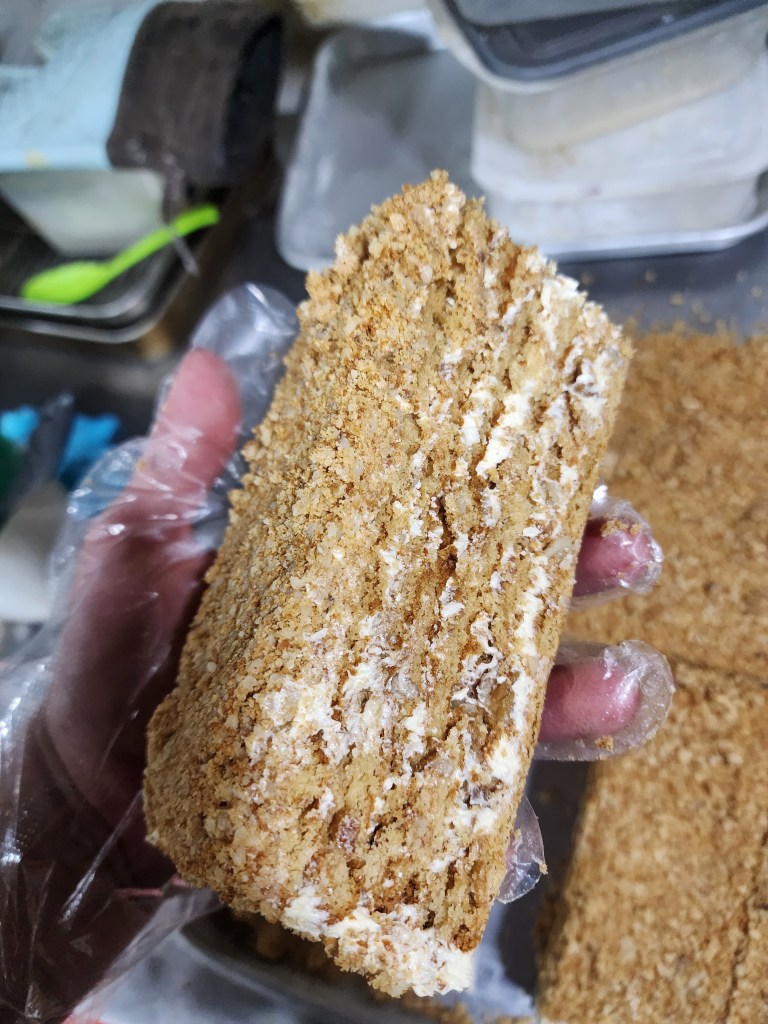
[Photo: Making Medovnik in my pub]
Encouraged by the praise 🤣, I gained confidence that my taste was superior to global brands. I tried to launch a packaged sales business by supplementing the texture for distribution using additives like emulsifiers, sorbitol (a humectant), and guar gum. However, I found that the path to acquiring these materials in the market was blocked. Of course, the state didn’t legally ban them, but in reality, they were as good as banned. Why? This is where the Blame Avoidance Structure designed by the democratic welfare state is hidden. (If you are curious about the administration’s blame avoidance structure, please refer to the following article.)
First: Administrative Ban on Fractional Distribution
To sell raw materials that large corporations distribute in 1-ton drums to small businesses in 1kg increments, a distributor must obtain a separate Food Additive Fractional Distribution License from the Ministry of Food and Drug Safety. The hygiene facility standards and the cost of hiring dedicated personnel required for this license far exceed the profit gained from small-scale sales. The state set a high hurdle in the name of “safety,” and because it isn’t profitable, distributors simply closed down the fractional market for small businesses. They literally told me they do not sell to individuals like me.
When I kept asking if there was any way to get small amounts, a supplier told me: “There are companies that buy from us to manufacture products. Why don’t you just buy the pre-made cake sheets from them and simply assemble them?”
But when I contacted those manufacturers, they refused to ship unless I met their Minimum Order Quantity (MOQ). As I was only in the planning stage, I couldn’t afford to take on a massive inventory. Even if I could, using someone else’s pre-made sheets would mean losing the unique taste of my own recipe.
Second: Shifting Responsibility and Risk Avoidance
Emulsifiers and humectants require precise blending. However, as the state strengthens comprehensive regulations—essentially saying “the seller shares all responsibility in case of an accident”—large suppliers have no reason to risk their business by selling small amounts to micro-producers. The weight of administrative responsibility imposed by the state has caused suppliers to erase small businesses from their client lists.
Any small producer who has tried to source “complex phosphates” to improve the texture and moisture retention of handmade sausages or patties will know exactly what I mean. Without them, the moisture just leaks out of the meat. It’s not that they don’t sell these things; it’s that in reality, there is no way for a small producer to buy them.
(Note: There is a “league of their own” where these materials are bought in bulk and shipped illegally, but as a law-abiding citizen, I won’t tell you about that! Haha.)
The conclusion is this: I created a product acknowledged even by locals, but because I couldn’t obtain the materials needed to scale for distribution, I had to stop at selling in a small shop. This isn’t a boast or a lament. I am pointing out that if I faced these issues, then other producers with even greater creative potential are also hitting these invisible hurdles. Consequently, producers either give up or leave the market for places where such hurdles don’t exist.
(2) The Quagmire of Facility Regulation
The second reason why “bad money drives out good” in the manufacturing market is facility regulation. In South Korea, for a general restaurant to package and sell cakes for distribution, they must obtain a “Direct Food Manufacturing and Processing Permit” in addition to the standard restaurant business report.
Reporting is one thing, but a permit is another; it involves onsite inspections by bureaucrats. Two aspects were particularly soul-crushing:
- Mandatory Self-Quality Testing: Every nine months, products must be sent to state-designated laboratories for testing. You must also attach complex labels including the product name, business name, address, expiration date, and raw materials. In a country with high labor costs, when is a solo producer supposed to find the time for this?
- Strict Separation of Facilities: While not as stringent as HACCP, the law requires the manufacturing area to be physically separated from the existing kitchen by partitions or walls. The logic is “don’t even let the air mix” to prevent cross-contamination.
This effectively prohibits leveraging an existing kitchen to scale up. It makes an already cramped kitchen even tighter. Placing dedicated ovens and workstations in a partitioned space ruins the “workflow” and tanks operational efficiency. If you need separate drainage, tiling, and ventilation for the manufacturing zone, you are essentially forced to remodel the entire kitchen from scratch or rent additional space.
This is a classic case where the cost of compliance outweighs the potential gains. Unable to abandon my existing shop, I had to give up on expanding production and packaging. My business shrank to merely selling to those few customers who knew to ask. Only established market players, not creative small-scale producers, can clear these physical and administrative hurdles. This is how regulations intended for “good” end up leaving only shoddy, mass-produced goods in their wake.
(3) Attempting a Standalone Branch: The Wage-Productivity Paradox
Since expanding our product line utilizing the currently leased store has become unfeasible, I have drafted a proposal for establishing a separate retail location. My strategy was to run a takeout cafe with a mix of two handmade desserts and OEM (Original Equipment Manufacturer) products to save capital, eventually obtaining HACCP certification to expand into supply. Without HACCP, selling on online platforms is legally impossible. Below are the figures from my business plan at the time:
Monthly Business Plan for a Specialized Dessert Branch
| Item | Monthly Figure | Remarks |
|---|---|---|
| Target Sales | 12,000,000 KRW | 12k KRW per unit / 1,000 units/mo (33/day) + Coffee |
| Variable Costs | 3,000,000 KRW | 20% COGS + Other variable costs |
| Fixed Costs (Labor) | 6,000,000 KRW | Author + 1 Full-timer (Min. wage) + Coffee staff |
| Fixed Costs (Rent) | 2,000,000 KRW | Rent for the branch location |
| Other Ops Expenses | 1,000,000 KRW | Utilities, consumables, marketing |
| Net Profit | 0 KRW | Net Profit Margin approx. 0% |
| Total Investment | 50,000,000 KRW | Interior, key money, equipment |
A 20% COGS (Cost of Goods Sold) is not a bad structure. However, without substantial support from coffee and OEM dessert sales, the business was likely to hit negative territory from day one. Why?
Mandatory High Wages for Zero-Productivity Bottlenecks
In a multi-layer dessert like Medovnik, which process takes the longest while contributing zero productivity? People think it’s the cream spreading. In reality, the true bottleneck is dishwashing. Medovnik requires numerous tools: oven pans, spatulas, mixing bowls, and agitators. To increase output, the dishwashing module must run in parallel with the manufacturing process.
Dishwashing requires no special skill. It can be done by the elderly or simple laborers. It is a job worth about 5,000 KRW per hour—a task one can do while listening to music. However, because the law mandates a full-time minimum wage of roughly 15,000 KRW (including benefits), there is no way out.
The Lost Opportunity Cost:
- Working Alone: 14 units (1 batch) in 3 hours = approx. 4.6 units/hour. Considering 40 minutes for washing and 20 minutes for process transition, actual value-added time is 2 hours.
- With Parallel Washing: Output triples over an 8-hour shift, meeting the target of 33 units/day. The problem? After paying the assistant the mandatory minimum wage, there is no profit left.
When I shared this plan, acquaintances said, “Then just increase sales. That’s the owner’s job.” That is like asking a student why they didn’t go to a top-tier university if they just “studied harder.” A target of 1,000 units was the realistic limit for an offline location, given that online sales were legally blocked without HACCP. Combining labor costs with low-margin items like coffee proved that the business was simply not viable. Furthermore, my capital was insufficient to deploy capital-intensive equipment to automate dishwashing, and my confidence in the business’s success was only fifty-fifty. Consequently, it was rational to initially utilize labor-intensive dishwashing and, as the business thrived, gradually expand and replace low-marginal-productivity labor with capital. However, if purchasing a large-scale commercial dishwasher from the very beginning yields better returns than paying high mandated minimum wages, it effectively tells entrepreneurs not to start a business at all. After all, is it not the norm for every business to start small and scale up over time?
In conclusion, the combination of raw material restrictions, facility regulations, and wages exceeding productivity meant that tasting good did not equate to business viability. I quit. For a small producer to get rich, the answer is to dominate a niche market with a single product and gradually transition to a capital-intensive model. But here lies the dilemma: transitioning requires massive investment and high utilization rates. Most small producers cannot cross this Death Valley solely with their existing revenue. They need external investment or loans, but since food manufacturing isn’t structured for VC investment like IT, expansion becomes practically impossible.
(4) Why the Market Floods with Shoddy Goods
If even the F&B industry—with its relatively low barriers to entry—prevents good items from being commercialized due to these regulations, I can only imagine the state of other industries. A strong structure exists where established producers lobby for safety, human rights, and hygiene as pretexts to block new entrants.
In reality, the Pro-Production pressure is not strong enough to tear down these moral justifications. If every citizen had to be a producer, they would demand deregulation. But citizens of a democratic welfare state prefer to remain as consumers or employees. It is more rational for them to receive redistributed value-added wealth through welfare than to jump into production and risk 100% of their capital. They have no incentive to demand deregulation. Bureaucrats, fearing public backlash if they preemptively remove a regulation that later leads to an accident, stay silent. Moral justifications always win.
Yet, even without blanket regulations, hygiene issues would not arise in a free-contract environment. Private General Liability Insurance can hedge hygiene risks more efficiently than any government facility mandate. Insurers assess risk based on probability, not law or bureaucracy; they know better than any official that a shop like mine, which doesn’t even use raw eggs, poses zero risk of food poisoning in summer.
However, in reality, producers who could have accumulated reinvestment profits to become corporations are crushed by the law before they even begin. This creates an asymmetric advantage for established players. Competition for Making it Better, Cheaper disappears. The market is flooded with shoddy products—smaller portions, stagnant taste, but higher prices. Everyone focuses on Selling Dearer, Faster through celebrity branding and marketing.
The more the democratic welfare state intervenes, the more it kills the path for a small business owner to become an entrepreneur. For instance, in South Korea, snacks and ice cream brands introduced between the 1960s and 1980s still maintain the number one market share. This serves as definitive evidence that new products from newly established companies rarely manage to emerge. Because entry barriers remain impenetrable and protective tariffs are imposed on imported goods, a handful of oligopolistic firms dominate the market. They flood the domestic market with supposedly “new” products that are merely cosmetic variations of the same old items, leaving the market to stagnate without genuine innovation.
4. Why the Current Conservative Right Cannot Be the Alternative for Small Producers
It would be a mistake to assume that the current Conservative Right offers a viable alternative. The answer to increasing national wealth has already been proven—both theoretically and empirically—by the Austrian Schools.
National wealth is maximized only in a system where the state exists solely to protect life and property, allows free entry and competition in private markets (outside of minimal order functions like police and military), and checks the democratic tyranny of mandating social insurance burdens on employers through a Republican Constitution. Even an autocratic state can generate wealth if it adheres to these principles.
However, the current Conservative Right is incapable of establishing Producer Sovereignty. Why? Because they are Nationalist Neo-Mercantilists.
They do not respect market autonomy or the sanctity of property rights. They are Pseudo-conservatives who intervene in the market even more aggressively to maintain state power. They justify intervention in the name of National Competitiveness and Security, creating Keynesian effective demand through war, and driving up domestic prices through tariffs and subsidies. They pressure central banks to lower interest rates, while treasuries incessantly manipulate market liquidity through bond issuance. They mobilize pension funds to prop up stock prices and coerce private enterprises.
The themes they champion—freedom and tradition—are merely counter-narratives used to combat the left’s dominance over “human rights, equality, and diversity.” In practice, their actions are identical to the populism of the left. They cannot escape the structural limitations of managing a Leviathan State. This is neither conservatism nor libertarianism. It is merely a modern resurgence of mercantilism, exploiting national security, nationalism, and war to bypass the inherent flaws of the democratic welfare state—such as low growth, high inflation, skyrocketing costs, and social conflict. In terms of their high time preference, they are no different from the left.
| Analysis Item | True Liberal/Conservative | Nationalist Neo-Mercantilist (Pseudo-Right) |
|---|---|---|
| Protagonist | Individual, Enterprise, Consumer | The State and Bureaucrats |
| View on Trade | Mutual-benefit game | Zero-sum game of national power |
| Resource Allocation | Market price system | State strategy and subsidies |
| Priority Value | Efficiency and Consumer Welfare | National Security and Regime Survival |
| Preferred Currency | Hard Money (Gold, Bitcoin) | Fiat Money (Manipulable) |
5. What is the Alternative?
If true liberals no longer exist, is there no way forward? Is giving up on production altogether the only answer?
Viewed through this lens, the declining birth rate is not an instinctive rejection of hardship; it is a rational judgment. In a democratic welfare state like South Korea, where the majority of the sovereign population has become “employees” of giant manufacturers, it is only logical for the masses to support high inheritance tax rates and expect the state to guarantee their retirement with that plundered capital. Simultaneously, it becomes rational” for an individual to focus on current consumption while expecting someone else’s child and someone else’s means of production to sustain their pension. (Note: I plan to post my detailed thoughts on the low birth rate issue separately.)
However, for small producers, their livelihood is at stake; they cannot simply abandon production. It is now time to move to Part 2 of this series. What methods must producers use to resist the “Dictatorship of the 51%”?
I believe we must first study the Brain of the Democratic Citizen. To state the conclusion first: Democratic citizens open their wallets for things that are Romantic yet Efficient. This might seem obvious, but historically, the period when Romance began to command such a high premium coincides with the birth of the Mass Society.
If focusing solely on Making it Right no longer grants access to a sufficient market, one must also master the art of Selling it Fast. To do this, we must understand why democratic citizens are so obsessed with the “Romantic yet Efficient.” I am currently conducting research on this topic. I will post the follow-up once I am ready.
6. Related Articles
- [The 51% Legal Dictatorship] How Democracy Plunders the Productive Class (The Collapse of American Republicanism)
- [The 51% Legal Dictatorship] A Geopolitical Autopsy of the Welfare State (U.S, U.K, France, Korea)
- [The 51% Legal Dictatorship] From Craftsmanship to Captivity — How the Democratic Caste System Traps the Producer
- [The 51% Legal Dictatorship] A “Rigged Democracy” Happy for All, Save for the Growth-Oriented Entrepreneur (Beyond James C. Scott’s “Legibility”)
- [The 51% Legal Dictatorship] Making vs. Selling: The Solo Producer’s Exit from the Democratic Millstone
- [The 51% Legal Dictatorship] The Arch-Enemy of the Market: The “Legislature” Butchers Producer Sovereignty
- [The 51% Legal Dictatorship] Slaughtering the Moral Titans: Why Rawls, Sandel, and Piketty are the Enemies of Personal Sovereignty
- [The 51% Legal Dictatorship] The Fall of Truth: A 200-Year History of Capitalism as the Engineered ‘Enemy of Democracy’

If you enjoyed this article, you can support the project – thank you!