
1. Intro
In the previous article, I introduced the Aura Dissolution Theory through the case of Starbucks. The core argument was simple:
As Starbucks expanded, it erased human traces and local context. Over time, it lost temporality — and drifted toward becoming a global vending machine.
As an alternative model, I briefly pointed to Japanese chado (the way of tea) — a practice where wabi-sabi aesthetics can elevate an ordinary tea moment into something almost spiritual. But this raises a practical question.
Does this mean small business owners should copy wabi-sabi interiors, use old bowls, and serve coffee in chipped cups?
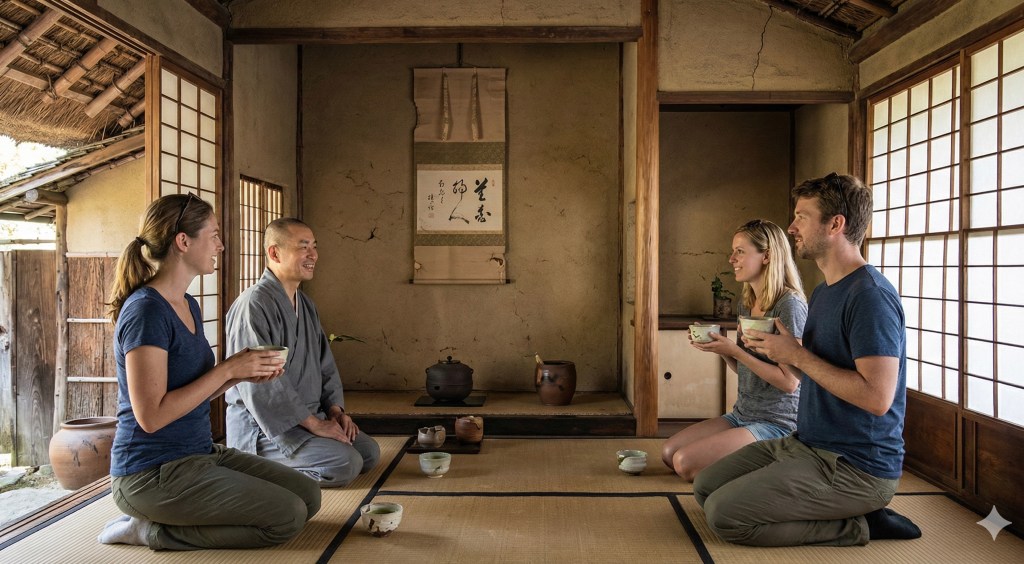
[Photo: A wabi-sabi tea ceremony designed to help readers understand]
Of course not. Imitating the surface style is not the answer. Vintage props alone do nothing. The real question is deeper:
Why do worn bowls and cracked teacups feel meaningful in the first place?
Unless we understand that mechanism, we cannot apply the idea in real business settings. That is why, in this new series —“Wabi-Sabi and Participatory Perception” — I will unpack the concept, history, and practical logic of wabi-sabi step by step, with direct lessons for small business owners.
2. What is the Japanese Aesthetic of Wabi-Sabi?
(1) Why Wabi-Sabi?
Some readers may wonder why I suddenly bring in this Japanese concept. My interest is not cultural imitation. It is structural logic. I see wabi-sabi as one of the most refined real-world examples of what I call: Impressionist Interior & Food Decoration Strategy
That strategy works like this: Give the customer a 1% anchor, and let them construct the remaining 99% of meaning themselves. The Impressionist strategy isn’t about shouting that you’re special; it’s about making the customer feel that you are in their own minds. It’s an investment in software rather than hardware.
Wabi-sabi follows the same structure. A cracked teacup. A sun-faded tatami mat. A weathered wooden surface. These small imperfections — the 1% — invite the guest to imagine time, impermanence, lecture, and natural flow — the 99%. That Suddenly becomes a ‘Zen’ experience. In that sense, wabi-sabi is not just an aesthetic. It is a management-efficient perception design model. Minimal material input. Maximum experiential output.
Think about the implication. If a cheap rice bowl and a worn rural interior can generate spiritual elevation and emotional depth, then nothing is more cost-efficient. Unlike brands that spend heavily on spectacle and polish, wabi-sabi generates meaning through restraint. That is exactly why F&B and B2C operators should understand its logic — not to copy its look, but to apply its mechanism.
(2) Traditional Definitions of Wabi-Sabi — And Their Limits
Leonard Koren, who introduced wabi-sabi to Western audiences, defines it like this:
“The beauty of things imperfect, impermanent, and incomplete.
The beauty of things modest, humble, and unconventional.”
This definition is elegant — but too abstract for practical use. Western beauty traditions often come from Renaissance classicism: geometric perfection, proportion, symmetry — the ideal human form as divine geometry. Wabi-sabi begins from the opposite premise. Humans are not masters of nature. They are subject to it. Beauty appears in:
- withering flowers
- rain on dry ground
- cracked tree bark
- aging surfaces
In other words: impermanence, darkness, incompleteness.
The problem is not the idea — the problem is the explanation style. Many writers describe wabi-sabi in conceptual language so abstract that readers finish the book without operational clarity.
For example,
| Wabi | Sabi |
|---|---|
| Way of life, spiritual path | Material objects, art, literature |
| Inwardness/subjectivity | Outwardness/objectivity |
| Philosophical thought | Aesthetic ideal |
| Spatial event | Temporal event |
(Source: Leonard Koren, Wabi-Sabi for Artists, Designers, Poets & Philosophers)
Even when “wabi” and “sabi” are listed separately, the bridge between them is often unclear. Because of this, some modern interpreters like Beth Kempton skip theory entirely and reduce wabi-sabi to lifestyle imitation:
- wear kimono
- sit on tatami
- live simply
- buy Japanese-style goods
But this is also misleading. It turns wabi-sabi into “anything Japanese,” which is useless if our goal is practical business application. So, let me propose a clearer, more operational redefinition of wabi-sabi.
(3) A New Hypothesis on Wabi-Sabi — A Linguistic and Historical Approach
Anyone who has tried to understand wabi-sabi has likely felt this confusion:
How do wabi, sabi, Zen, tea ceremony, and Japanese lifestyle all connect?
Let’s separate the parts first. To understand wabi-sabi properly, we must split the term. It is simply a combination of two different Japanese words: wabi and sabi.
Wabi and Sabi Are Not the Same
According to Leonard Koren’s usage, Wabi points to:
- simplicity
- modesty
- imperfection
- plain living
- minimal structure
Think: a cracked teacup, a bare hut, an unadorned space.
Sabi points to:
- solitude
- quietness
- fading
- aging
- time-worn patina
Think: a wooden handle polished by decades of touch, or a rusted iron doorknob. Later writers fused these into one slogan: “The beauty of the imperfect, impermanent, and incomplete.” This was often framed as a reversal of Western symmetry-based beauty.
But here’s the structural problem: There is no strict logical reason why wabi and sabi must always be fused. Conscious of the criticism that his first book merely listed adjectives for Japanese aesthetics without developing them into an epistemology, Koren distinguished between Wabi and Sabi in his second volume as follows:
- Wabi = present lifestyle attitude
- Sabi = temporal aging process
Something ornate and perfect today can still become sabi over time. A golden palace can age. A luxury object can decay.
So why must sabi depend on wabi?
Even many Japanese scholars and monks admit the distinction — then simply say, “They overlap, so we use them together.” That answer is descriptive, not explanatory. Let’s build a stronger bridge.
A Linguistic Look at Wabi
The original character for wabi (侘) combines: the “person” radical (亻) + with the idea of a house (宅). First, looking at the characters, Wabi means ‘the way a person lives.’ However, in the context of ancient Japan, living meant having to endure overwhelming disasters like fires, earthquakes, storms, and tsunamis every year. This inevitably led to the realization that life is inherently ephemeral. This was understood as a spiritual imperative: to accept the absolute powerlessness of humanity before the immense forces of nature. A lifetime of wealth could disappear overnight. Impermanence was not philosophy. It was daily experience. Under those conditions, a small and modest dwelling meant fewer worries. Less to lose. This realization provided an aesthetic justification for a way of life rooted in profound reverence for the natural world.
Cultural ideals reflected this shift. Not the wealthy estate owner — but the wandering ronin, like Miyamoto Musashi, carrying little, became an admired figure. So behind modern cheerful talk of “Japanese love of nature” lies something more severe: A fear of nature’s destructive power.
From that lived condition, wabi came to mean:
- non-possession
- modest living
- low attachment
- reduced anxiety
Aesthetic simplicity is rooted in survival psychology.
A Linguistic Look at Sabi
Now consider sabi. In modern Japanese, people say: “Nanka sabishii na…” — “It somehow feels lonely.” Notice something subtle. The loneliness is not stated as: “I am lonely.” Instead it is projected onto the environment: “This place feels lonely.” Self and surroundings are blended. This reflects a broader Japanese perception style — where subject and environment are not sharply separated. (For more on this cultural pattern, see my article on Japanese “reading the air.”)
The character for sabi (寂) combines: a house radical (宀) + with an aging figure (叔). It points to quietness, stillness, and time accumulation within a dwelling. Again, the nuance is environmental:
- Not: “The old man is lonely.”
- But: “The house containing the old man feels lonely.”
Person and place age together. That is sabi.
Bridging Wabi and Sabi — A Stronger Link
Viewed linguistically and historically, the bridge becomes clearer.
- Wabi = living modestly with little, under nature’s overwhelming power.
- Sabi = the quiet aging and fading of that modest life over time.
Together they express a coherent life philosophy:
Do not fight nature’s vast force. Live simply in a small dwelling. Age within it with quiet dignity.
Where many modern interpreters stay abstract adjective — “imperfection, impermanence, incompleteness” — this reading grounds wabi-sabi in lived Japanese conditions. It becomes phenomenological, not slogan-based. Now we can state the bridge more precisely:
Wabi and sabi are linked not by poetic convenience, but by lifestyle shaped under cruel environmental pressure. Wabi-sabi is the aesthetic of not resisting nature’s scale — but living simply within it, and aging there.
Ultimately, Wabi-sabi was developed as a lifestyle to transcend the transience of life and the fear of the natural world. Leonard Koren’s work doesn’t explicitly bridge the gap between Wabi-sabi and Yugen(the mysterious beauty of the afterlife and its rites), but my perspective offers a clearer link. Because Westerners viewed it merely as minimalist or abstract aesthetics, they missed the historical reality of the Japanese people—a culture defined by thousands of years of being overwhelmed by the forces of nature.
3. How Wabi-Sabi Became Central Through the Tea Ceremony
Let’s briefly trace how wabi-sabi moved from a lifestyle attitude to the core aesthetic principle of Japanese chado (the tea ceremony).
(1) Murata Jukō and the Birth of Wabi-cha
Originally, wabi-sabi was not a formal aesthetic theory. It was closer to an everyday attitude:
- live simply
- accept frugality
- respect nature not as something to conquer, but as a spirit (kami)
During the Muromachi era, Zen monk Murata Jukō transformed this attitude into a tea philosophy. At that time, tea gatherings in Japan were displays of wealth and prestige. People used them to show off expensive Chinese utensils and refined taste. Murata Jukō broke from this pattern. He proposed a distinctly Japanese alternative — humble tools, simple spaces, restrained atmosphere. Ultimately, in an effort to distinguish Japanese tea rituals from Chinese aesthetic influence, Murata Juko integrated the sacred Zen Buddhist doctrines of the era with a Wabi-sabi mise-en-scène. The result of this synthesis was Wabi-cha. This move was radical.
If an ordinary farmer had said,
“My cracked rice bowl is now a sacred tea vessel,” no one would have listened.
But Murata Jukō was a respected Zen monk. He had cultural authority.
He reinterpreted: humble pottery, small huts, rough utensils as expressions of Zen spirit. People began seeing low-value objects differently. In today’s language, this is almost a prototype of Aura Branding model:
lifestyle (Murata Juko)+ mise-en-scène(Zen Cafe) + object(Wabi-cha) → aligned meaning.
(2) Sen no Rikyū and the Elevation of Wabi-cha into Chado
Later, Sen no Rikyū pushed wabi-cha further — turning it into fully codified chado, the Way of Tea. He was a very competent Zen Cafe CEO.
Wabi-cha as Sacred Experience
Wabi-sabi originally described daily living attitude in Japan. Rikyū needed to elevate it into a spiritual event. He used Zen doctrine as the frame. Without Zen context: cracked bowls, tiny tea rooms, rough walls would just look shabby. With Zen framing, they became symbols of:
- impermanence
- humility
- transcendence
Context converted poverty into sacredness.
The Merchant–Monk Paradox
Today, Zen is often associated with anti-materialism. But in Rikyū’s time, Zen and commerce were not seen as opposites. He was both monk and merchant, possessed a lethal insight into the Japanese subconscious—the primal hunger for the ‘Sacred Experience.’ His Way of Tea only becomes clear when dissected through the framework of Mircea Eliade.
- The Cleaving of the Sacred and the Profane: The Nijiriguchi (躙り口)
Rikyu constructed a thatched-roof hut (Chashitsu), a Temple of the modern age, completely isolated from the turbulence of the profane world. The ‘Nijiriguchi’—the intentionally low entrance—is the ultimate psychological device. By forcing everyone, whether king or warrior, to bow their heads to enter, Rikyu mandated a ‘Rite of Passage.’ It was a structural enforcement to shed one’s social rank and ego before stepping into the sovereign, sacred void.
- The Shamanic Rite and Hierophany
Inside the tea room, the host undergoes a metamorphosis into a Shaman, performing repetitive and disciplined movements. Through this precise ‘Ritual’, ordinary tea leaves and water are transubstantiated into something far beyond a mere beverage. It is an act of alchemical elevation.
- The Aesthetics of Yugen
‘Yugen’ is the pinnacle of Japanese aesthetics. It embodies a chilling insight: life and death are not distinct realms. Instead, they form a single, fluid continuity. Consider the ritualistic nature of Noh theater. It consoles the dead while unifying the living. This served as a survival strategy for people facing centuries of relentless warfare. They hungered for a permanence that transcended the grave. Sen no Rikyu took this vast religious rite and distilled it. He designed tea rooms to embody the mise-en-scène of Yugen by introducing features reminiscent of a ‘tomb.’ He achieved a profound sense of darkness by minimizing windows and strictly limiting light, paired with austere decor and cryptic scrolls. The presence of a host who had perfected the ritual, along with the use of rugged, black tea bowls, all contributed to recreating the somber, interior atmosphere of a burial chamber.
In the words of Mircea Eliade, the tea room becomes the ‘Axis Mundi’. It is the fixed anchor of the universe. It pierces through both the abyss and the heavens. In this way, it tethers the soul to the realm of the eternal.
Rikyū’s End
His influence grew — and so did suspicion. He was accused of profiteering from tea utensils. He clashed with Toyotomi Hideyoshi. He was ordered to commit seppuku. Ironically, his death fixed his legend. He became the immortal master of tea — and his model still defines chado today.
(3) Wabi-cha Through Aura Branding Theory — Lessons for Small Business
Here is the key puzzle:
Why do cracked bowls and shabby huts —worthless in the marketplace — become spiritual experiences inside a tea room?
Aura Branding Theory explains this cleanly. When three elements align:
- leader’s lifestyle
- staged environment (mise-en-scène)
- objects
an aura of irreplaceable value emerges.
Murata Jukō and Sen no Rikyū functioned like early influencers. They embodied Zen lifestyle + staged it spatially + surrounded it with wabi-sabi objects. The tea room was essentially a Zen café. Objects gained aura not through explanation —but through synchronization.
Guests were not told what to feel. They were invited to project their own meanings. Each experience became unique.
A visit to their ‘Zen cafe’ allows the fleeting nature of life and the dread of death to fade away, as they become accepted as part of the world’s natural order. This transformation was the core ‘product’ they offered. (Though European salons provided a similar intellectual heightening, the essence differed.) Their alchemy—turning weathered tea bowls into instruments of Zen—is nothing short of extraordinary. It serves as a powerful inspiration for modern small business owners.
Contrast With Modern Over-Explanation Marketing
Modern product marketing often sounds like this:
“Brewed under the 1516 German Purity Law, aged X months, at Y degrees, producing 2000 aroma notes…”
Information increases. Meaning decreases. There is no lifestyle to sync with. No embodied figure to aspire toward. Without aura, it’s just beer.
The Core Lesson
A random farmer in Rikyū’s era could not have led wabi-cha. And Rikyū did not succeed by explaining theory. He succeeded by synchronizing:
- life attitude
- space
- objects
- ritual action
into one lived structure.
Practical Takeaway for Modern Entrepreneurs
Do not copy wabi-sabi style. Do not imitate cracked bowls and old interiors.
Instead: Align your life attitude with your space and your products.
That synchro — not imitation — is the source of aura. However, simply being inspired by the investment efficiency of Wabi-sabi and copying its exterior is meaningless. People can tell when it’s fake. First, you must complete your own lifestyle by truly understanding the culture of Wabi-sabi and the doctrines of Zen Buddhism. If you are not the ‘real deal,’ the cafe you create can never be authentic.
4. Common Misunderstandings About Wabi-Sabi
(1) Wabi-Sabi Is Not “Beauty” — It Is an Experience
Many scholars present wabi-sabi as a form of “Japanese minimalist beauty” and encourage people to admire it as an aesthetic ideal. But in reality, public response has always been muted.
If you’ve followed my previous essays, you’ll notice something important: I never praised wabi-sabi as mystical beauty. I treated it as a designed experiential structure. Let’s be honest. If a half-cracked cup is sitting on your table right now, what is your first reaction?
- Not: “What a beautiful wabi-sabi object.”
- But more likely: “I should probably throw this away.”
(This is the honest, biological truth that most scholars are too polite to admit.)
People do not instinctively perceive wabi-sabi as beauty. Why? Because in everyday life, our sense of beauty is tied to vitality and survival:
- healthy bodies
- symmetry
- youth
- shine
- strength
Wabi-sabi shows the opposite:
- cracks
- decay
- erosion
- wrinkles
- fading surfaces
Biologically speaking, these are signals of decline — not beauty.
Then Why Wabi-sabi moves us? This is because highly sophisticated mechanisms are embedded to induce a shift in perception. To transform old, commonplace Wabi-sabi objects into something perceived as ‘sacred,’ an ‘initiation rite’ is essential. Murata Juko sought to achieve this through ‘Zen Buddhist doctrine,’ while Sen no Rikyu solved it through ‘tea room design.’ The combination of their reputations and the word-of-mouth from those who had experienced these spaces made the act of drinking tea feel like a ‘truly different experience’. This is phenomenology — the lived body sensing the depth of time and space. That’s why wabi-sabi works as experience, not as decorative beauty. It must be understood and practiced as embodied perception.
(2) Why My Wabi-Sabi object feel mundane ?
A common question comes up:
“Wabi-sabi feels profound in Japanese tea rooms or shrines. But when I recreate a wabi-sabi interior at home, it feels flat. Why?”
Leonard Koren once answered with an example:
If you artificially distress jeans, are they wabi-sabi? “It depends on how people receive them.”
Koren could not properly answer this reader’s question because he understands Wabi-sabi as an ‘adjective’ rather than a lifestyle. That answer is too vague. There is a clearer structural reason.
What matters is not the ‘object’ itself, but the ‘perception’
I have brought back my definition above.
- Wabi = living modestly with little, under nature’s overwhelming power.
- Sabi = the quiet aging and fading of that modest life over time.
The examples I provided are merely epistemological distinctions to help understand the concept; on an ontological level, Wabi-sabi is understood as a unified whole. It refers to a lifestyle that does not resist the harsh natural environment but accepts it as a given, finding meaning in life within it.
In other words, Wabi Sabi is the aesthetic expression of Entropy. Elevating the entropic to the level of ‘aesthetics’ is impossible through conventional logic; it requires a unique philosophical foundation. In other words, if you cannot provide an experience of why the aged traces and impermanence of a space or object—rooted in Zen Buddhist logic or deep historical origins—are part of the natural order and hold sublime meaning in a customer’s life, then it lacks inherent appeal.
Therefore, if someone asks why they can’t feel the same ‘vibe’ they experienced in Japan after buying a Wabi-sabi object, I would answer like this: That object may be Wabi-sabi in its form. However, unless you embrace the origins and philosophy of Wabi-sabi as a lifestyle through a proper teacher or an initiation rite, the ‘Wabi’ aspect will feel like a functional defect, and the ‘Sabi’ aspect will feel like nothing more than an old antique.
5. Conclusion
Understanding wabi-sabi is not decoding a visual style. It is:
- linking past traces of time (sabi)
- with lived simplicity (wabi)
- inside your own embodied experience
In short, Wabi-sabi was a Nietzschean sublimation used to endure the brutal realities of life.
In Part 2, I will delve into a phenomenological analysis of wabi-sabi. [See: Wabi-Sabi and Participatory Perception: A Phenomenological Management Theory for B2C, Part 2]

If you enjoyed this article, you can support the project – thank you!