
1. The Basic Principle of Flavor Flow Design
Small restaurant owners can’t rely on celebrity endorsements, TV shows, or massive SNS ads. Thus, we must implant unforgettable experiences directly into the customer’s memory through food itself.
The golden rule: Flavor must flow rhythmically.
If a dish just explodes with a single strong flavor, the brain quickly becomes saturated and says, “That’s it?”—then forgets it. To avoid this, we must embed a rhythmic flow of taste and texture into each dish. Flavor rhythm operates on two layers:
- Temporal Layer (time difference attack): Flavor unfolds step by step over time.
- Physical Layer (texture variation): Changes in physical sensations like crispiness vs softness.
When both layers are synchronized, the brain feels a dynamic rhythm, deepens emotional reactions, and remembers the experience for a long time. You don’t know good; you just feel it. We aim to engineer this feeling consciously.
2. What Is a Rhythmic Flavor Flow?
(1) Time Difference Attack: Sequential Service Example
In traditional French fine dining:
- Aperitif: Slight acidity stimulates the palate.
- Amuse-bouche: One bite-sized dish to trigger curiosity.
- Appetizer: Refreshing and light dishes like salads.
- Soup/Entrée: Deepening focus with rich elements (foie gras, seafood).
- Poisson (Fish Dish): Warming up for climax with moist textures.
- Viande (Meat Dish): Full burst of sweetness, saltiness, umami.
- Fromage (Cheese Plate): Eases down the climax gently.
- Dessert: Sweet, refreshing closure with lingering emotional trace.
Why all this hassle? Because like a symphony, emotion builds through rhythm and climax. If all food were served at once, it would be “delicious but forgettable.” → Flavor is an art of time.
In German beer halls (Munich):
- Start: Pretzel + beer to lower tension.
- Middle: Sweet → Bitter → Sour/Aromatic flow in beer.
- Main: Crispy crackling + juicy pork (Schweinshaxe) create texture variation.
- Background: Live band supports the emotional rhythm.
All these sensory flows work together to leave deep emotional memories.
(2) Single Dish Flow: Internal Flavor Variations
Even in a single dish, we must structure a rhythmic flow. Examples:
- Carbonara: Salty → Savory → Sweetness from starch breakdown.
- Goulash: Salty → Sweet → Spicy → Sour (sour cream) 👉 Key technique: Emulsification (Fats bind flavors smoothly into moisture.)
Internal flavor variation usually appears in foods where heat causes chemical changes in texture and structure. Not always — but in most cases, that kind of depth comes from thermal transformation. If internal flow is weak, we often use external sauces (like ketchup for fries) to create rhythm. Without it? → The brain says “That’s it?” and loses interest.
(3) Texture Variation: Crisp Outside, Soft Inside
Texture variation is crucial for physical rhythm. Examples:
- Sous-vide meat often lacks crispness → easily feels boring. Good chefs grill or torch the surface after sous-vide to add contrast.
- Bagels, Cheese Soufflé: Ideal first bite with crispy crust + soft center. Crisp-soft dynamics keep the brain engaged and rhythm flowing. Add a coffee pairing (bitterness) after sweetness → emotional oscillation deepens.
(4) Summary
The key to preventing “That’s it?” reactions: Flavor Flow Design.
- Problem: Single flavor explosions cause “That’s it?” reactions → Forgettable food.
- Solution: Build rhythmic flavor flows through temporal layering and texture variation.
- Goal: Embed emotional memories via dynamic, layered sensory experience.
Key Techniques:
- Sequential serving order (French dining, German beer halls)
- Emulsification to bind flavors
- Crisp-soft texture control (grilling, baking)
Result: Longer memory, stronger satisfaction, repeat customers.
4. Foods Suited for Rhythmic Flavor Flow
Now, let’s move on to practical application. What types of food naturally support rhythmic flavor design? Mainly dishes that use:
- Liquid mediums (broths, sauces)
- Structural combinations of different physical properties (crisp vs soft)
- Advanced techniques like emulsification, smoking, aging, pickling, Maillard reactions, etc.
In short: Where there is cooking technique, there can be flavor flow.
(1) Example: Pilsner Urquell Beer
- Sweet foam → Bitter body → Sharp carbonation → Gentle acidity finish.
- Why does this happen?
Because liquids allow multiple taste elements to layer and release sequentially, based on receptor response times. Korean lagers often lack this flow—only carbonation is felt, leading to immediate “That’s it?” reactions.
(2) Example: Smoked Sausages
- In Germany, sausages like Bockwurst are smoked with beechwood chips.
- Smoking adds volatile aromatic layers on top of the meat’s natural umami and saltiness,
creating multi-sensory flow. - Maillard browning through searing does the same: building aromatic complexity and rhythm.
(3) Example: Schweinebraten (Roast Pork)
- Pig skin (crisp) and meat (tender) coexist.
- This creates layered texture variation (crackle vs softness) and taste rhythm (nuttiness + saltiness).
5. Foods Difficult for Flavor Flow
What types of food are harder to engineer flavor flow into?
- Dry, assembly-type foods with no liquid binding.
- Simple-prep foods with little chemical fusion (e.g., no emulsification, no Maillard, no smoking).
(1) Example: Hamburgers
- Delicious but stacking ingredients physically (meat, cheese, veggies) leads to one-shot flavor.
- After one bite, the brain quickly predicts the rest → “That’s it?” reaction.
- That’s why we instinctively reach for fries and soda.
(2) Example: Nachos
- Salty and satisfying at first, but without sauces (cheese dip, chili), it quickly becomes boring.
- The brain demands new stimuli—without rhythm, interest drops rapidly.
(3) Example: Schnitzel vs Jägerschnitzel (Personal Experience)
- I serve both at my pub.
- Customers overwhelmingly prefer Jägerschnitzel (with mushroom cream sauce).
- Why? Because the sauce layers saltiness → onion sweetness → mushroom umami → slight peppery notes, creating sequential flavor flow.
- See: Crispy Pork Cutlet with Mushroom Gravy (Jägerschnitzel Recipe)
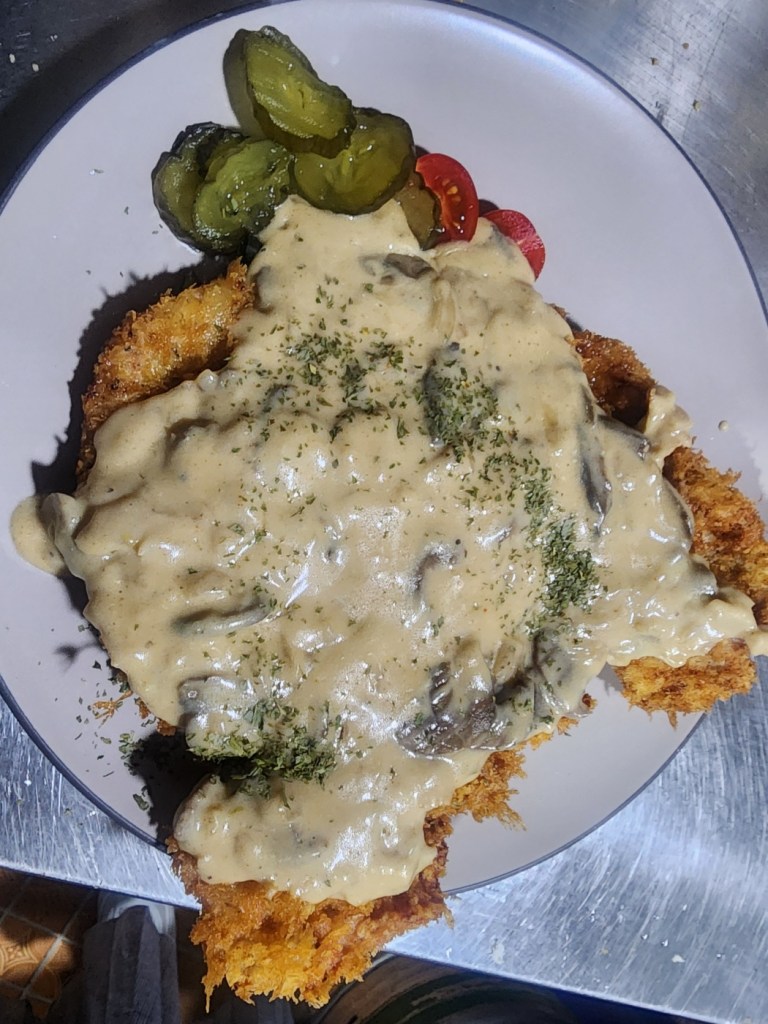
Flavor without flow is still tasty—but the brain quickly gets bored and asks “That’s it?”
6. How to Improve Non-Flow Foods
(1) Introduce Sensory Variation through Crispiness
Good pizza crust and fried chicken create texture rhythm (crispness). For example, Neapolitan pizza uses intense Maillard browning to build crispy, flavorful crusts. Fried chicken offers crisp outside → juicy inside → evolving saltiness and umami over time. Even without strong emulsification, sound, mouthfeel, and taste variation can simulate rhythmic flow.
(2) Use Pairing to Create Horizontal Flow
Hamburgers alone have little flow. But how about this way? Crispy Buns + Juicy Patties like Fried chicken (Texture rhythm) Adding fries, coleslaw, and soda allows customers to self-generate flow by alternating bites. Traditional Korean set meals (Hansang) work similarly: → Multiple small side dishes allow self-directed rhythm building.
(3) Business Implications:
Why Non-Flow Foods Are Dominated by Chains ? Food without internal flavor flow is easily mass-produced:
- Cheap bulk ingredients
- Simplified prep → Automation
- Pairing with drinks and sides to simulate variation.
Thus, large franchises excel at selling non-flow foods through price, speed, and marketing firepower. Small restaurants trying to compete on the same ground are almost guaranteed to lose.
Survival for small businesses requires building emotional memory through internal rhythmic flow, not just taste.
7. Flavor Flow Hierarchy (Not a Taste Ranking)
| Grade | Characteristics | Example Dishes |
| S | Liquid/Sauce based -> Time difference flow | Stews, Pasta, French Sauces |
| A | Texture-based structure -> Crisp-soft variation | Schweinshaxe, Fried chicken, Schnitzel |
| B | Assembly foods -> One shot flavor burst | Hamburgers, Rolls, Korean Bibimbap, Sandwiches |
| C | Dry foods -> Monotone sensation | Plain Sashimi & Grilled pork Belly (without sauce), Dry nachos |
8. Addressing Common Misconceptions
(1) Isn’t a burger with bacon, pickles, mustard layered enough?
A burger has to be eaten in one bite — bun, patty, vegetables, and cheese all together. It’s not chemically integrated. Bun, patty, vegetables, and cheese are just physically stacked together. Imagine eating each ingredient separately, one by one. It’s terrible. There’s no rhythm. Just fragments. So, a hamburger tastes best when you take a big bite of several layers.
- Adding physically multiple flavors = Not Chemical integration.
- Without time difference and texture shifts, the brain still feels “That’s it?” after the first bite.
- With Sauce, Fries and Coke, We can enjoy flavor rhythm.
(2) No rhythm doesn’t mean bad taste.
Simple foods with little or no rhythmic flavor — like burgers or pizza — are where franchises dominate. Because the cooking process is mostly assembly, not transformation. Small independent restaurants can’t win on scale or consistency. They have to win by creating rhythmic flavor — something that stays in the customer’s memory long after the meal. That’s the only real leverage they have. Without emotional memory, there’s no repeat visit or word-of-mouth growth.
9. Conclusion
- Problem: Static flavors cause quick boredom → “That’s it?” reactions.
- Solution: Engineer rhythmic flavor flow through liquids, texture shifts, and time difference attacks
- Business Edge: Emotional memories = Survival for small restaurants.
Small restaurants must sell rhythmic flavor experiences. Flavor flow must be engineered through cooking techniques, a domain franchises ignore, thus opening the only viable path for small operators to survive.
Big brands bind flavor mechanically. Independent chefs bind flavor chemically. That is the difference you can taste.

If you enjoyed this article, you can support the project – thank you!