
So far, we have examined the forces that generate anxiety from two perspectives. First, the structure of dependence on the world. Second, the fear that arises when one’s personal narrative remains uninterpreted. This article addresses a third dimension: the anxiety that emerges from losing control over one’s body.
The core argument is simple. Anxiety cannot be solved by thinking. It disappears only when bodily control is restored.
1. Franz Kafka’s The Metamorphosis 🐛
In Franz Kafka’s The Metamorphosis, the protagonist, Gregor Samsa, wakes up one morning to discover that he has turned into an insect. Gregor had been a diligent man. He supported his family through his labor. But once he becomes an insect, his family abandons him completely. They leave him alone. They treat him with cold indifference. After being wounded by an apple thrown by his father, Gregor slowly starves to death in isolation. His family feels relief. They go on a picnic.
The novel is often interpreted as a story of brutal alienation. Once a person acquires a grotesque body and loses their economic “function,” even family will discard them. This interpretation is not wrong. But I read the story somewhat differently.
If Gregor had become an insect, he should have moved according to the rhythm of an insect. But he could not use his body freely. He was freed from the obligation to support his family, yet he lacked both the freedom and the ability to survive on his own. That is why he ended up dying from an apple. What pushed Gregor into fear and anxiety about death was the loss of bodily control.
From this perspective, modern anxiety reveals itself as a fundamentally physical problem. Low stamina. Lack of sleep. Chronic pain. The sensation of being unable to move as one wishes. These conditions generate anxiety because they force us to depend on others for survival. A life shaped by such anxiety cannot produce meaning. Here, meaning refers to contributing to the survival of others.
Without that, life can hardly be called fully human.
2. The Meaning of the Body
(1) The Body as the Basis of Survival in Korean Society
Gregor’s tragedy is not a matter of personal misfortune. It is an experiment that shows how a human being loses the meaning of existence once bodily control is taken away. In South Korea, this experiment is being repeated in a particularly explicit form.
As discussed in the previous article [🚚 Why Restaurants Are Dying — and Why Logistics Keeps Winning in South Korea 🇰🇷], Korea is a country where good physical health can lead to substantial income. Parcel delivery, freight transportation, construction labor, carpentry, electrical work, and stone masonry are physically demanding occupations. Yet many people earn net monthly incomes of $5,000–$8,000 through them. But why do young people try to avoid physical labor as much as possible? This is not because young people prefer “easy work.”
Korea has an extremely high college enrollment rate. As a result, taking up manual labor after graduating comes with heavy social stigma and a large economic sunk cost. Externally, social safety nets and financial systems are weak, making individual survival difficult. Labor market flexibility is also extremely low. Once someone enters a large corporation or a professional track, they often enjoy lifelong stability. But if they fail to enter early, the opportunity is effectively gone.
In other words, starting one’s career in manual labor often means being unable to escape that path.
Under these conditions, preparing for large corporations or professional careers— with better welfare, easier access to credit, and higher wages — becomes the rational choice. Paradoxically, this structure turns the body into the final option and the last line of survival. When the body collapses, anxiety transforms into fear.
(2) A Single Thorn or a Back Pain Can Bring Everything to a Halt
When intelligent people passionately debate space, consciousness, abstract concepts, or the future of AI, it feels like a different world. In my reality, a single thorn in my foot or a bout of back pain is enough to stop everything. Work no longer proceeds smoothly. All bodily functions deteriorate. Truly important things are always close at hand, which is why we fail to notice them. We live as if we were beings of the mind, but in truth, we are beings of the body. Even small, recurring pain can collapse the narrative we are living and sever our connection to the world. All small business owners engaged in B2C industries confront the world as individuals.
For them, managing their health is the condition for surviving without anxiety.
(3) Bodily Control as Small Feedback During Periods Without Results
Dopamine capitalism dominates the world, operating through cycles of stimulus, expectation, response, and reward. These processes always involve time delays. Reality is too complex and intertwined to unfold according to our intentions. While waiting for results, imagined expectations grow. We keep increasing our input. Disappointment accumulates. The cycle repeats.
By contrast, walking, moving, and feeling control over one’s body produce immediate feedback. A consistent physical routine. The refreshing sensation after a shower. The sense of achievement when a movement once impossible becomes possible. As these small feedback loops accumulate, life begins to feel fuller. They give us the strength to endure periods when dopamine-based rewards are delayed
or turn out to be smaller than expected.
(4) The Experience of Being Alive
Joseph Campbell believed that through mythic narrative structures and carefully designed rituals,
humans could discover meaning and become “elevated beings.” This is not entirely wrong.
But humans have thresholds. Any form of ecstasy eventually becomes ordinary. Without ever-new and ever-stronger rituals or narratives, boredom quickly sets in. Paradoxically, it is bodily training that requires accepting 1% pain that helps us overcome this boredom. Choosing difficulty, discomfort, and inconvenience on purpose, and overcoming them, allows us to feel alive. This is not asceticism in the sense of conscious self-punishment. It is a practical call to move the body and discover new meaning through action.
(5) The Recovery of Proprioception
There is a sense known as proprioception. Sight, hearing, and taste are individual senses tied to specific organs. Proprioception integrates them all. It allows us to understand where our body is situated in time and space, and what kind of world it is oriented toward. In other words, proprioception is the bodily sensation that allows us to perceive objects as meaningful. Put simply, it is the rhythm that naturally emerges in a given space.
Consider a person skilled at kicking a ball. To them, a grassy field is not merely land where weeds grow. The type of grass, its length and distribution, and the firmness of the soil all change running speed and the resistance of the ball. Because such a person has kicked balls on countless surfaces, they intuitively adjust their force even when kicking from the same distance. This knowledge precedes individual sensory data, Google searches, and language itself. It is produced by repeatedly placing the body in varied contexts and interpreting those experiences through action.
Maurice Merleau-Ponty called this integrated bodily sense proprioception. He believed that by training it, one could grasp the meaning of the world more richly. As time spent cultivating the body accumulates, the past deepens the present, and future possibilities expand. When we can engage in dialogue with the world in this way, anxiety naturally begins to fade.
3. An Endorphin-Style Bodily Care Routine
I am not a fitness or medical expert. I do not even enjoy exercising. Still, I practice a routine aimed at maintaining my health, reducing anxiety, and strengthening my ability to carry out my life’s narrative. I do this because I have come to realize one thing clearly: the body is both the foundation of survival and the subject of the narrative. The goal is not aesthetic, high-intensity muscle. It is to prevent chronic pain and to strengthen bodily control.
(1) Quitting Smoking
I smoked for fifteen years. After considerable effort, I finally quit. [See: Smoking Cessation Journal]
In Georgia 🇬🇪 , many men smoke. The streets are thick with heavy, unfiltered cigarette smoke. Whenever the smell wraps around me, the urge returns. The mechanism of smoking is simple. It delivers calm through bitterness and a heavy physical hit. That is why it is so difficult to quit. But after quitting, the advantages were undeniable.
- I wake up feeling lighter, without headaches.
- Acid reflux has eased.
- I get less short of breath, and my rhinitis has improved.
(2) Quitting Alcohol
I used to drink beer with snacks two or three times a week. Now, I rarely drink at all. In my late thirties, sleep after drinking no longer feels deep. As the body’s recovery slows, it feels as if cognitive capacity never fully returns during the day. If this continues, anxiety about survival intensifies, and one may end up drinking again just to escape it.
If forced to choose, I would rather smoke than drink. Alcohol, I believe, should be kept at a distance.
(3) Bodyweight Training
Every two days, I do bodyweight workouts using the Freeletics app. Going to a gym where I could add weights would be ideal, but circumstances make home training more realistic. One thing I like about the app is that when I submit that a movement is too difficult, it automatically adjusts the next session.
As I count repetitions and repeat movements, idle thoughts disappear. I realize how stiff my body has become. Whether I am reading or studying, inserting these short bodyweight sessions creates a shift in rhythm. My concentration improves noticeably.
(4) Solo Sports: Basketball and Fishing
Every two or three days, I play basketball alone for about thirty minutes at the Gori University court. A basketball has elasticity. Its irregular bounce creates variation, even when repeating the same shots.
I focus on the rhythm: bending and extending the knees, flicking the ball with the wrist. Once I start running, my breathing becomes heavy, and all thoughts disappear. Because it is exhausting, the boundary between the ball and myself begins to blur. I have pain in my left knee. But after slow, solo basketball sessions, it feels refreshed for several days. I regain a sense of bodily control.
Recently, I tried fishing for the first time on the Mtkvari River.
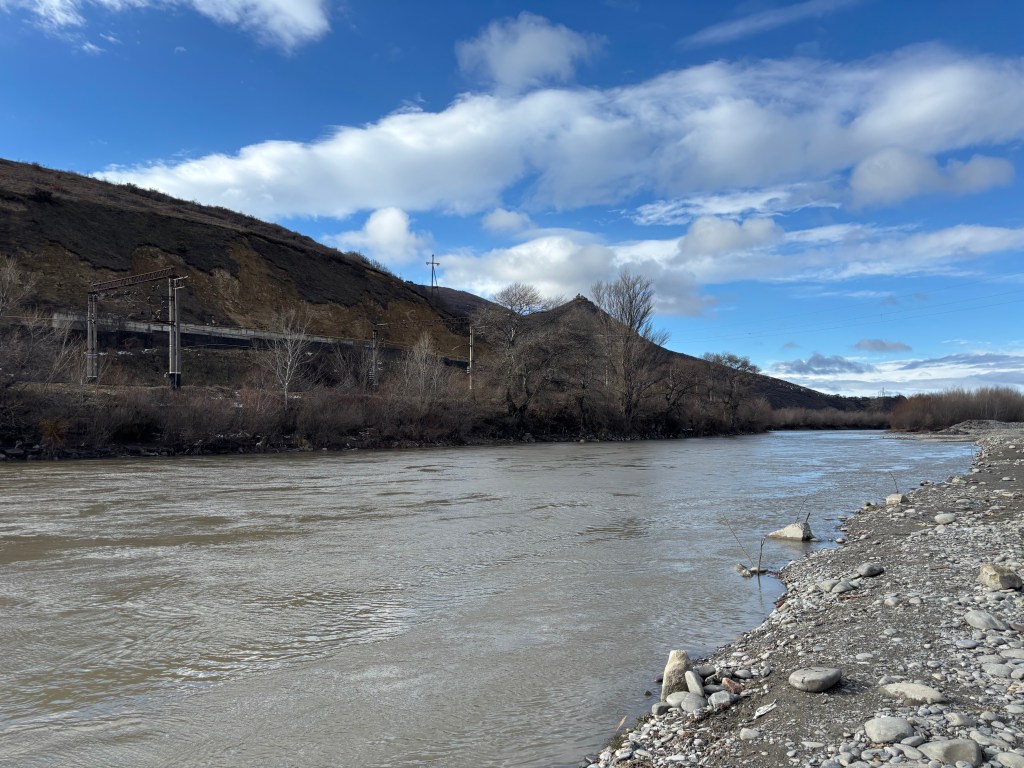
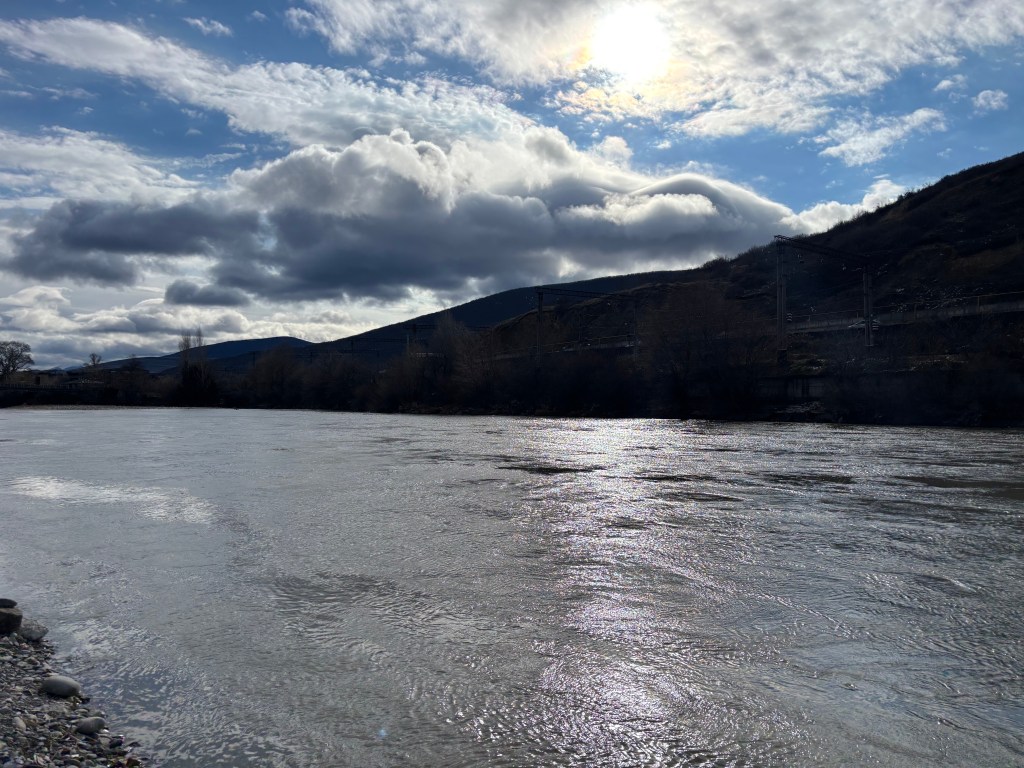
[Photo: fishing spot of the Mtkravi River, Gori]
I learned roughly through YouTube and advice from GPT, investing about $200. My goal was not to catch many fish. I saw it instead as a way of learning how to converse with the river. I wanted to imagine the underwater terrain and the movement of fish through the fishing rod.
On the first day, everything went wrong. The line tangled. The current was too fast. The lure floated and drifted away uselessly. Still, I plan to keep going. The wind was strong that day, yet I lost all sense of time for an entire hour.
(5) Walking
In Seoul, many people walk while wearing headphones and staring at their phones. KakaoTalk. YouTube. Instagram. ChatGPT. I am no different. But in Gori, I noticed something. People simply walk while looking ahead. Very few wear headphones. There is no culture of sending messages and waiting. If something is needed, they just call.
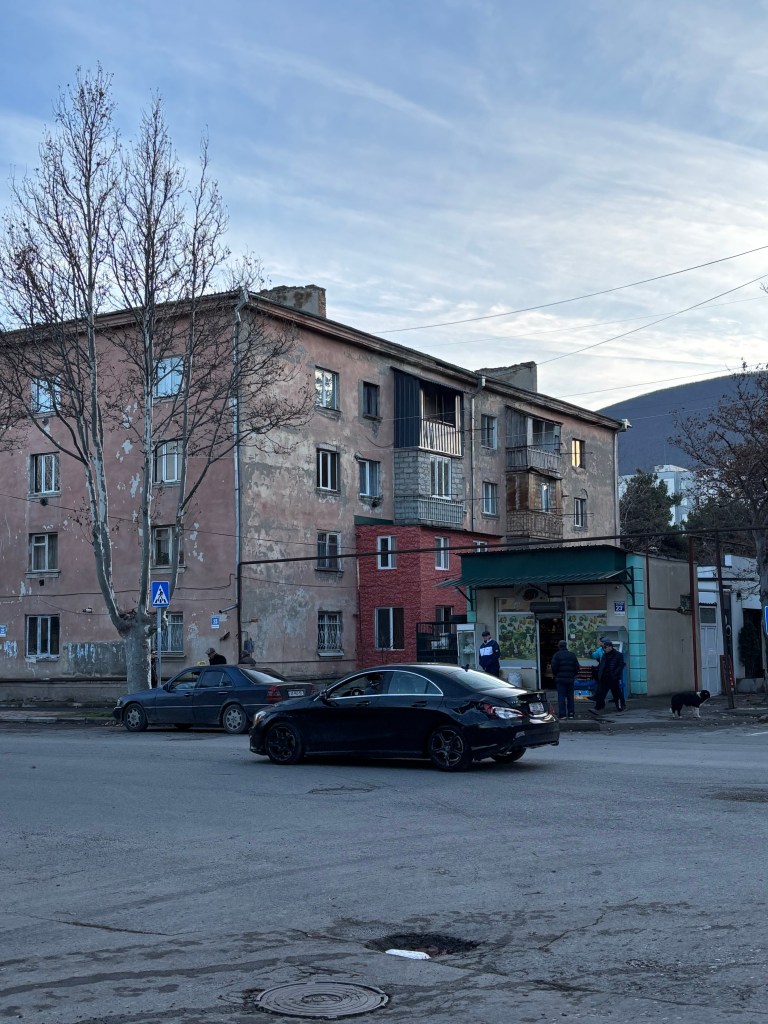

[Photos: Walking scenes 1, 2, Gori.]
So I stopped listening to music. I walk while simply observing the scenery. Surprisingly, this kind of walking produces many questions about the world.
Why is this like this? Could it be seen differently?
The idle thoughts I had forgotten during basketball begin to flood back in. In the age of AI, moderately correct answers no longer matter. Value now comes from the ability to complain, to question, and to remain curious. For small business owners engaged in creative production, I recommend walking— through the city, along rivers. Avoid repeating the same routes. Changing scenery prevents boredom and enhances the sense of bodily control.
(6) Not Watching the News
Bodily care also includes how we gather and process information. For that reason, not watching the news is important. Although news claims to deliver “objective information,” its format is designed to provoke anger and induce fear. Humans are highly sensitive to information that threatens survival. Calm, neutral reporting rarely attracts attention. When you stop consuming news, you notice something immediately. Anger and fear suddenly vanish from daily life.
Let me share my experience after avoiding the news for two weeks. When I first arrived in Gori, I was busy learning the terrain, finding a place to live, and buying daily necessities. I did not have time for news or YouTube. The language barrier helped. During that period, time seemed to slow down. The world felt unexpectedly peaceful. I was not resting. I continued writing and researching.
As news disappeared, the empty space of meaning began to fill with other things. Anxiety decreased.
I started looking for elements of life that I could physically control. Recently, however, friends began sending photos and news from Korea. My immersion broke. I even found myself leaving angry comments about politicians. I need to cut the news out again.
4. Conclusion
This article examined why restoring bodily control reduces anxiety and enriches the meaning of life. The body is the foundation of survival. It allows us to experience being alive. It enables us to interpret the world and assign meaning to it. When we focus solely on consciousness while neglecting the body, anxiety inevitably intensifies. I then shared several routines through which I manage my body to regulate anxiety:
- Quitting smoking
- Quitting alcohol
- Bodyweight training
- Solo sports (basketball, fishing)
- Walking
- Avoiding the news
I do not follow these perfectly every day. I collapse often, then pick myself up again. But when practiced consistently, anxiety almost disappears. Even for someone like me— with no current income, living abroad without the language, with little money, and completely single. Most people are in better circumstances than I am. If these practices reduce my anxiety and make life feel fuller, isn’t it obvious what they might do for you?
5. A Complete Summary of The Phenomenology of Anxiety
This was full series about Anxiety.
[See: The Phenomenology of Anxiety (Foreword): No Job, No Salary, No Security]
[See: The Phenomenology of Anxiety (Part 2): Your Anxiety Isn’t Emotional — It’s Structural.]
[See: The Phenomenology of Anxiety (Part 3): The Silent Killer of Small Businesses — Buying Traffic Kills Your Narrative]
[See: The Phenomenology of Anxiety (Part 4): Survival is a Structure — How to Endure the “Silent Phase” of Business]
(1) The Anxiety We Misunderstood: “Not Status, but Dependency”
We believed, following Alain de Botton, that anxiety came from living worse than others — from status anxiety. That belief is wrong. The true nature of anxiety is dependency on the world.
When survival must be entrusted to others— to a company, to a bank, to parents, to the state. When we cannot control our own body and time. When we must beg, ask, or lower ourselves just to remain alive. At that moment, we experience an ontological fear— a sense of indebtedness. That is what anxiety really is.
(2) The Three Pillars That Sustain Anxiety
We are anxious because we have lost control over three fundamental domains.
- Body : Can I move my body when I want to? —or has health and freedom already been taken from me?
- Narrative: Can I explain where my life is heading? —or have I lost all sense of direction?
- World : Is the value of my life determined by others? —or have I surrendered the right to define it myself? When control over these three collapses, anxiety becomes permanent.
(3) The Solution: Abandon Dopamine (Expectation) and Build Endorphins (Structure)
Most people respond to anxiety by chasing higher status and greater success. But this only creates deeper dependency— on investors, on public approval, on constant validation. It is nothing more than a dopamine treadmill. The real solution is to cut the chain of dependency.
- Jig (Internal Structure) : A personal routine repeated every day, independent of external evaluation.
- Independence : The minimum skills and assets required to survive without asking others for permission.
- Sensation : A life felt directly through the body, not endlessly compared in the mind— walking, making, writing.
(4) A Final Word
“Anxiety is not a feeling. It is a signal.”
It is an alarm telling you that your life depends too heavily on something external, and that your survival structure is no longer truly yours.
Do not seek comfort when you feel anxious. Do not look for pills. Do not hide in meditation. Do not try to escape upward. Instead, quietly begin building your own jig— a structure that prevents mistakes and absorbs uncertainty. Learn skills that allow you to survive without bowing your head. Secure time that no one can interfere with.
Find a small structure that can feed you on its own. The world is uncertain. But the structure you carve with your own hands is certain. Only within that structure can we finally escape the gaze of others—that hell— and live freely, like Zhuangzi’s turtle, dragging its tail through the mud. And when that freedom begins to support the survival of others, we move beyond the turtle and recover meaning as human beings. Success is luck. Peace is design. Now, begin your design.
Anxiety isn’t a mood — it’s a signal your body no longer leads your life.

If you enjoyed this article, you can support the project – thank you!