
Disclaimer: This is not investment advice. This is a survival log written by a writer studying small-business survival philosophy. All investment decisions are your own responsibility.
I’m a slow user. Far from IT. Far from “tech innovation.” So when a friend heard I had finally bought Bitcoin—late, as always—he called me.
Friend: Who buys crypto these days? The trend is Tesla and KOSPI. Korea is #1 in global market performance. Get in.
Me: Yeah. I bought recently. Down 16% already.
Friend: Exactly. Bitcoin’s dead for now. No catalyst.
His advice was reasonable. I did the opposite. I sold everything. Nasdaq. ETFs. All of it. While others were raising glasses, I quietly packed my bags. I rebalanced. 70% Bitcoin. 30% Apple. Bitcoin is unpopular right now. Apple is “falling behind in AI.” “Talents are leaving.” I’ve read the headlines. Still, I had my reasons. I don’t want to talk heavy philosophy today. Let’s keep it light. This is just a survival story. I’m not an expert. Just one person’s judgment.
1. Bitcoin Is the Last Shelter for Small Operators
(1) Becoming a Tax Non-Resident
Under Korean tax law, Bitcoin capital gains are taxed at 22%. But if a Korean citizen stays abroad for more than 183 days, he becomes a tax non-resident. I plan to register as a small business owner in Georgia and pay income and capital gains taxes here.
I believe the Korean government is printing far more money than its economic fundamentals justify. I don’t want my assets swinging with a single sentence from a central banker, a party leader, or a president. This isn’t mere dissatisfaction. I believe democratic governments are inherently a political system that plunders small business producers. I miss the era before democracy, welfare, and massive bureaucracy — when taxes were low. That was a time when families were intact, people held religious faith, and there was a genuine belief that hard work could lead to success. So I wanted to keep assets that the state cannot read. For me, Bitcoin is my 21st century Walden. They sit in a cold wallet. In my pocket.
(2) Bitcoin Is Doing Nothing—and That’s the Point
As of February 2026, asset prices have fallen sharply due to liquidity tightening.
(As of April, my return is -10%.)
The U.S. Treasury is issuing massive bonds.(Liquidity absorption). Bitcoin crashed. Prices dropped close to mining cost. MVRV hit its lowest level since 2022. And yet—nothing happened. No narrative. No excitement. No drama. Mining rigs kept running. 1 BTC stayed 1 BTC. Transfers between Georgia and Korea? Slow, but fine. Bonds cry and laugh at every Fed speech. Stocks dance to every CEO’s mistake. Bitcoin stays silent. It’s the coldest asset I know. Stripped of human greed and fear.
I like that boredom. As Murray Rothbard argued, in a situation of high medium-to-long-term uncertainty, holding the hardest money is the surest way to preserve purchasing power.
Liquidity tightening won’t last forever. Democracy was designed on the assumption of growth. When growth stops, past promises turn into debt. So liquidity cannot stop. Eventually, at some point, the government will try to stimulate the economy and reduce real debt by printing money and expanding credit, even if it means accepting inflation.
I don’t want to place my entire survival in the hands of the state. Especially in times of high uncertainty like these. 2026 matters to me. This year, my blog must finally get indexed. I have too many books to read. Too many goals to execute. I need something reliable. Something non-human. A place with no earnings calls, no elections. So I parked my money in Bitcoin—to stop thinking about it and focus on my work.
The key is that the uncertainty I feel is subjective and relative. That is why I shouldn’t obsess over daily returns. Even though a price drop leaves a bitter taste in the short term, I feel more at peace than I would facing the uncertainty of holding Korean Won or KOSPI stocks. If everyone felt the exact same level of uncertainty, it would become a self-fulfilling prophecy, and I wouldn’t have even had the chance to buy Bitcoin.
2. The OpenAI Bloc and Tesla — Something Feels Off
The second is the story of Apple. I sold every S&P 500, Nasdaq ETF. And bought Apple stock. Why ?
(1) The OpenAI Bloc Feels Strange
I Miss ChatGPT 4.0
ChatGPT doesn’t taste the same anymore. It used to talk nonsense with confidence. People called it hallucination. I called it a friend who could talk. I’ve used ChatGPT since 4.0—for translation, research, etc. I believed in AI as a life coach. It helped me a lot. (I even ended up living in Gori because GPT recommended it. No regrets.)
Since 2025, I’ve been tracking how GPT has changed. And I deleted GPT. By 2026, the tone clearly shifted. Neutral. Defensive. Safe. This is not the GPT Sam Altman promised as a life coach. These days, it only gives legally safe advice. Technically correct. Practically useless.
Ask about Bitcoin terminology and it dodges: “This is a very sensitive topic. I can’t give a clear answer.” Over nothing. This isn’t just user frustration. It’s alignment tax. When an AI tries too hard to be neutral, it distorts answers, lowers information quality, and burns extra compute just to stay safe. These days, I rely on Google Search, Claude and Gemini. It wasn’t always like this. Back then, it had aura.
The Leaders Talk Too Much
In grad school, I was part of a stock investment club. I reread Peter Lynch and Enron case studies over and over. A few lessons stuck.
- Don’t trust financial statements. Complexity hides deception.
- When a CEO’s name floods the media, the stock eventually falls. Media praise → step back. Media pessimism → consider buying.
- Buy stocks like janitorial companies. Dirty. Boring. Quiet.
I don’t read charts. I don’t worship balance sheets. I trust small-business survival instinct. The MS–OpenAI–NVIDIA–Oracle revenue loop feels too circular. Michael Burry’s point—that depreciation should be recognized more aggressively—makes sense to me. If you’re interested, see Burry’s interview. I’m not saying he timed it right. I’m saying the logic isn’t wrong. Lately, the same names keep showing up everywhere: Sam Altman. Jensen Huang. Larry Ellison.
Meanwhile, the so-called anti-OpenAI side—Google, Peter Thiel, Tim Cook—barely appear. They’re probably doing fine. They’re just careful. One slip and it’s regulation or lawsuits.
The OpenAI-friendly camp is everywhere. Every hour. Every platform. To sustain valuation. To maintain the myth. To claim the future of humanity. Having a lot of media exposure is not a good sign.
Peter Lynch said it best: Never trust companies that constantly try to sell you the future. When the media praises them, step back.
That is why I feel the Nasdaq market, led by OpenAI and its allies, relies far too heavily on narrative and showmanship — despite the fact that their actual product competitiveness is woefully lacking.
(2) Tesla Enters Robotics?
When talking about narrative and showmanship, Tesla cannot be left out. Koreans love Tesla. They love autonomous driving even more. But in reality, not many people actually drive Teslas.
Driving one for style is fine. But even Tesla fans admit the value proposition isn’t great. Doesn’t that feel strange? What worries me more is this: Tesla is quietly discontinuing some EV lines and jumping into humanoid robots.
No company on Earth has fully commercialized humanoid robots at scale. Prototypes and demos are easy. Mass production and quality control are a different universe. Even FANUC—dominant in industrial robotics for decades—is cautious about humanoids. They look like coffee bean vendors waiting to sell robot arms. (Robot arm Buyer will be Tesla)
I’m not saying Tesla can’t do it. They lead innovation again and again. I believe they’ll get there eventually. But hardware moves slower than software. Agile processes don’t translate cleanly. Words move faster than factories. And the market prices the words first.
(3) Summary
When Tesla and the OpenAI bloc make up 15–20% of total market cap, Nasdaq and S&P ETFs feel uncomfortable. So I sold.
3. Why I Kept Apple
I sold all Nasdaq and S&P ETFs. But I kept Apple. The mystical aura died with Jobs. Still, Apple holds two positions at once: Luxury and essential infrastructure. A PER of ~36 (Feb 2026) isn’t crazy. I’ve already pushed back on the “Apple will become Nokia” argument in [Will ‘Apple’ 🍏 Really Die Because of AI? — Phenomenological Analysis]
- Apple is the only firm vertically integrated across OS, hardware, and app store.
- It isn’t behind in AI—it’s choosing standardized AI suppliers.
- When AI objects open the market, Apple will enter late and dominate.
- Vision Pro, HomePod—targeting the home—is the right move.
- An iPhone Foldable + on-device Gemini = the first real combination of form-factor innovation and embedded AI in iPhone history. Could be a total game changer. (If it launches at $2,500, the margins could be insane.)
(As of now(June), Due to an unexpectedly rapid price increase, after achieving my target rate of return, I invested in an altcoin called Stacks (STX))
4. Why Google Felt Expensive
After Tesla, Koreans love Google stock. Google controls its own AI chips. Power efficiency is better than NVIDIA. Long-term leadership in AI seems likely. OpenAI won’t disappear. But relying on general-purpose NVIDIA chips is costly. Over time, Google probably becomes #1. OpenAI #2.
Still, at PER 42–45, Google feels expensive. Because Search—the core business—feels neglected. They say they’re filtering AI spam and boosting originality. I’m not sure search quality is actually improving.
Among web writers, there’s talk: Crawling and indexing are slower than ever.
(My “clean” blog not showing up for 10 months feels excessive, honestly) If PER drops to ~35, I’ll reconsider.
5. Conclusion
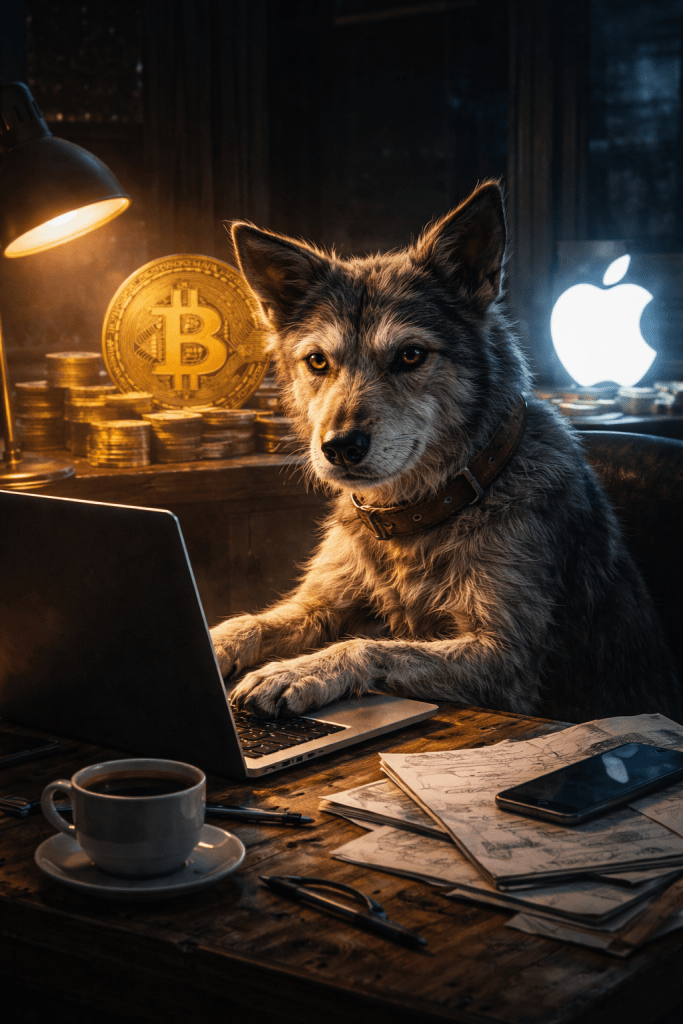
I see myself in the stray dogs of Gori. They sleep with eyes closed during the day. They move only at night. I’m the same. No visa. No nation. No company paying half my insurance. So I chose the quietest asset. If this resonated with you, I’m glad.
Conclusion: 2026 — Bitcoin 70%, Apple 30%.

If you enjoyed this article, you can support the project – thank you!