
Dear Saltnfire
Hey brother. I read [The Phenomenology of Anxiety, Part 4] The part where you mentioned buying Bitcoin caught my eye. When I read your work, you come across as a survival philosopher— almost a conservative anarchist. So I have to ask. Why Bitcoin? Did you buy it because you think it’ll go up?
— from a reader
Dear Bro
Disclaimer: This is not investment advice. This is a personal essay, written from what I’ve witnessed while living in Georgia.
Yes. I bought Bitcoin. I’m a cowardly investor by nature. I don’t touch assets with no cash flow. I avoid volatile, speculative bets. I like Buffett’s classic discounted cash flow models. Back in grad school, I even belonged to a value investing club. From that worldview, Bitcoin should have an intrinsic value close to zero. To borrow Buffett’s words, it should be “rat poison squared.”
And yet—Here I am, standing in the freezing winter wind of Georgia, watching a financial world that feels increasingly… stateless. I buried a portion of the money I earned through hard labor into Bitcoin— money I can afford to pretend never existed.
Only that much. Money I won’t need for the next twenty years, even if it goes to zero. So why would someone who believes in value investing, who already holds Nasdaq and S&P 500 ETFs, burn real money on what looks like a digital seashell? The answer didn’t come from an economics textbook. It came from the streets of Gori, Georgia—Stalin’s hometown.
1. Sanctions Don’t Work
In Gori, the currency exchange boards never stop blinking.

[Photo: Small Money Exchange Market, Gori]
USD. EUR. GBP. JPY. And RUB. The West claims Russia has been cut off from the global financial system. But here, near the border, reality looks different. You hear Russian spoken openly. Russian rubles are exchanged legally. The rate—roughly 1 GEL to 30 RUB—stays surprisingly stable. Thick stacks of cash slide across the counter and disappear.
People understand this instinctively: When fiat money starts turning into paper, you convert it into anything that survives. Rubles become dollars. Dollars become Bitcoin. But cash is heavy. Every border crossing comes with inspections, fear, and sometimes bribes. Bitcoin slips into that crack— an asset with no borders, no checkpoints, no sanctions. Standing in front of that exchange office, I realized something simple: Markets don’t follow morality. They follow survival.
What this phenomenon demonstrates is that Bitcoin is already acquiring utility as an economic good. If it proves its marketability to become a form of hard money—an attribute that fiat currency lacks—an appreciation in its value will be inevitable.
2. Georgia: A Strange Crypto Haven
What’s more interesting is this country’s attitude. As a foreigner, all I need is a local debit card from the Bank of Georgia. With that, I can buy Bitcoin on Binance or anywhere else—no friction. No layers of identity verification. No warning pop-ups about “foreign exchange law violations.” No threats.
Even better: capital gains tax on crypto for individuals is 0%. The government doesn’t bother blocking it. They know their currency—the lari—will never be a reserve currency. So instead of pretending otherwise, they’ve positioned themselves as a hub. A place where global capital passes through. And it’s working.
3. I Didn’t Buy an Investment. I Bought Insurance : Two scenarios
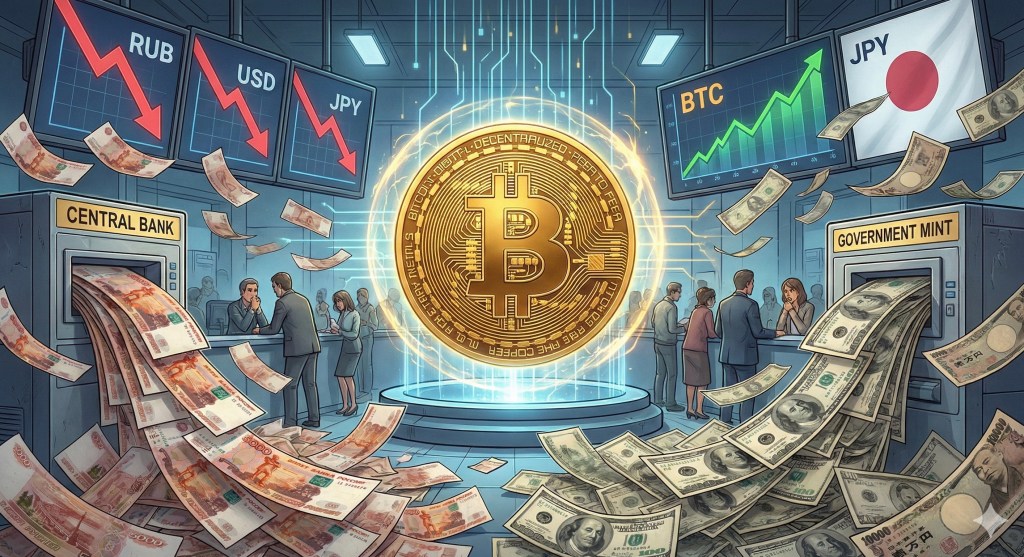
Let’s go back to the beginning. I still believe in value investing. Bitcoin pays no dividends. It generates no interest. But as insurance against currency collapse?
That’s a different story. The U.S. prints dollars to service debt. Japan and Korea follow. In late 2025, Japan raised interest rates for the first time in 30 years. It barely made a dent. The market knows the truth: Japan’s government debt is too large to sustain real tightening. Korea’s currency is melting even faster. The government pumps money into the system, throws national pension funds at the exchange rate, and still can’t stop the slide.
How long can that last? If you can’t be a reserve currency, the rational move is to become Georgia or Singapore—remove friction, drop taxes, and attract global capital. But Korea wants to be a reserve currency—without the structure to support it. That’s the tragedy. So I made a decision.
Bitcoin isn’t an investment for me. It’s a time capsule. A disposable premium paid against a potential seizure in the global financial system. You don’t understand how little governments can be trusted until you’ve lived at the bottom.
- Scenario A: Bitcoin goes to zero. I lose money. I keep writing. I drive a truck to make a living or back to kitchen. It hurts—but it was money I could afford to lose.
- Scenario B: Money printing never stops. Bitcoin goes 100×. And I keep writing.
For a cowardly investor, this is the most conservative and the most radical survival strategy I’ve found in the wild.
4. Carrying Taleb’s Knife Inside Buffett’s Chest: The Barbell Strategy
There’s only one framework that explains my contradictory portfolio. It comes from the eccentric statistician Nassim Nicholas Taleb and his idea of the Barbell Strategy.
The core principle is simple: Eliminate the middle. The “middle”—moderate risk, moderate return— is where people lose everything when a Black Swan hits. That zone only worked in an era when governments didn’t print endlessly and when the narrative “study hard and you’ll succeed” still held. Today, the middle is where inflation quietly kills you. Taleb’s answer is extreme positioning: hold assets at both ends of the barbell.
One side as safe as possible. The other as risky as necessary.
Bitcoin’s volatility is very high. No one knows. But if you hesitate—if you try to be clever in the middle—the government will melt your money anyway. So I chose chaos over slow death.
People ask me, “Isn’t Bitcoin too risky?” From my perspective, the most dangerous thing isn’t Bitcoin. It’s blind faith in the system. State-backed monetary systems are far more fragile than advertised.
During COVID, small business owners trusted the government. Everyone is currently struggling to repay their debts. However, observing the large-scale debt relief projects currently being executed by the government is deeply concerning. Under such logic, one might as well take a massive gamble to turn their life around—if it succeeds, great; if not, they can simply receive a debt bailout. It is difficult to justify a measure that utilizes the taxes and credit of diligent taxpayers to absolve individuals of the consequences of the risks they voluntarily assumed. Allowing individuals to pocket the fruits of successful speculation while shifting the liability of failure onto society—relying on this form of socialistic democracy is precisely what it means to bet on the “middle” position.
This is evidence that capital is not flowing to those with the highest productive capacity, but evaporating. So yes—when systems crack, you want assets that grow stronger under stress. Anti-fragile assets. Bitcoin is one of them.
5. Bitcoin’s Weakness: It’s Not Intuitive. And It’s Hard.
People do not yet clearly differentiate between Bitcoin’s utility as an economic good and its monetary characteristics. Consequently, some view it as a speculative asset correlated with the NASDAQ, while others perceive it as digital gold. Its utility as an economic good primarily lies in censorship resistance, resistance to taxation for tax non-residents, and portability. And, While its security has already been proven, it is equally true that nation-states are tightening their grip on fiat fiat-crypto gateways.
However, its monetary characteristics are still in the nascent stages of evolution. This is because conducting peer-to-peer (P2P) transactions directly on Bitcoin itself remains complex and slow. Ultimately, this monetary transition must be facilitated by a Layer 2 network that supports more convenient and intuitive transactions, while utilizing Bitcoin as the ultimate collateral on Layer 1. For now, its primary focus remains on serving as a store of value—acting as a put option against state-led inflation and credit expansion. Furthermore, considering the current economic situation in South Korea—characterized by rapid currency degradation driven by personal bankruptcies and debt relief programs—investing in this specific utility is rational.
6. Conclusion: The Age of Every Man for Himself
If I had stayed in a corporation, or pursued a PhD and a stable career, maybe I wouldn’t sound like a “conservative anarchist.” When Bitcoin first appeared, I dismissed it as a scam. But once you step outside the system—into the battlefield of self-employment—you realize how naked you are.
I had to learn survival fast. I’m grateful I learned it early. I have realized that no matter how much a nation calls itself a democratic welfare state, it does not assume responsibility for an individual’s life. The meaning of one’s existence must never be outsourced to others. In fact, relying on external entities for survival and purpose was the very root of my anxiety and stress.
from saltnfire
Sincerely

If you enjoyed this article, you can support the project – thank you!