
0. Introduction
What is the definitive variance between a gastro-pub selling items like pasta and gambas, and a pub applying the Toyota Production System centered around Central European cuisine such as German and Czech fare (hereafter referred to as the “Toyota Pub”)?
The core characteristic of a gastro-pub’s menu is that the prepped ingredients and work-in-process (WIP) inventory do not represent a finished state. This operational structure forces culinary labor to be locked into specific cooking stations during peak service hours. Consequently, because labor density spikes exclusively during the high-pressure “last mile” when orders converge, labor costs escalate and throughput velocity cannot be managed consistently. To mitigate this and compress the live cooking sequence, the system must accumulate high levels of pre-process inventory. This buffer is required so line cooks can immediately retrieve components for pan-frying or grilling. However, because food assets remain stagnant in a semi-processed state, it introduces significant operational waste and qualitative degradation.
In contrast, a Toyota Pub utilizing a German-centric menu framework—such as stews (Goulash), roasts (Schweinsbraten), boiled potato dumplings (Knödel), breads, or breaded cutlets (Schnitzel) and fried cheeses—completes the core cooking sequence during the initial prep phase. Furthermore, due to the historical evolution of these dishes in regions with extended winters and low ambient temperatures, they possess a longer shelf life, enabling extended storage capability. As a result, items are stored as finished products rather than work-in-process inventory, allowing them to be executed on a “heat-to-serve” basis upon order entry. Because culinary workers are not locked into a single station, labor expenses are minimized. The primary managerial focus shifts to time-allocation management, ensuring the workflow across fryers, burners, and ovens remains uninhibited, which empowers a single operator to execute multiple menu items simultaneously. For a practical demonstration of this mechanic, please refer to the previously introduced case study: Preparing Five Menu Items in Fifteen Minutes.
This Toyota Pub production framework is governed by eight core operational principles and utilizes a cellular manufacturing model.
- Bottleneck Management
- Heijunka (Production Leveling)
- Kanban System
- Andon System
- Poka-Yoke (Fail-Safe Systems)
- 5S Activity
- Standardized Front-of-House Operations
- Toyota Pub-style Kaizen—and how they work in a real-life kitchen.
1. Bottleneck Management
(1) Modularize Cooking Processes
In TPS, each production step is modular—composed of autonomous, self-contained units rather than linear dependencies. In a pub kitchen, modular cooking means one machine = one menu item. For example:
- Stove 1 = Goulash
- Stove 2 = Chicken Paprikash
- Fryer = Schnitzel
- Oven = Schweinshaxe
Because final execution is completed within each independent production unit, complex interprocess dependencies—such as joint processes that restrict workflow—are eliminated. Furthermore, since the operational core relies on reheating pre-cooked items, culinary labor is not required to manually monitor pans or ovens during the last mile.
In the Toyota Production System, this mechanism of allowing machinery to operate autonomously through a fixed cycle time while human labor monitors for abnormalities is defined as “Jidoka.” The role of the operator shifts to managing the overall takt time to ensure all menu items are served concurrently, followed by a final quality check immediately prior to service. Consequently, a single trained operator can achieve multi-tasking capabilities, controlling multiple independent units simultaneously.
Conversely, if a chef is manually stretching dough or pan-frying every dish by hand, this is not modular—it creates bottlenecks. When operators manually toss pans or stretch dough, the overall kitchen workflow becomes subordinated to the preceding process. Operators in other sectors must remain idle until that specific operation is finalized, meaning the overall production lead time is dictated by the processing speed of that singular bottleneck.
Ultimately, these bottlenecks regress the kitchen architecture from a “one machine = one menu” framework into a labor-intensive “one human = one menu” structure. Alternatively, to mitigate operational anxiety, systems are forced to accumulate excessive safety stock of finished goods. Within a restaurant context, this introduces severe waste (“Muda”) in terms of spatial allocation and labor expenditures.
(2) Use Multiple Small Appliances, Not One Large Machine
Within the framework of the Toyota Production System, operating multiple small-scale units with rapid lead times in parallel is considered superior to utilizing a single massive unit. While large-scale equipment offers larger batch capacities, it prolongs lead times and tends to accumulate high levels of inventory; furthermore, its utilization rate drops substantially when production volume decreases.
In this operational philosophy, an inability to maintain a stable, consistent utilization rate is identified as a primary driver that forces the system to increase its safety stock.
For example, when mixing dough:
- One large mixer (1 batch): 15 mins
- Two small mixers (split batch): 10 mins
The physical mechanism behind this variance lies in the efficiency of energy transfer. In dough mixing, a smaller volume allows mechanical shear stress to be distributed instantly and uniformly, which accelerates gluten formation.
For sauces, batters, and creams, this energy transfer shifts to thermodynamics: a smaller volume enables a faster rate of heat transfer due to a higher surface-area-to-volume ratio.
While processing larger batches initially presents the illusion of operational efficiency, it frequently introduces bottlenecks due to extended heat transfer requirements and prolonged preparation windows. Consequently, operating multiple small-scale units in parallel yields a shorter overall cycle time than batch processing with a single massive unit.
Applying the same principle, operating a configuration of manual washing paired with two small-scale rinsing machines in parallel incurs lower depreciation costs and achieves higher throughput velocity than relying on a single large-scale dishwasher. While a large dishwasher forces a ‘batch processing’ trap where dishes must accumulate and freeze vital kitchen inventory, a parallel small-scale configuration enables an immediate ‘one-piece flow’ that eliminates lead-time bottlenecks.
Similarly, in the cooking process, preparing two separate five-serving batches of Goulash stew simultaneously using two burners requires a shorter overall cycle time than boiling a single ten-serving batch on a single burner.
(3) Active Line Balancing (Sho-in-ka)
Within the framework of the Toyota Production System (TPS), operations are standardized to ensure that the deployment of any personnel to any given process does not disrupt or diminish the overall workflow velocity.
A case study observed by myself at a Yakisoba specialty restaurant in Japan illustrates this mechanism. At this establishment, male and female operators executed the griddle-frying process sequentially and precisely, functioning as a single integrated unit. While one operator’s labor was dedicated to the main griddle, the other managed beer service, dishwashing, and transactions. Concurrently, aligned with the exact timing of the primary cook, the second operator positioned the supplementary ingredients at designated locations, minimizing the cook’s movement and accelerating the production rate.
This system of dynamically allocating labor to eliminate bottlenecks within the kitchen is defined as “Shoinka” (labor flexibility) in TPS. The core metric of Shoinka is to flexibly adjust the volume of personnel in response to fluctuations in order volume, thereby preventing the waste of fixed costs. In particular, deliberately compressing labor capacity serves as an evaluative tool to test where process bottlenecks occur and where hidden waste (“Muda”) exists within the kitchen layout.
Consequently, the head chef of an ideal Toyota Pub does not need to remain static in the kitchen to manually supervise line cooks. Operating within an established standardized system, when idle time is detected, the head chef immediately directs that labor to flow seamlessly into alternative processes. Through this method, the system maintains a consistent overall production lead time with minimal personnel. When employees possess a comprehensive understanding of the entire production sequence, the flexible reallocation of labor can be executed with greater efficiency. This principle is defined as cross-training or developing multi-skilled operators.
(4) Sequence Work by Reverse Lead Time
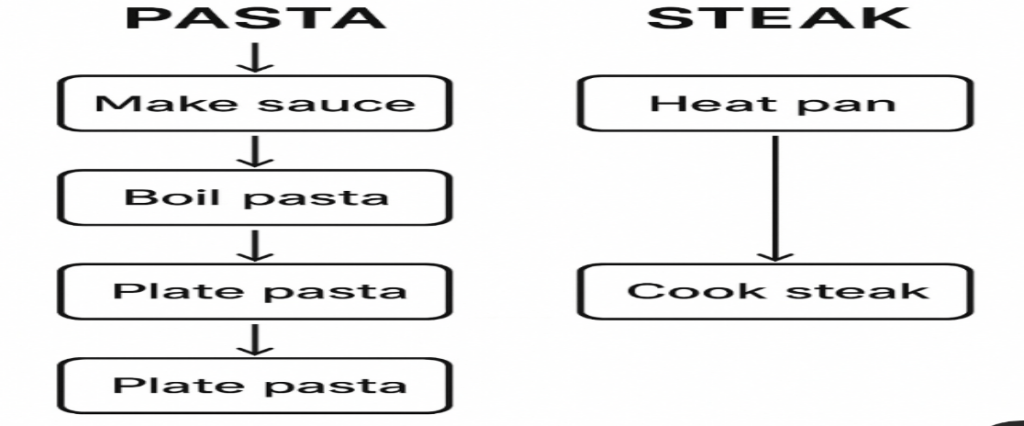
To maximize operational efficiency, multiple culinary tasks must be executed through parallel processing based on their respective lead times. For example, if boiling pasta requires ten minutes and preparing the sauce requires twenty minutes, executing these tasks sequentially would result in a prolonged total cycle time of thirty minutes. Instead, the process must be engineered by initiating the sauce preparation first. While the sauce reduces, the operator boils and chills the pasta, synchronizing the workflow so both components reach completion simultaneously.
The same balancing logic applies when a table orders a steak and a pasta dish concurrently. The operator first initiates the pasta sauce, utilizes the reduction window to preheat the steak pan, and then coordinates the plating of the pasta to coincide with the steak reaching a medium-rare internal temperature.
The core principle of this kitchen sequencing is to prioritize the task with the longest lead time, subsequently transitioning to shorter operational tasks while the primary machinery or process runs autonomously.
2. Heijunka – Production Leveling
Heijunka means maintaining a consistent production flow despite variable orders. For example, consider a scenario where you must produce three units of Product A and three units of Product B. Fordism dictates a sequential production pattern of AAA followed by BBB, as this is a specialized batch production method. However, in a subsequent process that requires A and B sequentially, downstream operators must remain idle until the entire batch of B is completed. Furthermore, the excess units of A remain stagnant in the system as work-in-process (WIP) inventory.
Toyota Motors proposes an alternative production sequence: ABABAB. Under this framework, as each set of A and B reaches completion, it is immediately absorbed by the subsequent process. To apply this leveling philosophy to a pub environment, three operational mandates must be executed:
(1) Reject Orders that Disrupt Flow
Because a pub model is characterized by high-mix, low-volume production, processing times vary significantly across different menu items. Consequently, operators must reject variables that destabilize the production cadence, such as unexpected bulk orders from large groups, taking advance orders before guest seating is confirmed, or accommodating excessive customization requests. Within the Toyota Production System, these inputs are classified as “special orders.”
Special orders demand proactive coordination between the Front of House (FOH) and Back of House (BOH). An accumulation of these variables disrupts standardized cycle times, triggering process bottlenecks across all production units, including burners, ovens, and plating stations.
While this fluctuation poses fewer challenges for a Fordist establishment structured for mass-producing a singular item, special orders dismantle the leveling flow within a Toyota Pub, where a single operator simultaneously manages four to five distinct menu items in an ABC-ABC sequence. This disruption forces the system to increase its safety stock to buffer against unpredictability.
(2) Eliminate Real-Time-Only Dishes
Menu categories such as pasta, steak, and burgers require highly concentrated labor inputs during the final execution stage. Consequently, they demand a station-centric, division-of-labor layout. This structure is incompatible with a pub operation that requires the simultaneous execution of diverse menu items in an ABABAB sequence.
To facilitate leveled production, the menu architecture should be converted to a “heat-to-serve” model wherever feasible. For instance, chicken rolls or steaks should be transitioned to a low-temperature sous-vide par-cooking process in the oven, requiring only a rapid finish at the point of service. If house-made execution proves inefficient, substituting select components with high-quality frozen items paired with pre-prepared signature sauces serves as an effective alternative.
(3) Zero Setup Time
In TPS, there is a core methodology called SMED (Single-Minute Exchange of Dies), which establishes that tool transition windows must be minimized when switching production between disparate items like A and B. In a kitchen environment, this is achieved through three sub-principles:
- Eliminating equipment sharing between distinct dishes
- Preventing overlapping cooking sequences
- Standardizing operational movements.
During peak service hours, the system lacks the time allocation required to wash a singular pan and transition it from gambas to pasta. Operating dedicated gambas pans and pasta pans independently minimizes tool changeover windows, effectively reducing “internal setup time” to zero. Furthermore, if a sauce specification is standardized to achieve emulsion within fifty agitations, operators must not waste labor on one hundred agitations, which extends their lock-in time at a station. This excess movement constitutes over-processing waste and diminishes the velocity of tool transition. The head chef must eliminate these changeover losses across all kitchen movements to preserve a leveled, single-operator multi-product system.
3. Kanban System (Information Flow)
Within the Toyota Production System (TPS), a Kanban functions as a production instruction or withdrawal ticket issued when a downstream process retrieves components from an upstream process. In a restaurant environment, this mechanic is executed not through physical cards, but via real-time synchronization between the Front of House (FOH) and Back of House (BOH).
For instance, when order density spikes or skews heavily toward a specific menu item, it is critical for FOH operators to enforce a Kanban limit by restricting further orders of that item or steering guest selections toward lower-load alternatives. If necessary, throttling guest seating at the entrance must be deployed. Accepting orders unconditionally based solely on seating capacity causes the kitchen’s processing capacity to fail, accelerating friction between the FOH and BOH while causing qualitative defects, such as undercooked or cold dishes, which diminishes guest satisfaction.
Conversely, when an item is depleted, the kitchen (upstream) must immediately notify the floor (downstream) to prevent the issuance of invalid Kanbans (failed orders), thereby eliminating redundant communication cycles.
Through this integrated communication framework, FOH personnel acquire a comprehensive understanding of the culinary sequence, enabling superior menu articulation to guests. Furthermore, by observing kitchen workflows, FOH staff can intuitively gauge the operational takt time, effectively mitigating kitchen bottlenecks at the FOH stage.
In my own kitchen, for example, when a floor operator observes me splashing water droplets onto a steel pan to test thermal readiness, they immediately extrapolate that the Currywurst will reach completion within five minutes, and proactively communicate an accurate wait time to the guest.
4. Andon System
In the Toyota Production System, Andon refers to immediately stopping the production line when an abnormality is detected, solving the problem in real time, and optimizing the flow again. Andon is not about “simply stopping”; it is about rapid response to restore flow.
In a kitchen context, Andon can be interpreted as a containment action triggered when a specific asset—such as a stove, fryer, oven, or salad station—experiences continuous overload, disrupting the operational workflow. Under these conditions, operators must execute an immediate line stop by halting further orders for that specific menu item.
The long-term resolution requires either expanding equipment capacity or pruning the product lineup to re-establish a modular “one machine = one menu item” framework. Single shared thermal resources, such as ovens, are susceptible to this vulnerability when different products demand disparate temperature profiles and processing durations. Because adjusting an oven’s interior temperature requires thermal setup time for preheating or cooling down, it tends to paralyze the entire assembly line.
In my own operation, I previously offered Cream Cheese Kolache, Apple Strudel, and Hoppelpoppel as side menu items. Because all three required different cooking durations and thermal specifications, overlapping orders generated severe process bottlenecks within the single oven unit. However, the sales volume for these items was insufficient to justify the fixed capital expenditure of purchasing additional machinery. Despite their moderate popularity among guests, I executed a product pruning by removing the Cream Cheese Kolache and Apple Strudel from the menu to restore overall production efficiency.
5. Poka-Yoke – Fail-Safe Systems
Within the framework of a Toyota Pub, Jidoka implies that operations run on a “one machine = one menu item” modular baseline, where human operators intervene during exceptional circumstances. Poka-Yoke (mistake-proofing) refers to the mechanisms engineered to block cognitive errors that human operators might commit during these exceptional intervention phases.
Achieving this system reliability demands two practices:
- Standardizing recipes, procedures, and checklists, and
- Deploying timers, thermometers, and scales.
For example, I enforce a 1:1 ratio between each equipment unit and a dedicated timer; consequently, even during solo operation, six independent timers run concurrently within the kitchen layout. Because standard processing times are hard-coded into each unit, operators bypass the manual action of adjusting time settings. Conversely, a number of kitchens operate with zero timers, relying instead on visual estimation, wristwatches, or mobile devices to monitor duration. During peak hours, these micro-movements increase cognitive load, trigger operational defects, disrupt workflow continuity, and ultimately prolong overall production lead time.
Furthermore, I carry a probe thermometer and a utility cloth on my utility belt to minimize the waste of motion while preventing human error. Previously, relying solely on a timer and visual verification, I sold a Schweinshaxe, determining it was fully cooked. However, the meat near the bone was insufficiently cooked, resulting in a guest complaint. This incident proved that relying on visual, temporal, or tactile heuristics is insufficient for verifying thermal readiness. Since that failure, I carry the thermometer continuously to verify the precise core temperature via deep insertion prior to service. As a result of this final inspection checkpoint, identical quality defects have been eliminated.
6. 5S Activity
Many view 5S (Sort, Set in order, Shine, Standardize, Sustain) as a simple hygiene checklist. At a Toyota Pub, however, 5S is understood as a production optimization tool. Executing 5S minimizes transition delays between tasks while maximizing spatial efficiency, thus reducing overall lead time.
✔ Detailed Breakdown:
- Sort: Eliminate unused menus, ingredients, and tools immediately. Don’t hoard.
- Set in Order: Fixed places for every tool. Use labels if necessary.
- Shine: Minimize the number of machines to maintain cleaning capacity.
- Standardize Cleanliness: Trim nails, wear hats, wash hands, use FIFO for ingredients.
- Sustain: Daily checklist maintenance.
7. Standardized Front-of-House Operations
Standardized work is not limited to the kitchen; the Front of House (FOH) must also operate systematically.
Specifically, kitchen personnel engaging in casual conversation with guests provides no operational utility. At a Toyota Pub, there is no allocation for emotional service. Once a dish is served, staff must immediately return to beer pouring or alternative workflows. Even if a subset of guests prefers detailed interactions, chasing emotional service disrupts the standardized flow and escalates labor expenditures.
At one establishment I observed, the floor layout consisted of only seven four-seat tables, yet it employed a total of three FOH operators. Despite not operating as a fine-dining establishment, these operators spent excessive time explaining menu items—without wearing masks—which represents a severe operational waste. In these scenarios, manual explanations can be substituted by menu descriptions or pre-recorded informational videos playing within the venue.
Every sequence within the FOH framework—including beer pouring, order entry, and food service—must be standardized. Consumers rarely generate word-of-mouth marketing or increase return visits simply because a specific waiter was perceived as friendly or entertaining. Conversely, they retain negative experiences involving overt unfriendliness. Therefore, executing the baseline standards is sufficient.
8. Toyota Pub-style Kaizen
Within traditional Toyota Production System (TPS) frameworks, Kaizen (continuous improvement) emphasizes on-site, worker-led initiatives, monthly problem-solving dossiers, and the horizontal deployment of established best practices across disparate manufacturing lines.
While this method remains ideal for capital-intensive, large-scale assembly environments, it is not easy for low-volume, single-operator restaurant models. Consequently, at a Toyota Pub, the scope of Kaizen is compressed into the “5 WHY” methodology—a diagnostic framework that interrogates process failures until the root cause is isolated and the entire operational flow is optimized.
A definitive case study illustrating this analytical mechanism in a commercial kitchen involves resolving the “Panko Crust Separation Anomaly” during Schnitzel production:
- First Why: Why does the panko crust delaminate and separate from the meat matrix post-frying? → Because the panko particles fail to adhere securely to the raw meat surface.
- Second Why: Why is the panko adhesion failing? → Because the intermediate egg wash binding agent lacks sufficient viscosity and adhesive tension.
- Third Why: Why is the egg wash failing to coat the substrate evenly? → Because the initial flour dusting failed to bond with the meat, causing the egg wash to slip off during immersion.
- Fourth Why: Why did the flour fail to bond with the meat surface?→ Because the superficial moisture levels of the meat substrate were insufficient to hydrate the starch and trigger bonding.
- Fifth Why: Why was the meat surface excessively dry prior to coating? → Because I hold the protein in refrigerated storage and manually padding it with towels extracted surface moisture.
Prior to executing this 5 WHY sequence, conventional culinary heuristics dictated that extracting surface moisture via paper towels was mandatory to prevent oil splattering and ensure crispness. However, isolating the causal chain proved that this habit was the root cause triggering the delamination of the crust.
Based on this diagnosis, I inverted conventional wisdom. By eliminating the manual towel-drying step, the natural, micro-scale moisture retention of the protein was preserved, allowing the flour starch to hydrate immediately and form a high-tensile bond with the egg wash. Consequently, the defect rate was reduced to zero percent, stabilizing Schnitzel quality without additional expenditures.
Ultimately, Kaizen in a Toyota Pub does not mandate organizational reform. Rather, it demands that operators cross-examine legacy kitchen habits through the logical architecture of the 5 WHY framework, identifying and rectifying the root causes that disrupt workflow quality.
9. Cellular Manufacturing Model
(1) Definition
Within the framework of the Toyota Production System (TPS), the operational mandate of high-mix, low-volume manufacturing dictates a continuous, inventory-free Just-In-Time flow. Under this architecture, a singular manufacturing “cell” is engineered to execute multiple disparate processes with minimal personnel. A single operator inside the cell controls the entire value stream—from initial preparation and assembly to final shipment. This flow is regulated by lead times, while the utilization of standardized work, modular components, and shared parts minimizes tool changeover delays.
Applying this model to food service highlights the limitations of traditional kitchen structures. Conventional kitchen layouts rely on station-centric division of labor—separating buns, patties, sauces, and packaging into isolated batch production units. While highly effective for low-variety, mass-production models like fast food, this structure fails under high-variety, low-volume conditions.
A Toyota Pub solves this friction by converting the layout into dedicated, product-oriented cells, where each cell retains responsibility for the flow of a menu category. For instance, the Wet Cell (stew and sauce) executes vegetable prep, simmering, service, and dishwashing within its own boundary. Concurrently, the Dry Cell (fryer and oven) independently manages its own sequence of preparation, cooking, plating, and sanitation. Managed under the central synchronization of the head chef, this isolation guarantees that one cell = one continuous flow = one responsibility. Because the Wet Cell and Dry Cell utilize distinct, non-overlapping equipment configurations, the risk of joint bottlenecks is eliminated.
Please note that this design does not mandate the immediate, literal installation of duplicate dishwashing stations. Instead, it emphasizes a modular line architecture engineered to minimize cross-process interference. In real-world kitchens operating with only one or two chefs, a single sink and a single dishwasher typically coexist in parallel; the core strategy lies in allocating and separating their usage depending on the production context to prevent cross-contamination of workflows.
(2) Why Cell Production is Essential in Pubs
Traditional fine-dining kitchens prioritize functional specialization. A sauce master, a stew master, and a bakery master each perfect their own part of the menu. This division of labor works under two conditions: customers expect slow, premium service, and lead-time synchronization is not the primary objective.
However, a pub operates on a different value proposition. Pub customers do not demand culinary perfection; instead, they seek a smooth service flow, consistent taste, and a relaxed atmosphere. Therefore, maximizing margins in a pub depends on optimizing production flow rather than chasing absolute quality. Cell production eliminates batch inventory, bottlenecks, and unnecessary labor costs, making it the most efficient operational model for pub businesses.
(3) Comparison with Traditional Kitchen Layouts
A traditional kitchen layout for a medium-sized pub with 20 to 30 tables is designed to minimize movement and optimize specialized tasks. A typical configuration includes:
- Prep Station: Vegetables, sauces, meats, and dough
- Pasta & Pizza Station
- Burger, Steak, & Fryer Station
- Dishwashing Station
In this structure, each worker masters a specific function. While this looks efficient, it introduces a critical flaw: the workflow is not synchronized. Because production speeds vary between stations, semi-finished products (work-in-progress inventory) pile up. During peak hours, bottlenecks occur at specific stations, food timing gets disrupted, and physical clashes in the kitchen become frequent.
A Toyota Pub solves this friction by converting the layout into dedicated, product-oriented cells. It eliminates functional division and deploys multi-skilled workers to maintain an uninterrupted production flow. Inside their assigned cell, a worker handles end-to-end (A to Z) production—from initial prep and cooking to plating and sanitation. The head chef monitors the kitchen and coordinates real-time pace adjustments (Sho-in-ka) to match incoming order volume.
This shift guarantees distinct operational benefits:
- No mid-process inventory buildup
- No handoff friction between stations
- Optimized lead times and lower labor costs
The only trade-off is a lower level of specialization per worker compared to traditional layouts. However, for a pub business where production flow dictates survival, cell production serves as the ultimate operational weapon for small business owners.
This lower individual specialization is naturally offset by the socio-economic structure of these businesses. In regions like Japan and Germany, establishments utilizing cellular operations are rarely dependent on high-turnover, part-time labor; instead, they are designed for long-term retention, often operating as family businesses or tightly-knit partnerships. This high-trust, permanent setup allows co-workers to accumulate deep, mutual tacit knowledge over years of collaboration. Consequently, what traditional layouts attempt to solve through division of labor, the Toyota Pub solves through the speed and synergy of synchronized, long-term partners—turning labor from a variable cost into an optimized, core asset.
| Feature | Traditional Kitchen (Assembly Line) | Toyota Pub (Cell Production) |
| Structure | Functional Division (Grill, Sauté, Pantry) | Independent Cells (End-to-End responsibility) |
| Workflow | A → B → C → D (Linear) | Cell A (Complete) // Cell B (Complete) |
| Inventory | Piles up between stations (WIP) | Zero mid-process inventory |
| Labor | Specialists (High efficiency, low flexibility) | Generalists (Total flow ownership) |
| Risk | One bottleneck kills the whole line | One slow cell doesn’t stop the other |
(4) Menu Design for Successful Cell Production: Focus on German Dishes
To implement cell production, the equipment within each cell must operate in parallel. Central European cuisine, particularly German, is well-suited for this layout. Although upstream preparation during off-peak hours is lengthy and complex, it eliminates the need to concentrate culinary labor at the last-mile stage. This structure allows operations to level the workload (Heijunka) and apply the principle of Jidoka. For example, instead of manually pan-frying a Schnitzel—which requires continuous monitoring—placing it in a timed deep fryer achieves Jidoka. Consequently, pan-fried Schnitzels are now rare even in local German and Czech establishments.
| Menu Category | Upstream Preparation (Batch) | Last-Mile Execution (Jidoka) |
| Stews (Goulash, Paprikash) | Slow-cooked and concentrated in large batches | Instant reheating and plating |
| Fried Items (Schnitzel, Fries) | Breaded and portioned in advance | Quick timed-frying upon order |
| Roasts (Schweinshaxe) | Low-temperature pre-cooking and holding | Rapid oven-crisping upon order |
Conversely, if a kitchen relies heavily on real-time cooking—such as pasta, grilled shrimp, or steak—the chef becomes tied to a single pan, making parallel production impossible. This dependency forces the kitchen to revert to the traditional, station-centric Brigade System. However, as stated previously, the Brigade System requires high functional specialization at each station, which inflates labor costs. To sustain this overhead, a venue must be large enough to feature at least 20 tables. If a small-scale venue insists on real-time cooking, it must narrow its menu variety to maintain operational efficiency. Combining high variety with real-time cooking in a small space leads to sub-optimization—such as the previously mentioned pasta gastro-pub that required five workers to manage only ten tables.
Operating a German-centric menu under cell production alters these economics. For a venue with ten 4-seat tables, a staff of two—one chef in the kitchen and one part-time worker front-of-house—is sufficient to handle peak volume. If the venue scales to 10–20 tables, the layout should be divided into a Stew/Sauce Cell and a Fryer/Oven/Grill Cell. In this setup, the head chef transitions from manual cooking to managing the overall value stream, utilizing Sho-in-ka (flexible labor reallocation) to balance the workload between the two cells and control the production flow.
10. Conclusion
Traditional French and Italian gastro-pubs rely on real-time cooking upon order. This operational dependency concentrates culinary labor at specific stations during peak hours, creating predictable bottlenecks. Consequently, this structure drives a cycle of excessive work-in-progress inventory, inflated labor costs, and quality degradation (Muda).
Conversely, the Toyota Pub model—built around Central European and German cuisine—restructures this production flow. By executing the core cooking processes during upstream preparation, the system shifts the last-mile phase into a standardized “Heat-to-Serve” sequence.
Integrating the core concepts of the Toyota Production System (TPS) into the kitchen layout yields the following operational frameworks:
- Bottleneck Management and Jidoka: Establishing a “one-machine = one-menu” configuration secures process autonomy. Integrating automated timers and standardized measuring tools eliminates human cognitive errors (Poka-Yoke). This setup allows a single operator to control and multitask across multiple machines simultaneously.
- Production Leveling (Heijunka): The system maintains a consistent production cadence within a high-mix, low-volume environment. This stability is achieved by rejecting disruptive special orders, eliminating real-time reliance, and minimizing tool setup time (SMED) between product transitions.
- Cellular Manufacturing: The kitchen layout transitions from functional specialization into product-oriented, independent cells (Wet Cell and Dry Cell). High-trust, multi-skilled operators (such as family-business partnerships) retain total ownership over the end-to-end flow within their cell, establishing a agile line that prevents inventory accumulation between processes.
Ultimately, the continuous flow (one-piece flow) and Kaizen (continuous improvement via 5-Why analysis) practiced in a Toyota Pub do not target absolute culinary perfection. Instead, the core objective is flow optimization. By systematically eliminating waste, compressing manufacturing lead times, and maximizing labor productivity, this model allows minimum personnel (1 to 2 workers) to generate consistent, optimized profit margins—serving as the ultimate operational survival strategy for small-scale pub businesses.
- Why Do Things Sell Better When Customers Don’t Know Much?
- MIT Built a Perfect Kitchen — But Not a Great Restaurant
- Introducing the CEFSR Framework for Market Competition (Replication Risk) Analysis
- Why Your Food Is Delicious But Forgettable: The “That’s It?” Theory

If you enjoyed this article, you can support the project – thank you!