
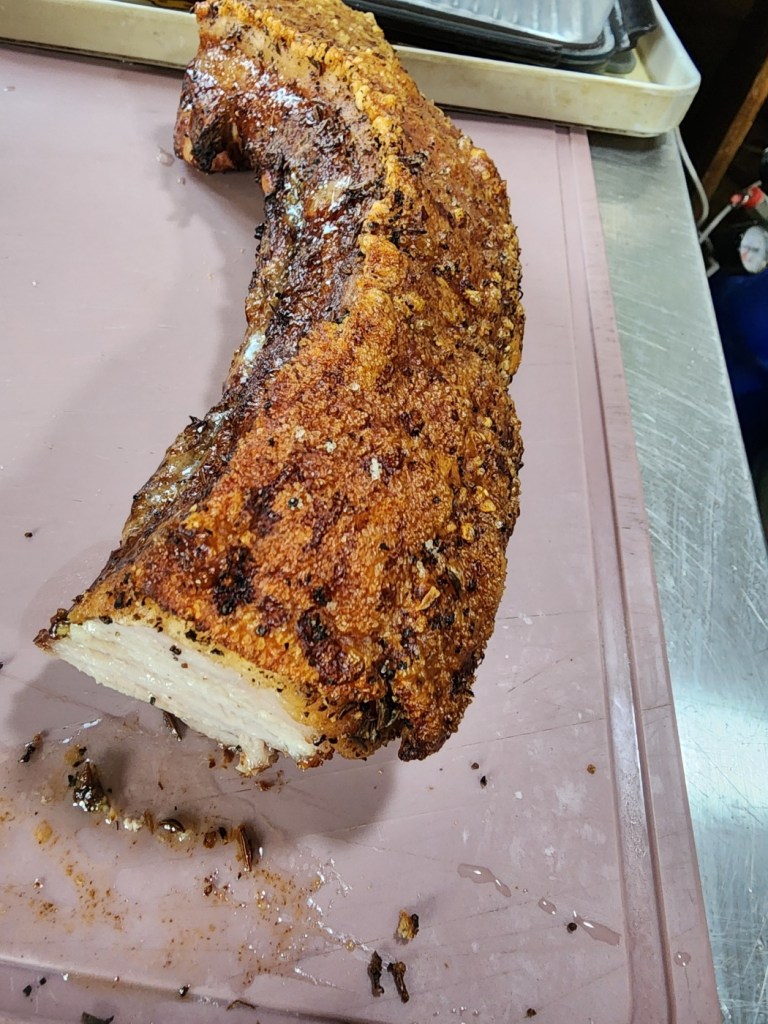
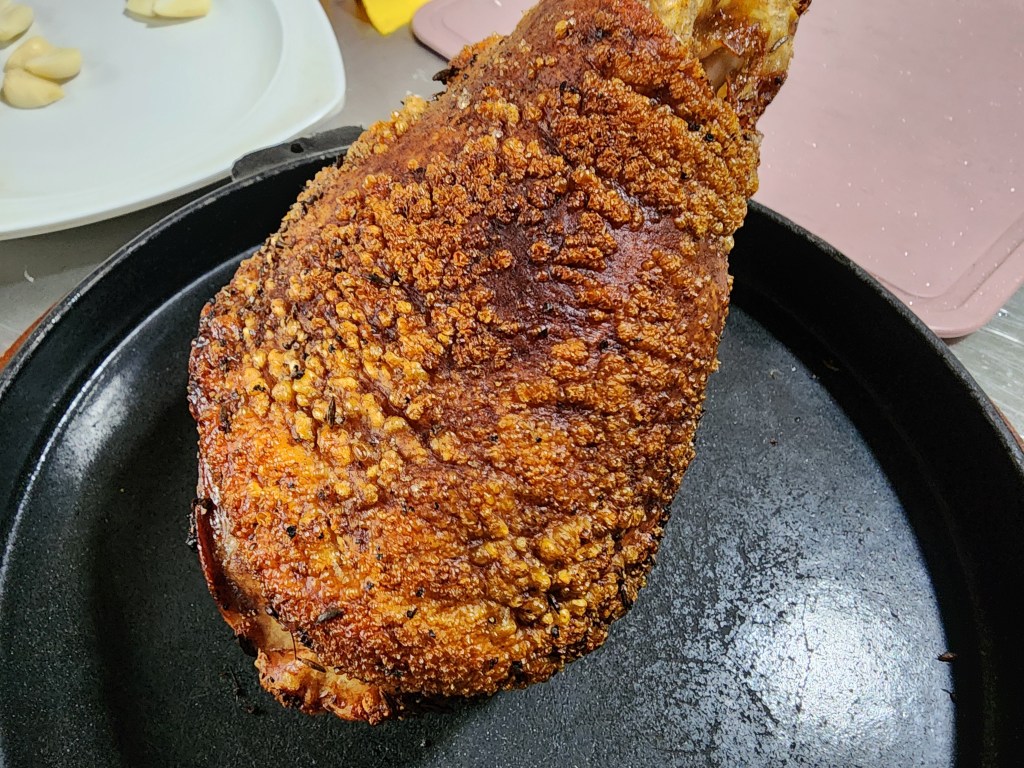
[Photo: Perfect crackling on Schweinebraten & Schweinshaxe made in my pub]
I run a German pub and spent a lot of time experimenting with ways to make Schweinshaxe (pork knuckle) more efficient—without compromising on flavor. If you’re a pub owner looking to add authentic German dishes to your menu without running a full-scale Bavarian kitchen, this one’s for you.
1. Traditional German Pork Knuckle vs. Sous-Vide German Pork Knuckle
For independent pub operators, introducing an authentic German pork knuckle (Schweinshaxe) without the infrastructure of a full-scale Bavarian kitchen requires an optimized, labor-efficient workflow.
The traditional execution involves three resource-intensive phases: dry-aging the protein in refrigeration, a low-temperature slow roast, and a final high-temperature blast to develop the characteristic crispy crackling skin.
Because a four-hour roasting cycle is operationally unsustainable for walk-in service, alternative pre-cooking methods like commercial vacuum-packed, sous-vide knuckles offer a theoretical solution, requiring only a 15-to-20-minute finish in a pan or a high-heat oven at 220–240°C to crisp the exterior. However, empirical testing of these pre-packaged sous-vide variants reveals a significant qualitative defect: the skin fails to blister into a proper crackling texture, instead becoming excessively dried, cracked, and flat in flavor profile.
2. The Sauna Moment: Understanding Crackling Through Sweat
While numerous online tutorials demonstrate the crackling technique, few explain the underlying science. The breakthrough understanding of this physics came from a personal observation in a high-temperature steam sauna, which illustrated the contrasting effects of dry heat versus ambient moisture on skin tissue. Prolonged exposure to dry steam evaporates surface moisture and contracts the skin, whereas soaking in liquid saturates the epidermis, leaving it bloated.
This distinction is critical to pork knuckle execution. When pork skin is subjected to boiling or vacuum-packed sous-vide cooking, it absorbs excess moisture and retains its elasticity. Introducing this water-logged skin directly to high oven heat prevents the formation of internal steam pockets and expansion. Without these air gaps beneath the surface, the skin cannot blister or pop, resulting in a tough, leathery texture rather than a crisp crackling.
3. Production Setup and Prep Specifications: Schweinshaxe
(1) Brine Formulation
Brine
- Water: 1 L
- Salt: 60 g
- Sugar: 1 tbsp
- Garlic powder: 1 tbsp
- Nutmeg: 1 tsp
- Whole black pepper & bay leaves: some
- Execution: Combine all ingredients in boiling water and heat until completely dissolved. Allow the mixture to cool to room temperature before introduction to the meat.
(2) Pork Knuckle Preparation (Raw Material)
- Weight Specification: 1.1–1.3 kg (Frozen or chilled)
- Thawing Protocol: If frozen, submerge the knuckle in cold water 24 hours prior to cooking and store under refrigeration. Cycle and change the water once during the thawing window to ensure sanitation.
(3) Spice Rub Blend
- Caraway seeds: 3 tsp
- Black pepper: 2 tsp
- Salt: 2 tsp
- Execution: Pre-mix dry spices uniformly in a designated container before topical application.
(4) Aromatics (Garlic)
- 40 g, thinly sliced
4. Schweinshaxe Cooking Method
Recommended YouTube video to watch before starting:
- Skin Perforation Take the fully thawed pork knuckle and prick the skin evenly across the entire surface using a sharp tip, creating approximately 200 micro-punctures. (⚠️ Warning: Do not make deep cuts or score the skin. Deep scoring compromises the structural shape during roasting and disrupts uniform heat distribution, preventing proper crackling formation.)
- Precision Brine Injection Calculate the brine volume so it does not exceed 10% of the total raw weight (e.g., 100–150g of brine for a 1.0–1.3kg knuckle). Using a meat syringe, inject the brine uniformly from multiple angles into the thickest parts of the muscle. (⚠️ Warning: Over-injection forces excess moisture to leak out as the muscle fibers contract during cooking. This liquid will soak the skin, leaving any moisture-exposed areas rubbery and incapable of blistering.)
- Garlic Insertion Using a small pairing knife, pierce narrow slots directly into the meat sections (avoiding the skin). Manually insert the thinly sliced garlic deep into the flesh to embed the aromatics.
- Surface Dehydration and Seasoning Pat the entire surface of the knuckle completely dry with kitchen towels. Apply a thin, light coating of oil to the skin, then rub the salt-pepper-caraway spice mix uniformly over the exterior. Place the seasoned knuckle uncovered into the refrigerator to air-dry for a window of 24 to 72 hours. (⚠️ Warning: Do not exceed the 72-hour air-drying limit. Over-drying depletes essential surface moisture completely, turning the skin excessively hard and significantly increasing the risk of burning during the final blast.)
(The identical cooking method, brine formulation, and spice rub profile can be applied directly when executing a Schweinsbraten using a 1.0–1.5 kg skin-on pork belly. Because pork belly possesses a significantly softer and more delicate tissue structure than a knuckle, you must use a lower-gauge needle when injecting the brine to prevent tearing the meat fibers. Additionally, due to the flatter geometry and open grain of the pork belly, manually piercing the meat to insert garlic slices with a knife is unnecessary.)
5. Crackling Mechanics 101: Dry First, Pop Later
I roast my haxe low and slow at around 110°C until the core hits 83–85°C. I poured a generous amount of leftover beer into the oven pan. I’ll cook the Schweinshaxe using steam convection. During this time, the outer skin dries out and the fat begins to slowly render. If you look at the beer or water tray underneath, you’ll see golden oil floating—that’s melted fat escaping from beneath the skin.
This is what you want.
Then, when you hit the skin with 260°C heat, that dried-out skin filled with tiny air gaps pops like popcorn. You get tons of crunchy bubbles and that addictive texture everyone craves. If you sous-vide or boil it, the skin is still holding onto moisture and fat. There’s no space for air to expand, so the high heat just stiffens it into rubber.
6. Three Versions Tested: 110°C vs. 160°C vs. Sous-Vide
All versions below were: 2-day fridge dry-aged + final 260°C blast.
(1) 110°C convection cook (my method):
This approach requires approximately 2 to 2.5 hours to bring the pork knuckle to a target core temperature of 85°C. The slow, controlled heat exchange allows the skin to blister into a thick, uniformly golden, and airy crackling texture with a clean, savory profile. When broken by hand, the skin must snap cleanly like a crisp wafer rather than stretching with a leathery resistance. Crucially, this low-temperature window thoroughly renders the subcutaneous fat layer, converting the underlying tissue into a delicate texture that breaks down easily upon consumption without leaving a greasy residue.
(2) 160°C oven cook (common internet method):
Commonly found in conventional internet tutorials and high-volume commercial kitchens, this method reduces total cooking time to approximately 1.5 to 2 hours. However, the higher ambient heat causes the protein in the skin to brown and stiffen prematurely before the final high-heat blistering phase can be executed. This prevents the formation of an airy, popcorn-like crackling, resulting in a dense, chewy skin texture with charred edges. Additionally, the shorter cooking window fails to fully render the fat layer, leaving a heavier, oilier mouthfeel.
(3) Pre-Cooked Vacuum-Packed Cooking (Sous-Vide Method)
While the sous-vide process ensures that the interior muscle remains soft and structurally intact, it yields poor results for the exterior skin. Because the tissue absorbs excessive moisture during the long vacuum-seal stage, the skin dries flat and cracks under final heat instead of expanding. The resulting exterior texture is intensely leathery and chewy, completely failing to develop the characteristic blistering, crispness, and deep roasted aroma associated with traditional open-air roasting.
7. Real Crackling: Tips from the Field
- Micro-Perforation Over Deep Scoring : Avoid deep longitudinal or cross-cuts into the skin. While deep scoring reduces total cooking time by approximately 30 minutes, it destabilizes the meat’s structural integrity during the roasting cycle, causing the shape to collapse and leading to uneven heat distribution.
- Brush with vinegar before final roasting: Brushing a thin layer of vinegar onto the skin immediately prior to the final high-heat blast chemically tightens the surface proteins and accelerates the blistering process. The acidic compounds fully evaporate under high temperatures, leaving no residual sour flavor profile in the final product.
- Irreversibility of the Crackling Phase: The crackling process is a one-time structural transition. If the skin is successfully blistered during the initial high-heat phase, the crisp texture will remain stable and can be successfully reheated later. However, if the skin turns rubbery during the primary roast due to excessive moisture or incorrect temperature, it hardens permanently and cannot be corrected.
- Use skewers to hold shape: As the muscle fibers contract during a long roast, the knuckle tends to tilt, which prevents uniform heat exposure. Inserting a metal skewer serves as a structural stabilizer to keep the meat upright. It is not necessary to insert multiple skewers in a precise cross-pattern; a single, strategically placed skewer is sufficient to maintain balance. (Note: For a flatter Schweinsbraten/pork belly, skewers or butcher’s twine are unnecessary. When roasting pork belly over a bed of beer in an oven pan, simply calibrate the liquid level so that the ambient moisture does not directly touch or soak the skin.)

[Please insert the skewer properly so that it does not fall over.]
Traditional methods may take time, but for real crackling, they’re absolutely worth it. If you run a small pub and want a standout menu item, go for it. But in terms of speed and repeatability, I personally recommend Schweinebraten over haxe (Pork knuckle). It’s faster, cleaner, and more consistent.

If you enjoyed this article, you can support the project – thank you!