
The early 2000s—when the Iraq War began—marked a sudden explosion of low-cost communication and internet-based media. Web forums. Satellite phones. Cheap digital cameras. For the first time, these tools entered an active battlefield at scale. One reality became unmistakable:
Information itself had become a weapon.
I was in middle school then. I couldn’t yet grasp how deeply these technologies would reshape society, power, and the economy. Later, I followed the conventional route—graduate school, corporate jobs—still thinking in paper-and-pencil terms. I didn’t see what was coming. And I missed Bitcoin. That’s why missing the AI wave now would be inexcusable. I suspect many of you feel the same urgency.
In this article, we’ll look at how two very different actors—the U.S. military (JSOC) and al-Qaeda—responded to technological shifts during the Iraq War.From there, we’ll examine the nature of AI itself and extract survival strategies for small business owners and creators, especially in F&B and solo enterprises.
1. Team of Teams — Lessons from General Stanley McChrystal
(1) Core ideas from the book
Iraq, 2003. Under Abu Musab al-Zarqawi, al-Qaeda exploited satellite phones, web forums, DVDs, and SMS to coordinate attacks and broadcast messages almost in real time. Strikes were sudden. Targets were unclear. Attackers vanished immediately. The U.S. military, in contrast, was slowed by its headquarters-to-field hierarchy. Intelligence was painstakingly gathered—yet often outdated by the time it reached operators. As commander of JSOC, General Stanley McChrystal realized the problem wasn’t tactical. It was structural. Siloed departments. A widening gap between headquarters and the field. Rigid, manual-driven procedures. These couldn’t defeat an enemy that was, in his words, “everywhere and invisible.”
McChrystal’s response had two pillars: Shared Consciousness and Empowered Execution. He maximized transparency so every unit shared the same operational picture. Authority was pushed forward, allowing decisions to be made at the edge—fast. The commander’s role fundamentally changed:
- from issuing orders → to setting direction
- from control → to trust
- from hierarchy → to orchestration
The result was decisive. JSOC ultimately eliminated al-Zarqawi in 2006. McChrystal later codified these lessons in Team of Teams.
The core takeaway: It’s not the strongest organization that wins, but the one that adapts fastest to shifting conditions.
(2) Implications and limits
The message seems straightforward: Technology reshapes organization. Social media and satellite communications produced speed, connectivity, and dispersion. JSOC responded with information sharing and delegated authority.
But the book has a blind spot. Al-Qaeda didn’t invent a new organizational model. Guerrilla warfare has always been decentralized, concealed, and fast. Their real advantage wasn’t structural novelty—it was using new communication tools to patch an old weakness: coordination. Likewise, the U.S. didn’t fail simply because it was hierarchical. The deeper question isn’t: “What is the ideal organizational design?” It’s: “Did we read the technology correctly?”
And there’s a second problem. As technology evolves, even shared consciousness and empowered execution can become obsolete. Team of Teams doesn’t fully confront this technological transience. The illusion of technological transience is that asymmetric advantages erode at terminal speed. Al-Qaeda’s early adoption of satellite phones and web forums temporarily patched their coordination deficit, but the moment the state apparatus integrated NSA-level surveillance, that exact technology became their tracking device for liquidation. For small business owners, using AI to drive operational efficiency is crucial. However, once major corporations deploy it at scale, that competitive edge will evaporate overnight. Instead, small businesses must leverage AI to amplify embodied knowledge, design aura-rich offerings, and curate meaningful experiences.
2. The Nature of AI: How Knowledge Production, Distribution, and Sales Are Changing
AI is often described as a general-purpose technology—like the steam engine, electricity, or the internet—one that sends shockwaves across every industry. I want to analyze AI through a more concrete frame: the knowledge value chain.
Production → Distribution → Sales
This lens makes one thing clear: AI does not affect all players equally. Large corporations and small businesses will face very different survival paths.
(1) Shift in Knowledge Production: From Labor-Intensive → Capital-Intensive
Since the Industrial Revolution, almost every major innovation has followed the same pattern: Labor-intensive industries are converted into capital-intensive ones. When firms can’t reorganize labor—or lack capital—they outsource production to cheaper labor markets.
Why does innovation always tilt this way? Because labor-intensive value creation doesn’t scale. Expanding markets requires low marginal cost—the cost of producing one additional unit. But labor-heavy systems grow like this: Workers → managers → managers of managers. More people, not proportionally more output. To reduce marginal cost, capital relentlessly searches for one solution: Replace humans with machines and money.
The same logic now applies to knowledge. At its core, knowledge creation consists of three steps:
- Pose a question mark about the world
- Find an exclamation point (a solution or pattern)
- Execute the solution and feed results back into the system
Historically, humans performed all three. Over time:
- Execution was de-laborized by industrial machinery
- Feedback loops were automated by software
Now AI is entering Step 2: finding the exclamation point.
How AI Generates Knowledge: The Power of Patterns
Why can AI now “solve problems”? Because it recognizes patterns. Patterns are perceptual frameworks. They abstract, structure, and generalize complexity. Before AI, discovering patterns—and verifying and reproducing them at scale—was expensive. Take medicine. Knowledge existed, but in fragments:
- clinical cases
- research papers
- textbooks
- surgical videos
Only trained doctors could integrate these fragments into usable patterns. That scarcity justified licensing power and high salaries. AI is now breaking into this domain. Once a pattern is mapped, applying it becomes trivial—across millions of cases. What was once limited by human cognition and computing power is now routine, thanks to GPUs and advanced semiconductors.
AI continuously: recombines existing knowledge, selects patterns that best explain new data, generates incremental insights.
The Immediate Consequence
Industries that: turn massive data into patterns, or repeatedly apply established patterns will lose entry-level human labor first. For example, Accounting / Insurance / Translation / Law. Where patternization is the job, AI arrives early—and stays.
Why the Human “Question Mark” Still Matters
There is one step AI still cannot perform: Asking the original question. The “Why not?” The “What if?” This explains the real ambition behind AGI. Without the ability to pose questions, autonomous problem-solving collapses. But question-posing is not computational. It is phenomenological.
To ask a genuine question is to feel friction with the world—to sense that something doesn’t sit right. That dissatisfaction is bodily. Frustration isn’t abstract. It’s tension in the gut. Pressure in the chest. Neural strain. As Merleau-Ponty argued, without a body, there is no perception of suffering. And without suffering, there is no rupture in perception.
No rupture → no new question.
Feeling inefficient or dissatisfied is a uniquely human sensation that comes from being a living being in this world. For AI, the world it is given is perfectly consistent, so it never questions anything. Therefore, the AGI Sam Altman speaks of—one that asks its own questions and solves its own problems—is a lie that can never be realized. His claims should be seen as a false narrative intended to justify reckless over-investment. A general intelligence that feels no existential suffering, no physical limitation — the idea that something like that could solve all human problems strikes me as profoundly naive.
Humans transform embodied pain into creativity. That friction fuels invention. AI, lacking a body, cannot. It only optimizes—pruning inefficiency and error. That is why AI will never be the kind of being that, out of sheer frustration, throws a new question onto the table.
📊 Table: Knowledge Production Stages — Before vs. After AI
| Stage | Past (Post-Industrial → Pre-AI) | Present (AI Era) | Implications |
|---|---|---|---|
| 1. Question Mark (initial inquiry) | Human (thought, perception) | Human (embodied frustration, curiosity) | Remains uniquely human |
| 2. Exclamation Point (solution/pattern-finding) | Human (research, verification, discovery) | AI (data-driven pattern search, knowledge recombination) | AI rapidly substitutes human labor |
| 3. Execution & Feedback (apply and adjust solution) | Human (operators, managers, system adjusters) | AI / machines (automation, optimization) | Shift from labor-intensive → capital-intensive |
(2) How AI Changes Knowledge Distribution and Knowledge Sales
Knowledge Distribution: Near-Zero Search Cost, Optimized Application
Humans have always navigated reality by moving between question marks and exclamation points. We ask. We test. We fix meaning.
Rationalism isn’t the whole of perception—but it is efficient. Objective knowledge relies on: shared premises, causal explanations, reductionist frames. That efficiency lowers: search cost, verification cost, reproduction cost. Knowledge distribution system abstracts subjective phenomena—which could previously only be understood within specific contexts and histories—into rational, objective knowledge, then distributes it customized to the user’s taste. Such as:
- ancient publishers
- academic journals
- encyclopedias
- search engines
The audience expanded too—from kings and nobles to everyone.
Despite such development, exploration remained painful before AI. For my Korean-language master’s thesis, I spent months inside English Google Scholar: collecting, reading, summarizing. Sometimes the pain produced insight. Most times, it was just pain.
Now, AI erased that exploration cost almost entirely. It doesn’t just retrieve information. It converses. In under a minute, it returns: cross-lingual, context-aware, synthesized knowledge. More importantly, it optimizes application. You ask:
- “Explain this more simply.”
- “Here’s my case—what changes?”
- “I tried this. These were the results. What next?”
And it responds with tailored next steps. Academics tell me the old all-nighter—meta-analyzing dozens of papers—is disappearing. “Extract sample sizes, effect sizes, and confidence intervals into a table.” One prompt. Done.
The Net Effect
AI: minimizes exploration of objective knowledge. maximizes exploitation. Commodity knowledge distributors—recipe dumps, summaries, listicles—will fade. What survives is perceptual reframing.
- Narrative.
- Context.
- Why this matters to me.
If you can’t explain why the Habsburg jaw affects my day you can’t differentiate. F&B is no different. A restaurant grounded in its own recipes and lived story can survive. A restaurant selling dishes anyone can assemble from GPT instructions? It will be crushed— by capital-intensive, heat-to-serve franchises racing to the bottom on price.
As near-zero distribution costs strip objective knowledge of its premium, information collapses into a generic commodity, leaving unique, lived narratives as the final frontier of scarcity and value.
📊 Table: Knowledge Distribution Stages — Before vs. After AI
| Task | Pre-AI | With AI |
|---|---|---|
| Explore (find the best sources) | Manual search, months of reading | Conversational retrieval in minutes |
| Synthesize (summarize core) | Human note-taking/outlining | Instant multi-source summarization |
| Personalize (apply to my case) | Human translation to context | Iterative, context-aware prompting |
| Iterate/Exploit (next steps) | Trial-and-error, slow feedback | Prompted optimization loops |
(3) Knowledge Sales: As Knowledge Becomes Portable, It’s Judged Purely by Utility
Capitalism loves portability. Portable products can be sold anywhere. Knowledge has followed the same path. Historically, knowledge moved slowly—on paper and through lectures. You needed libraries for books and campuses for classes. Knowledge felt rare, even sacred.
Masters were revered. Lineages and schools formed. A doctorate elevated not just the individual, but the family. Then came printing. Recording. Video. Scanning. The aura of the master dissolved. Today, a PhD may still know less than GPT in a narrow domain.
![[Photo: Prunksaal (14th Century, Austria), The Sanctuary of Sacred Knowledge. Source: Self]](https://saltnfire.net/wp-content/uploads/2025/09/IMG_8815-HDR-1024x683.jpg)
![[Photo: Prunksaal (14th Century, Austria), The Sanctuary of Sacred Knowledge. Source: Saltnfire]](https://saltnfire.net/wp-content/uploads/2025/09/IMG_8818-1024x683.jpg)
[Photo: Prunksaal (14th Century, Austria), The Sanctuary of Sacred Knowledge]
Knowledge Is Now Priced by Use-Value
In this environment, knowledge is no longer valued by prestige.It’s judged by a simple question: Does this help me right now? How much more can I earn after learning this? AI intensifies this audit through two core functions: Summarization + Translation
Summarization: Automatic Fluff Removal
In the past, you had to climb the entire academic staircase: Calculus → Linear algebra → Probability → then regression. Now GPT collapses everything into the actionable core. A modern knowledge pipeline looks like this:
- Learn rough foundations via YouTube
- State your hypothesis to GPT
- Ask which models benchmark papers use
- Compare approaches
- Collect data
- Run analysis with GPT
- Validate and iterate
Years of formal training compressed into weeks—or days.
Translation: Real-Time Knowledge Liberation
Eight years ago, reading a 40–50 page English paper took me four hours—with a dictionary. Professors controlled “required readings.” That control was power. Today? I don’t need them. The process is brutally simple:
- Ask GPT for the ten strongest papers
- Skim summaries
- Translate full text
- Read everything in 30–60 minutes
The only metric left is ruthless: Maximum practical benefit per unit of time and money.
Market Consequences: Concentration and Collapse
The consequences are harsh. The most useful knowledge absorbs revenue. Traffic concentrates on: creators GPT ranks as high-quality and those capable of teaching GPT itself. Capital-rich firms, with data and feedback advantages, dominate this layer. But small creators still have lanes.
(4) Where Small Players Still Win
Embodied, Hand-Taught Skills
Some skills resist patternization. Cooking. Plumbing. Electrical work. These domains:
- are too bodily
- too contextual
- too fragmented
The market is large enough to live on—but too small for massive capital to fully invade. That’s where independents survive. Take Jean-Pierre, the YouTuber. He doesn’t list recipes. He teaches movement:
- how to roll chicken tight
- how to shake the pan
- how to stir until this color
All wrapped in humor and rhythm. That knowledge sticks because it lives in the body.
Meaning and Aura
Beyond bodily skill, small players sell meaning. Bookstores overflow with accessible philosophy: Nietzsche. Schopenhauer. Packaged with emotion and narrative. Others narrativize practical knowledge—sometimes drifting into conspiracy. (Was the Rothschild family really behind the currency wars? 😆)
The easiest survival path?
Narrative packaging.
Gladwell. Seth Godin. Story + vivid description + a dose of meaning. The core of this narrative is not about how great I am, or how impressive my capabilities are. It is about what emotional satisfaction I give the customer — and what meaning I add to their life. Because that is an existential experience that cannot be reduced to a price tag. And that is precisely what AI cannot do.
So the questions ahead are simple:
- How do you structure a compelling narrative?
- How do you describe so it lands?
- How do you make people perceive meaning?
📊 Table: Knowledge Sales Stages — Before vs. After AI
| Dimension | Pre-Portability | Post-Portability + AI |
|---|---|---|
| Access | Library/Campus-bound | Everywhere, on-demand |
| Authority | Master/lineage prestige | Utility and outcomes |
| Buyer’s filter | Professor syllabi, gatekeepers | GPT triage: summarize, rank, recommend |
| Winner profile | Institutions, credentials | High-utility knowledge + embodied skills + aura/narrative |
3. Surviving as a Small Business: Practical AI Playbook
(1) What Owners Should Actually Do ?
From a clear-eyed reading of AI’s nature:
- You throw the question mark. Let AI supply the exclamation point.
- Crush exploration cost everywhere. Recipe R&D. Market research. Promo ideas. Skip endless Google hunts, phone-a-friend loops, and overpriced consulting.
Ask AI your subjective questions directly. Then run: experiment → feedback → refine. Fast. Cheap. Relentless. Utility alone won’t save you. For any merely “useful” object, add narrative. Show: the life you live + the intent you pursue. Then manifest that in what you make.
(2) Field notes & examples
I cover aura-building elsewhere (Aura Building Theory). Here, I’ll focus on speed and optimization.
Improving storage for Linzer Torte

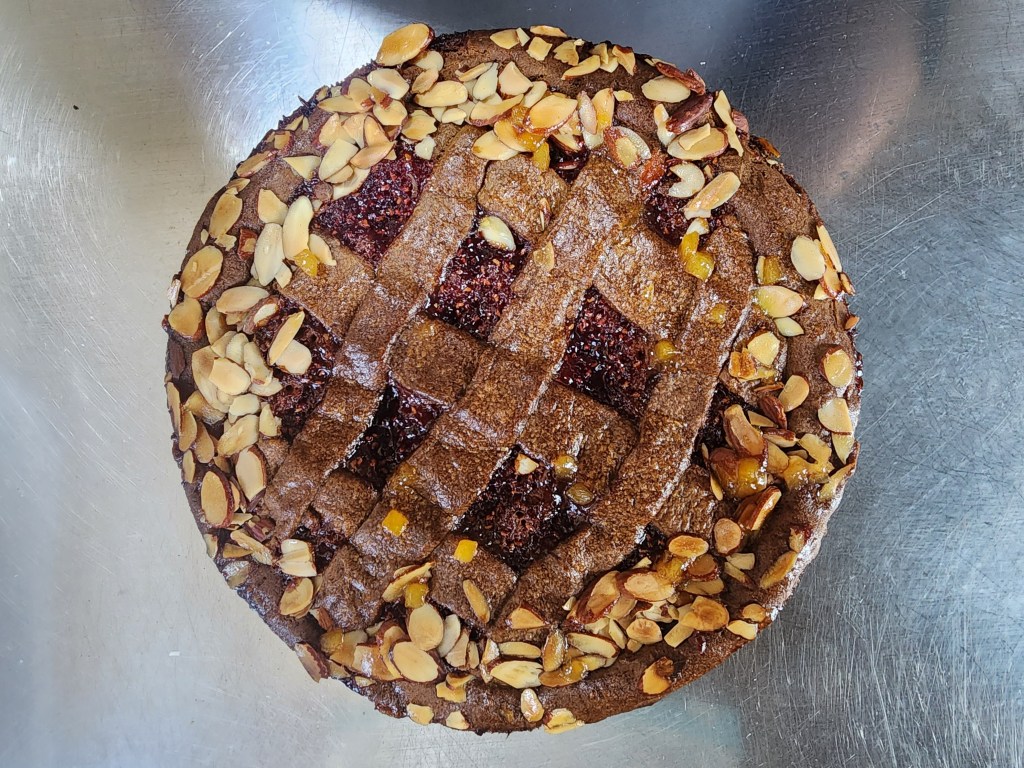
Photos: [AI-drawn Linzer caricature] [My Linzer Torte]
I’ve often co-developed recipes with AI: chicken dishes, fond brun, simplifying without losing depth. One product is Linzer Torte. A cake–cookie hybrid: crisp shell, tender crumb, deep butter notes, spice and nut harmony. It batches more easily than Medovnik. So I asked AI a blunt question:
Q1. It gets soggy in sealed containers. Fix?
AI suggested something I never would have considered: Silica gel inside an airtight container. Purpose: absorb humidity, preserve crust crispness. Would it extend shelf life? Partially. AI warned me: butter- and egg-based bakes at warm temperatures risk pathogens (e.g., Staphylococcus aureus). Silica gel controls moisture—not bacteria. Still, in practice:
- surface stayed crisp
- ~23°C room temp
- two days felt safe in my tests
Without AI, I’d never have thought of silica gel. Problem solved instantly.
Q2. Refrigeration makes it dry and crumbly. Now what?
AI explained starch retrogradation. Between 0–10°C, it accelerates. Fridges are basically staling machines for bread and pastry. Mitigation:
- wrap tightly to limit evaporation
- briefly rewarm below 150°C before serving
My tests matched this. Softness returned—briefly. After ~30 minutes on the table, it dried again. AI’s conclusion was blunt: Once retrogradation sets in, you can’t truly reverse it. Best strategy? room-temperature storage + faster turnover. Operationally: smaller batches, higher rotation. By accepting the AI’s suggestions and going through the experimentation and feedback process, we were able to find the best solution.
Translation & Cultural Fit
I’m a native Korean speaker. I speak Japanese. My English is enough for reading academic texts. I’m not perfectly fluent—but I can review and validate AI translations. For multilingual publishing, that’s enough. In the past, creators had to specialize narrowly. AI changed that. Now, intermediate competence across multiple domains unlocks exponential combinations.
In the pre-AI era, survival demanded hyper-specialization in a single field. AI has inverted this dynamic. However, this is by no means an invitation to settle for superficial, middling knowledge.
Survival belongs exclusively to the ‘Polymath.‘ The true edge is not an accumulation of mediocre skills, but the capacity for Architectural Orchestration. The sovereign producer possesses the human aura and the ‘Question Mark’ to see the connective tissue across disparate fields—such as culinary chemistry, cross-cultural nuance, and legal framework—and subsequently deploys AI as a high-velocity leverage to execute the ‘Exclamation Points.’
By synthesizing deep, localized human intuition with multi-domain algorithmic leverage, the creator builds a moat that single-focus corporate can’t replicate.
Operations optimization
When I closed my shop, I had to review contracts. In the past, I called a lawyer first. Now, I take a photo, ask AI, and understand the key points in minutes: performance clauses, termination conditions, penalties. Law, tax, contracts—unavoidable in business.
So the rule is simple: Build an AI-first decision flow. Push search and optimization cost as close to zero as possible. Then escalate only the truly hard, judgment-heavy parts to human experts. That’s how leverage works now.
A friend running a dry cleaner had a different problem. Training. Explaining workflows verbally never stuck. Instructions drifted. Standards decayed. After adopting AI, everything changed.
They now: generate clear training sheets, create show-and-do instructions, continuously update manuals with staff feedback. Training became faster. More consistent. Less emotional. Not because AI “understood” the job— but because it made iteration cheap.
Promotion & Storytelling (AI × Aura)
I still avoid overspending on ads. And I never inflate expectations. But AI changes one thing: video now costs almost nothing.
[Fake promotional videos using AI. I Used Gemini & deevid.ai. Click for checking details]
I write the storyboard and narrative— the question mark. AI handles visual realization— the exclamation point. Human aura × AI technique. Simple. Effective. Perfect for short-form. With specialized tools (e.g., deevid.ai), you can go further. Outsourcing is also great. Nowadays, creators who produce high-quality AI videos and promotional materials at affordable prices are also emerging.
In-Store Applications
- Loop a short film on a tablet while guests wait for beer.
- Turn photos into micro-stories: pouring beer as tradition, sweat, freedom.
- Show how your signature chicken was developed.
Even a small LED panel on the facade can work: flash “how it’s made” clips, pull foot traffic, signal life. Big brands avoid this. They protect uniformity. Small operators don’t need uniformity. They can be seasonal, improvisational, alive. Tablets. Digital frames. TVs.
In the AI era, your job is to throw the question marks and codify your shop’s aura.
4. Conclusion
This article started with the Iraq War. Low-cost communication didn’t just help insurgents. It forced even the U.S. military— a massive bureaucracy— to change its structure. Technology wasn’t a tool. It was the driver. Now we’re in the AI era. And the same pattern is repeating.
In the past, humans managed the entire chain: knowledge production → distribution → sales. AI has fractured that chain. Humans ask the first question. AI generates candidate answers. We test, iterate, and optimize— fast and cheap. Through summarization and translation, AI enforces a brutal filter: Does this help me now? Does this raise my output? That’s why utility alone is no longer enough.
Small businesses and creators survive through:
- Embodied knowledge: Skills learned only through lived practice (cooking, plumbing, electrical work).
- Aura-rich offerings : Atmosphere, philosophy, and narrative unique to you.
- Meaningful experiences : Moments that connect with the customer’s own life.
Everything else— research, optimization, drafting, analysis— should be delegated to AI. And exploited ruthlessly. Those who master this division (human questions + aura) × AI optimization will see their capacity for value creation multiply.
AI takes the use. We survive with meaning.

If you enjoyed this article, you can support the project – thank you!