
Most people see just a cafeteria. Through the lens of Phenomenological Management, I saw a blue-ocean F&B model. In this article, I’ll introduce the cheapest place to eat in Yongsan—one of Seoul’s fastest-rising price zones—and explain why this cafeteria represents a structurally overlooked opportunity.
1. Yongsan Library Cafeteria
(1) A Restaurant Without FOH
By now, you’re probably used to my stance: In countries with high wages and a low Food Limit Index (the maximum people are willing to pay per meal relative to income), front-of-house labor should be eliminated unless it creates real, measurable added value. For deeper logic and international case studies (Czech Republic, Japan, Russia), see the articles below.
- [See: Running Without FOH – Czech Republic’s Havelská Koruna, Soviet Stolovaya]
- [See: Running Without FOH – Japan’s Counter-Style Ramen Houses]
The Yongsan Library Cafeteria I’m introducing today is exactly that kind of place.
(2) Usage Info & Prices
- Location: https://maps.app.goo.gl/pmqjzxf7cXzfZuGz7
- Operating Hours: 09:30 ~ 19:10 (Closed on library holidays-Every second and fourth Tuesday of the month- and Sundays)
- Main Menu: Daily-changing Korean baekban (set meal), pork cutlet, stir-fried pork, and other home-style dishes.
- Tip: No need to feel awkward ordering—there’s steady demand from foreigners working at the nearby Goethe-Institut.
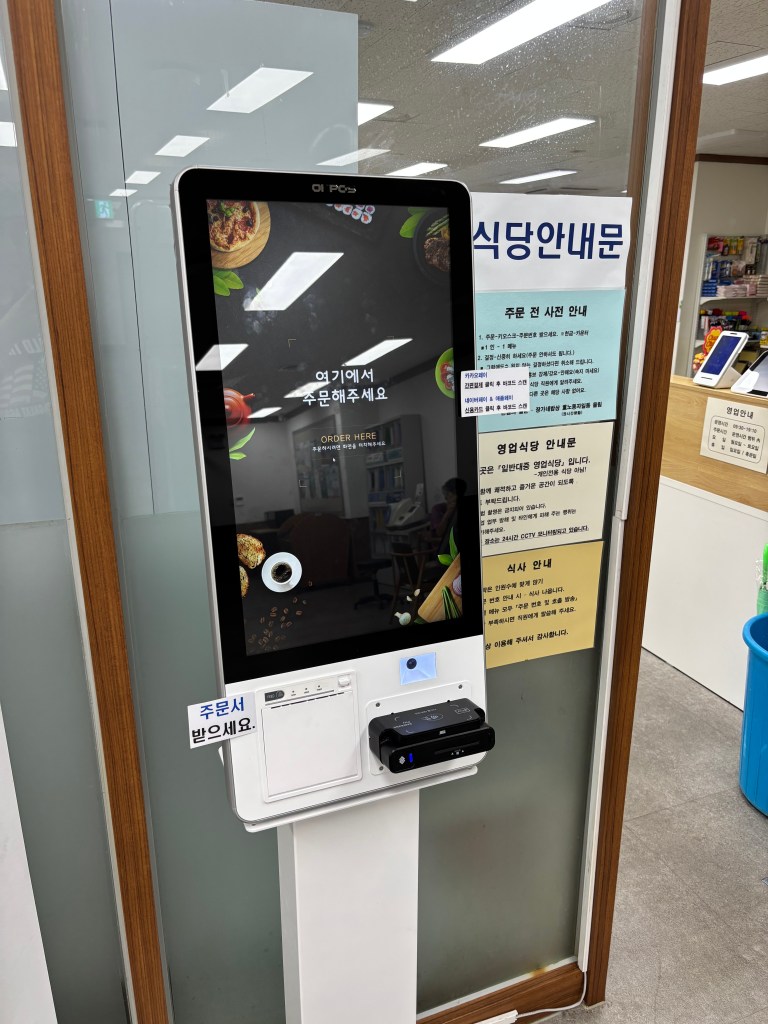

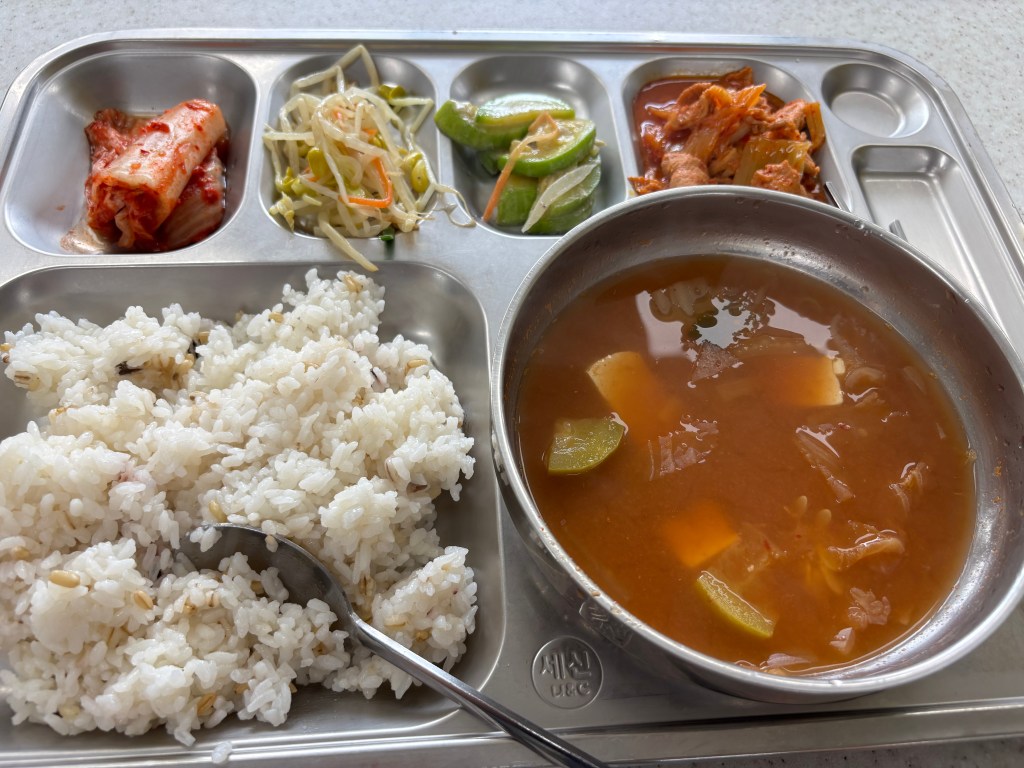
[Easy Process: Order & Pay at Kiosk -> Calling your order number with sheet -> Enjoy]
(3) Bonus Info for Those Who Also Want to Use the Library (Foreigners also available)
- Membership: https://yslib.sen.go.kr/yslib/html.do?menu_idx=43 → Register as an associate member to access reading rooms & digital archives.
- Borrowing Books: Foreign residents can join with a residence card showing a Seoul address (or proof of school/employment if from another city). Sign up at the 1st-floor info desk.
- Extra Perk: Once registered, you may also access Namsan Library (just up the hill, confirmation required at info desk).
- Contact Numbers: 02-6902-7780, 6902-7711, 6902-7768
2. Why Does the Yongsan Library Cafeteria Work?
(1) Geography That Locks in Demand
The cafeteria sits at the top of Huam-dong Hill. The slope is steep. There are no nearby restaurants. Instead: the area is dense with affordable villas, only one road runs past the public library, foot traffic cannot disperse. Anyone moving through the hill passes the library.
This creates three powerful conditions:
- Geographic monopoly
- Prices ~50% below Seoul average
- Daily-changing baekban menus (small, repeatable surprises)
As a result, the cafeteria attracts: library users, local residents, nearby office workers. If you’ve ever operated inside a public building, you already know this truth: Aside from weather, traffic barely fluctuates. Demand is stable.
(2) Predictability: The Hidden Luxury in F&B
I visited daily for three weeks. Ordering dinner around 6:30 PM, my ticket number consistently fell between 250–300. No spikes. No dead days. This demand curve resembles: schools, the military, hospitals. Of course, you can’t simply open a shop here. Operations are decided via public bidding. But that’s exactly the point. Because traffic is fixed, you can forecast five years of: revenue, costs, profit. Even beginners can calculate a maximum viable bid price.
This matters because the biggest mental burden in F&B is uncertainty: not knowing how much you’ll earn, or how much you’ll waste. Most restaurant waste comes from unpredictable demand: overstaffing, over-prepping, over-ordering. This cafeteria model minimizes that waste. That makes it ideal for Toyota-pub-style operators who value stability over spectacle.
Structural Stability You Can’t Buy
Another major advantage: rent risk is essentially zero.
Win the bid, and you lock in five years of stability. Private landlords often push rent hikes despite legal caps. Public institutions don’t. Rules hold. For operators who’ve lived through sudden rent shocks, this alone is priceless.
The Catch: Why It’s Not Easy Money
There is a downside. Competition is fierce. Specialist contractors aggressively target these bids. Many operate multiple sites simultaneously. Their advantages: bulk purchasing, flexible staff rotation, centralized cost control. They can submit ultra-low bids, sometimes with margins close to zero. Without: group catering experience, tight cost control systems, supplier networks, entry is difficult. This is not a romantic mom-and-pop game. It’s industrial.
Pricing Power & Menu Reality
Still, the killer advantage is price. In Yongsan: typical meals cost $10–15.
Here: Baekban: $5, Pork cutlet: $6. Roughly 50% cheaper. Taste? Decent. For a man in his 30s, though, the flavors felt a bit bland and watery— almost hospital-like. (They do offer refills if portions feel small.) Ironically, that blandness signals opportunity. Even a 1% improvement in flavor could expand the already stable customer base.
On the other hand, OEM semi-prepared items— pork cutlets, cheese cutlets, ramen— were genuinely good. Almost indistinguishable from franchise chains. Which makes sense. Franchises use the same factory products— they just stack on: headquarters margins, franchise fees, distribution markups. Here, you pay base cost only.
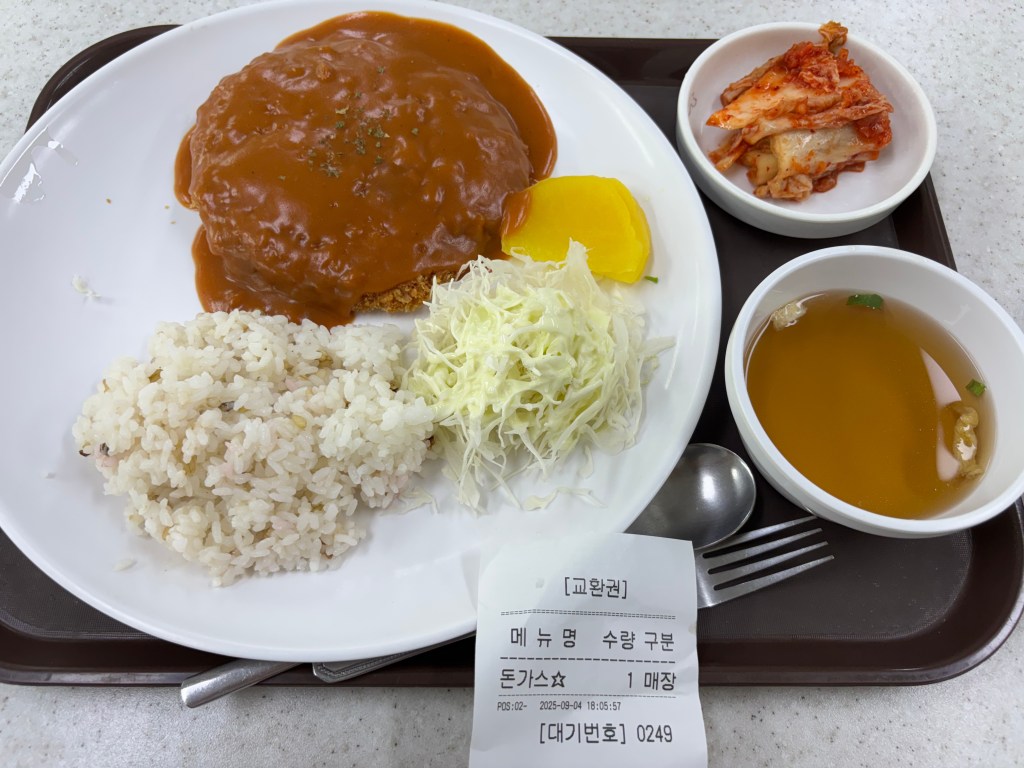
[My Recommendation: Pork cutlets, 6$]
3. Business Structure Analysis
When people think about starting a business, cafeterias or food-bank-style operations are usually dismissed as uncool. Instead, most people do one of two things: pour huge capital into a private restaurant, or sign a franchise contract right away.
But once you run the numbers, the conclusion flips.
(1) Estimated Financial Structure
When I ordered dinner before closing time, the waiting number was consistently around 250. With:
- Average ticket: 7,000 KRW
- Daily revenue: ~1.75M KRW
- Operating days: 6 days/week
That puts monthly revenue in the 40M KRW range (roughly $33,000). Here’s my estimate: Estimated Monthly Financials – Yongsan Library Cafeteria
| Item | Amount (KRW) | Notes |
|---|---|---|
| Revenue | 40M | 1.75M/day × 24 days |
| Food Costs | -8M | ~20% (simple set meals) |
| Rent | -5M | Estimated from public bidding data |
| Labor | -15M | 6 staff × minimum wage (incl. weekly allowance) |
| Utilities / Other | -2M | Water, electricity, misc. |
| Net Profit | ~10M | Excludes owner couple’s salaries |
Conclusion: Around 10M KRW (~$7.5k) net profit per month, comparable to franchise-level operating profit. The difference? Almost no upfront investment. No franchise fees. No interior overkill. Capital recovery is dramatically faster.
(2) Minimal Spending on Interiors = Faster Payback

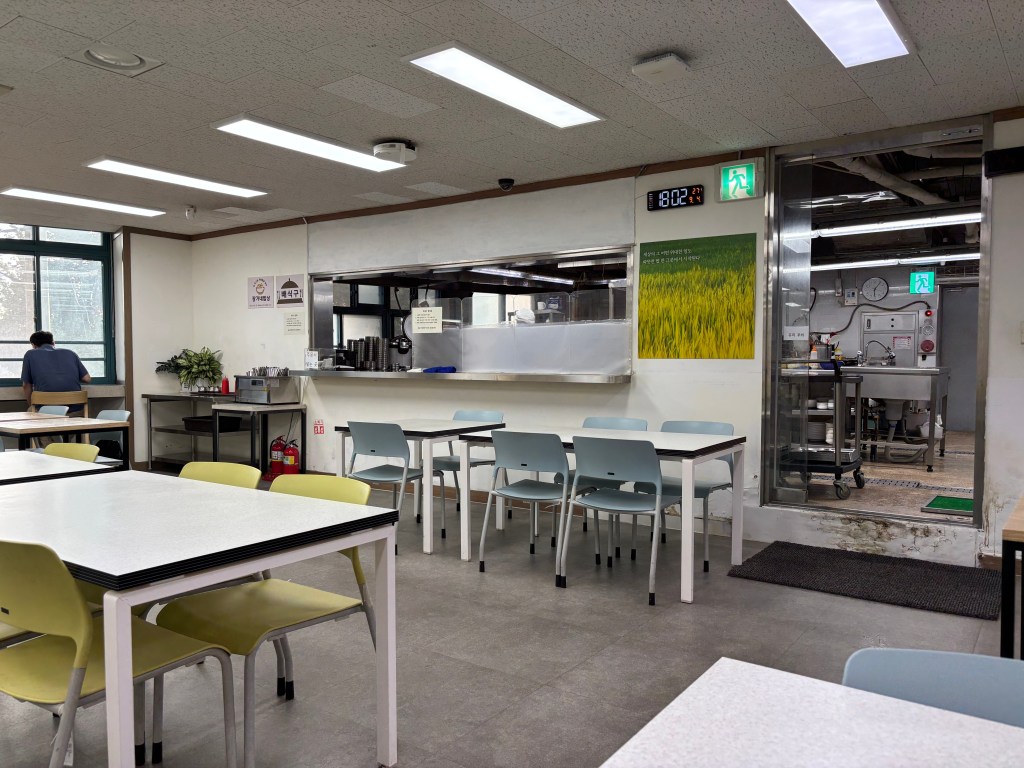
Look at the cafeteria photos. There is virtually no interior investment. This alone changes everything. To earn a similar monthly profit through a major franchise, you’d typically need ~1B KRW ($750k) upfront. Yes, franchise revenue may be higher. But it comes with: massive interior depreciation, expensive equipment, franchise royalties, bloated staffing structures.
And the irony? Customers don’t go to fast-food chains for the interior. They eat and leave. No one genuinely asks: “Does this Burger King feel like authentic New York?” That fantasy only enriches headquarters and construction companies owned by the owner’s family.
By contrast, the library cafeteria:
- uses existing public infrastructure,
- pays no interior cost (already covered by taxpayers),
- faces no demand for aesthetics.
Customers want: cheap, fast, predictable food.
Low expectation = low waste = high efficiency.
Why This Model Is Quietly Powerful
What looks uncool from the outside is actually a structurally optimized business: Guaranteed traffic, Stable rent contracts, Minimal waste, Predictable cash flow.
Add just a few layers: FOH minimization + Heat-to-serve parallel prep + Smart niche menu design. And this model can outperform many franchises with a fraction of the capital.
Choose survival and ROI over style.
(3) Investment Efficiency: Cafeteria vs. Franchise
| Category | Library Cafeteria | Franchise (e.g., Burger King) |
|---|---|---|
| Initial Investment | 50–100M KRW | ~1B KRW |
| Monthly Revenue | ~40M KRW | 100–200M KRW |
| Food Cost Ratio | 20-30% | 30–35% |
| Labor Cost | ~15M KRW | 30M+ KRW |
| Rent | ~5M KRW | 10M+ KRW |
| Other Costs | ~2M KRW | Heavy depreciation, royalties |
| Net Profit | ~10M KRW | 5–10M KRW |
| Monthly ROI | 10–20% | 0.5–1% |
| Value Creation | Stable meals + Public infra leverage | Branding + interior fantasy |
The takeaway is blunt:
- Franchise = flashy interiors + marketing → depreciation bomb
- Cafeteria = public infrastructure + fixed demand → practical, high-efficiency model
Most people chase style. The cafeteria quietly prints stability.
4. Future Risk Factors for the Yongsan Library Cafeteria
Below are the main risks I see for the Yongsan Library Cafeteria. Even if you’re not in Seoul, this works as a template for analyzing public-institution F&B sites anywhere.
(1) Long-Term Market Shift: When Monopoly Ends
Today, the cafeteria enjoys near-monopolistic traffic at the top of Huam-dong Hill. But this advantage is unlikely to last beyond five years.
Two major government developments are coming:
- Seoul Metropolitan Office of Education HQ (near completion)
- Planned U.S. Embassy on former U.S. base land (long-term)
The education office alone is massive. Its cafeteria will almost certainly be operated by a large corporate caterer (Hyundai Green Food, Ourhome, etc.), not a small independent team.
If that cafeteria opens to the public: price competition begins, taste competition begins, nearby residents may shift their dining habits. Once embassy construction starts, franchises and corporate tenants will arrive early to capture foot traffic.
The risk is counterintuitive but common: New external traffic does not always add to existing flow. It often cannibalizes it. This is the classic gentrification pattern: external traffic surges, rents and living costs rise, local residents and small merchants leave, library usage drops, cafeteria traffic declines.
I’ve seen this firsthand. When my old neighborhood turned into an Instagram hotspot, rents jumped 50–100% within 2–3 years— and the original residents vanished.
(2) Flavor Ceiling: When “Good Enough” Isn’t Enough
A $5 meal is excellent value. The food is decent—but overall flavor leans mild. It would be nice to have a menu item that has a strong flavor but doesn’t require much effort.
Why ramen works here
- Cultural memory : Many Koreans grew up eating ramen at school kiosks. Ramen inside a library triggers nostalgia.
- Operational advantage: Adding ramen burners there is easy. They may absorb ramen surges efficiently.
How to run ramen efficiently
- Use OEM soup base enhanced with dried shrimp + shiitake powder
- Hold stock hot in batches
- Blanch noodles, then finish in earthenware bowls (heat-to-serve)
- Rotate toppings (seafood, meat, bean sprouts)
One cook can handle ~10 bowls at once. That 1% spicy kick breaks the monotony of mild set meals and creates a repeat-visit rhythm.
(3) Dependency on Library Policy & Programming
Customer flow isn’t controlled by the operator alone. Libraries increasingly run: lectures, exhibitions, community programs. For public-institution cafeterias:
- demand depends on administrative decisions, not just location,
- policy changes matter as much as taste or price.
While this uncertainty is partly priced into a 5-year lease, any bidder must evaluate the institution’s traffic-generation capability carefully.
One final note: public facilities come with strict administrative and hygiene rules. Watching library cafeterias, I noticed constant cleaning— a sign of heavy compliance overhead. Operational efficiency here isn’t just about cooking. It’s about navigating bureaucracy without bleeding margins. It was presumed that bureaucratic intervention would be much greater in actual operation.
5. Industry Insights
(1) What You See on YouTube Is Red Ocean
Try Googling “how to run a library cafeteria.” You’ll find almost nothing useful. All that shows up online are bid notices and lease conditions. The real drivers of high ROI here are tacit knowledge—things you can’t search:
- bulk purchasing power
- operational efficiency
- bidding strategy (spreading fixed costs across sites)
- industry networks
By contrast, search for “Instagram-hot restaurant” or “fully automated shop making 10M KRW/month,” and you’ll drown in content.
Why? Because someone is selling something: manuals, franchises, processes, branding, consulting. Information is never neutral. It’s always produced with intent. That’s why blindly trusting YouTube and online chatter is dangerous. Popular business ideas usually have terrible investment efficiency. True blue oceans stay quiet— because sharing kills ROI.
As this cafeteria case shows, operators with invisible strengths (operations + networks) invest far less to earn the same margin. Yes, insiders will say, “Margins are thin. It’s tough.” But strip away the library-cafeteria positioning, and their food wouldn’t even compete on taste in the open market.
(2) Small Operators Can’t Win on “Cheap”, So Win on Taste or Specialization
Rapid wage increases are pushing F&B toward capital-heavy models:
- eliminate FOH
- replace people with kiosks or robots
- outsource recipes
- buy semi-prepared SKUs and do light finishing
Cutting FOH is smart. Cutting menu uniqueness is suicide. Do that, and your competitors aren’t neighbors— they’re franchises and global giants. For cuisines like Korean home-style food, where dishes don’t depend heavily on a chef’s personal technique, out-tasting large firms is even harder.
So what’s the move? Develop signature items. I once practically lived in my shop to perfect Medovnik. YouTube. Cookbooks. Endless trials. Solo R&D was expensive. Today, AI collapses that cost. Big companies are efficient—but slow to change recipes. Small operators can iterate fast. That’s not “optimizing for others.” That’s self-driven mastery.
It’s exactly what I call Endorphin Immersion Labor: painful, focused effort that compounds into real advantage.
(3) When Long-Term External Traffic Is Coming: Exit. Don’t Ride the Wave.
Final—and painful—lesson. When large public offices move in and external traffic surges are predictable, don’t think:
“This is our chance. Let’s grow with the area.”
Exit. Why? Because rents follow traffic—with a delay. Right before or after the move: foot traffic spikes, rent hasn’t risen yet, sales look great. Because your shop has limits: seating capacity, kitchen throughput, staffing. Even if area traffic doubles, your sales may rise only ~30%. Then lease renewal hits.
Landlords hear “business is booming” through networks. Rent jumps 50%. Or they reclaim the space for “self-use” (a legal option in Korea with weak tenant protection). At that point, you face a choice: grind harder for shrinking margins, or sell to the landlord or an incoming franchise. I made this mistake.
When the presidential office moved nearby, we got a temporary bump. Someone offered strong key money to take over. I didn’t sell. I hadn’t decided to emigrate yet.
Result?
- rent +50%
- minimum wage surge
- growth ceiling hit
- when I finally wanted out, buyers vanished
I lost roughly $30,000 by missing the window. Yes. It still stings. Once rent spikes, no amount of cost-cutting or recipe tweaking saves you. If someone wants to buy you out because of public-institution traffic, sell fast. Windows close quickly.
6. Conclusion
Some people look at a library cafeteria on a steep hill and think, “Uncool.” So what?
You don’t need to look cool. You need to invest little and earn a lot.
Behind the “inconvenient hill”: exclusive, stable traffic. Behind the “uncool interior”: free public infrastructure. Without FOH: operating costs stay low. With roughly 10% of a global franchise’s startup cost, you can earn similar net profit.
It’s too small for big caterers, yet just difficult enough for independents— which is why almost nothing about it exists online. Same blind spots: libraries, municipal buildings, public institutions with guaranteed traffic that are too small for corporate players.
If you can access one through your network, open a modest café or deli, add just 1% unique differentiation, you may have a very solid business. Train your eye to see what others overlook. Then turn that unseen structure into meaning and value.

If you enjoyed this article, you can support the project – thank you!