
1. Executive Summary
This analysis addresses the causes behind low customer retention rates in restaurants that otherwise receive positive consumer reviews. The primary variable governing repeat visits is not culinary execution, but consumer psychology. Based on neurological principles and field data, consumers divide into two behavioral profiles:
- Dopamine-driven consumers
- Endorphin-driven consumers
Identifying this behavioral split serves as a requirement for constructing a business model that maintains stability beyond initial market interest.
2. The Retention Problem
The development of this framework stems from empirical data collected via product preference splits. An analysis of beverage sales at my pub reveals a distinct division between two products with matching alcohol concentrations:
- Pilsner Urquell (bitter, crisp, dry profile): Selected predominantly by male consumers.
- Kozel Dark (sweet, aromatic profile, served with a cinnamon-sugar rim): Selected predominantly by female consumers.
This preference matrix extends to food categories across diverse markets, including the United States, South Korea, Germany, the Czech Republic, Japan, and Vietnam:
- Pork Stir-Fry Venues: Populated predominantly by male consumers.
- Dessert Cafés and Bakeries: Populated predominantly by female consumers.
Long-term observation confirms a correlation between sensory preferences and behavioral consumption rhythms. Consumers who favor bitter, heavy, and familiar flavor profiles display distinct retention patterns compared to those who seek sweet, aromatic, and novel configurations. This variance establishes the division between Endorphin-type and Dopamine-type consumers. Low repeat-visit rates occur because Dopamine-driven consumers prioritize novelty over retention, sensory stimulation.
4. Biological Foundations of Consumer Profiles
(1) Dopamine-Driven Profiles
Dopamine activates prior to reward acquisition, stimulated by novelty, anticipation, and unexpected elements. Upon consumption, dopamine levels experience a sharp decline. Consequently, dopamine-oriented consumers prioritize the acquisition of new sensory experiences. Once a venue or menu item is tested, consumption patterns shift toward alternative market options.
(2) Endorphin-Driven Profiles
Endorphins activate following comfort or physical relief, stimulated by warmth, familiarity, and environmental stability. This mechanism explains the segment of the consumer base that selects identical dishes at the same establishment weekly. Within this profile, repetition yields reassurance rather than monotony. This operates on the same principle as the food from childhood: it is simple, predictable, and offers comfort precisely because it lacks novelty.
5. Taste Profiles and Behavior Patterns
(1) Taste Profiles
Dopamine-driven consumers select products characterized by elevated sweetness, capsicum (spiciness), intense aromatic profiles, and visual presentation. Representative examples include honey-butter glaze formulations, multi-colored desserts, cinnamon-sugar beverage rims, and complex plating arrangements.
Saccharides (sugar) combined with vanilla accents, fruity esters, and soft textures deliver an immediate stimulus to the brain. The convergence of sweet taste, aroma, texture, and visual design triggers a rapid neurological loop: strong stimulus, immediate reaction, and subsequent emotional reward. For this consumer segment, this compressed loop functions as a primary driver of satisfaction.
Conversely, Endorphin-driven consumers select savory, mild, and bitter profiles, exemplified by grilled sausages, slow-cooked stews, braised meats, and classic dry pilsners. Their consumption utility stems from consistency rather than unexpected sensory variations.
(2) The Methodological Framework: Sensation as an Integrated Experience
These taste allocations (sweetness to dopamine, bitterness to endorphins) do not function as rigid, mechanical pairings. Within this framework, dopamine and endorphin serve as metaphors for the pursuit of novelty versus the pursuit of comfort.
From a phenomenological perspective, a single gustatory stimulus lacks an absolute, fixed meaning until it is processed as an integrated experience. For example, a spicy capsaicin profile can trigger anticipation and dopamine release in one consumer segment, while introducing physical discomfort in another.
(3) Demographic Behavior and Palate Preferences
An analysis of consumer reveals that individuals within professions characterized by high uncertainty and intense cognitive loads—such as medicine, law, academia, and writing—frequently avoid saccharide-dense profiles.
Operating under constant professional pressure, these consumers utilize dining and drinking venues for decompression. They identify the stability and predictability found in bitter profiles, such as whiskey or India Pale Ales (IPAs), as premium attributes, displaying an acceptance of higher price configurations.
This demographic rejects further dopamine stimulation. They seek the relief that occurs as initial bitterness fades, triggering a subtle endorphin release. Their objective is not sensory excitement, but stabilization.
(4) Consumer Typologies
Consumers seeking sensory excitement through dining frequently operate within rigid, repetitive, and low-stimulus daily routines. Conversely, consumers seeking physical comfort through dining operate within highly dynamic, competitive, and high-stress environments.
This behavioral split serves as a binary diagnostic framework to determine the target demographic for a given menu architecture. The following matrix delineates the attributes of Dopamine-type and Endorphin-type consumers:
| Category | Dopamine-Type Consumer | Endorphin-Type Consumer |
|---|---|---|
| Hormonal Mechanism | Driven by reward anticipation & novelty | Stabilized by routine & comfort |
| Emotional Response Speed | Fast, intense, short-lived | Slow, cumulative, long-lasting |
| Sensory Sensitivity | Visuals, aromas, sweetness | Texture, warmth, saltiness |
| Key Triggers | Sweetness, fragrance, color | Mildness, familiarity, heat |
| Flavor Preference | Sweet, sweet-salty, intense (truffle, mala) | Savory, umami, slightly bitter |
| Eating Rhythm | Front-loaded excitement, quick saturation | Comfort builds while eating |
| Menu Reaction | Drawn to new items and heavy decoration | Prefers roasted, boiled, braised |
| Revisit Tendency | Low (novelty fades quickly) | High (emotional safety in repetition) |
| Decision Drivers | Photos, reviews, first impression | Habit, location, rhythm |
| Typical Foods | Cinnamon rolls, cakes, highballs, pineapple pizza | Schnitzel, goulash, oden, pilsner |
| Typical Venues | Dessert cafés, Instagram bars, trendy spots | Neighborhood diners, old izakaya |
6. Case Study : Pineapple Pizza vs. Neapolitan Pizza
Pizza serves as a model to analyze the division between dopamine and endorphin structures.
- Pineapple Pizza: Characterized by sweetness, distinctive color contrast, and high visibility. These attributes trigger debate and digital media sharing, identifying it as a dopamine-oriented product. It relies on high novelty and a strong initial sensory reaction. However, consumer retention data indicates a low frequency of repetitive, weekly purchases.
- Neapolitan Pizza: Relies on a simple composition, mild salinity, a crisp and elastic dough texture, and low saccharide density. It does not primarily drive social media photography. Consumers select this option because it offers sensory predictability rather than surprise.
If an operator modifies a Neapolitan pizza by adding sweet sauces or heavy toppings, endorphin-oriented consumers do not issue complaints; they recognize the schema disruption and cease revisit. Within this segment, preference centers on rhythm, predictability, and restraint.
The core operational distinction remains:
- Dopamine targets initial impact.
- Endorphins construct consumption habits.
- Sweetness generates temporary sensory spikes, while umami establishes stable rhythm.
7. Case Study: Izakaya vs. American Sports Bar
The physical environment of a hospitality venue dictates the hormonal profile of its consumer base.
- Traditional Japanese Izakaya: Functions as an endorphin-driven environment. It utilizes dim lighting, warm and predictable food structures, a consistent regular clientele, and low-volume nostalgic music. The space delivers safety, predictability, and environmental calm. Consumers patronize these venues to reduce sensory stimulation rather than to acquire novel experiences.
- American Sports Bar: Functions as a dopamine-driven environment. It utilizes high-volume audio, multiple digital displays, high-intensity lighting, visually striking food items, and constant external stimuli. Consumers patronize the venue for the experience and social energy. While this model generates high initial engagement, it rarely establishes a place within the consumer’s weekly routine.
8. Causes of Retention Deficits: The Alignment Problem
(1) The Volatility of Dopamine-Centric Operations
An establishment featuring a menu centered on saccharides (sweetness), secondary profiles of capsicum and salinity, heavy visual plating decoration, and social-media-focused interiors functions as a dopamine-style venue.
This model naturally attracts dopamine-oriented consumers who prioritize novelty, external stimuli, and immediate sensory spikes. However, these consumers exhibit low retention rates. Once the initial experience is registered, the utility of the stimulus declines, and repetition fails to generate further demand.
Furthermore, Operating an environment characterized by loud color palettes, sweet sauce bases, and trend-driven design excludes endorphin-oriented consumers—the primary demographic capable of developing consumption habits. This creates a systemic operational loop: high marketing expenditure, initial acquisition, rapid customer churn, and a deficit in baseline stability. Business models relying on dopamine-seeking consumers remain unstable due to high overhead and promotion costs, yielding low net margins and exposure to market controversies.
(2) The Strategic Mismatch: Endorphin Products with Dopamine Marketing
A critical failure occurs when an establishment serves endorphin-style products—characterized by simple, savory, and calming profiles—but deploys dopamine-style marketing strategies, such as influencer hype, high-saturation digital imagery, and artificial scarcity through reservation constraints.
A representative example is observable in several Japanese-style izakayas operating in South Korea:
- The Operational Assumption: Operators assume the concept will attract dopamine-seeking consumers because Japanese cuisine holds an exotic market status.
- The Product Reality: Authentic izakaya menus utilize endorphin-style formulations, engineered for slow consumption alongside beverages without excessive saccharide density.
Consequently, consumers who understand the Japan culture or seek decompression avoid these establishments. When a venue shifts from an environment of relaxation to a space utilized for superficial photography, it fails to generate authentic peer-to-peer recommendations.
The mechanism follows a fixed sequence: polished digital imagery and influencer promotions trigger initial visits from dopamine-driven consumers. These individuals complete a single transaction, record the visual asset for social media, and defect from the establishment, leaving the business without a stable customer base.
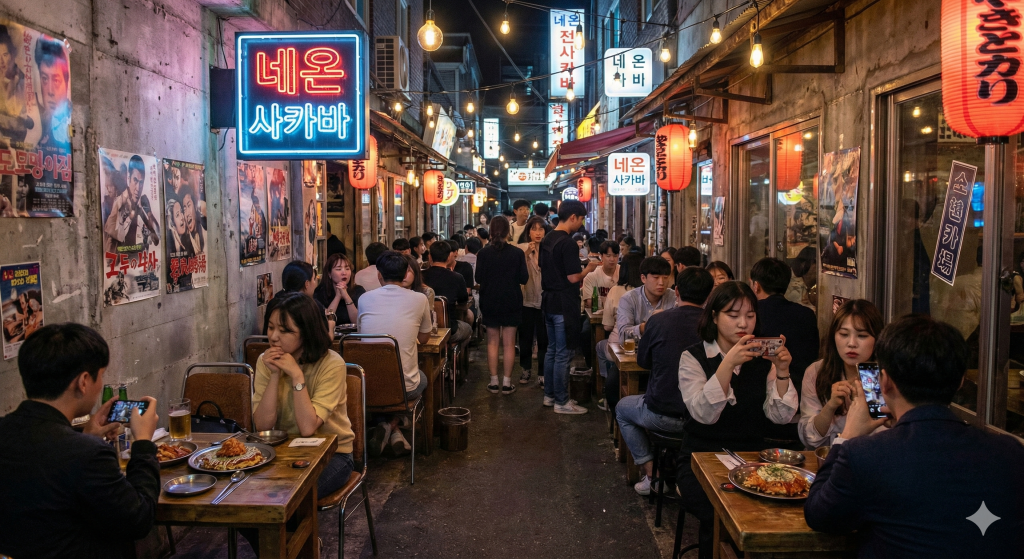
[Photo: Fictional Image of Japanese-style izakayas in Korea]
9. Conclusion: How to Increase Repeat Visits
If an establishment’s culinary framework relies on dopamine-centric attributes—characterized by high saccharide density, sharp spice profiles, and complex visual decorations—the customer retention rate will remain low. To transition toward higher customer loyalty, an operator must introduce endorphin-centric elements:
- Low-intensity ambient lighting
- Mild, savory flavor profiles that emphasize umami
- Sensory consistency prioritized over novelty
- An environment engineered for predictability rather than excitement
The operational objective must shift from driving initial consumer amazement to establishing comfort.
A definitive model of this strategy is Ttudari, a South Korean casual hospitality franchise established in 1987 that expanded to over 2,000 units. The operational architecture of Ttudari relies on specific baseline controls: low-intensity lighting, low-volume background audio, minimal marketing expenditures, and a stable emotional rhythm. The brand achieved long-term market survival not by introducing novelty, but by securing high repeatability.
To stabilize customer retention, an enterprise must cease the pursuit of dopamine-driven metrics. The business requires a pivot toward endorphin-driven design: reducing dopamine inputs and establishing long-term consumption endorphin rhythms.
Less Dopamine. More Endorphin

If you enjoyed this article, you can support the project – thank you!