
1. Why I Got Interested in FOH Optimization
One time, a group of American customers visited my restaurant. I had to process 16 separate payments. In Korea, there’s no tipping or Dutch pay culture — usually, one person handles the bill. But having to print 16 bills and confirm individual orders took me over 20 minutes. When I told my friend in the U.S., he laughed:
“Imagine if you had to calculate tips on top of that? You’d be toast. 😂”
That’s when I started thinking seriously about:
- How can a restaurant be optimized for Dutch pay culture?
- Is it possible to operate completely without FOH staff?
Sure, there are tech solutions like QR-code payments or enforcing a “1 table = 1 bill” policy, but not all customers understand these. And kiosks? Too expensive for small restaurants. This article is written for:
- People sick of tipping
- Independent restaurant owners who are interested with no FOH restaurants
2. My Eye-Opening Discovery in Prague: Havelská Koruna 🇨🇿
While traveling in Prague, I found a mind-blowing restaurant:
- No FOH servers
- Hot food served in 3 seconds (Cooked in Backstation)
- Hundreds of customers served with just 1 cashier
- By transitioning to line servers, they achieved an overwhelming increase in hourly throughput per staff member.
The place is called Havelská Koruna. [Official URL] MUST Watch: Shorts Video
(1) Spatial Layout Analysis
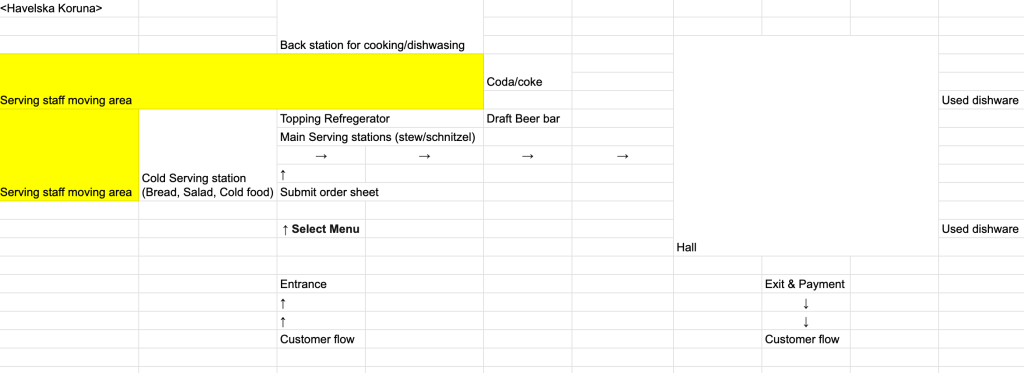
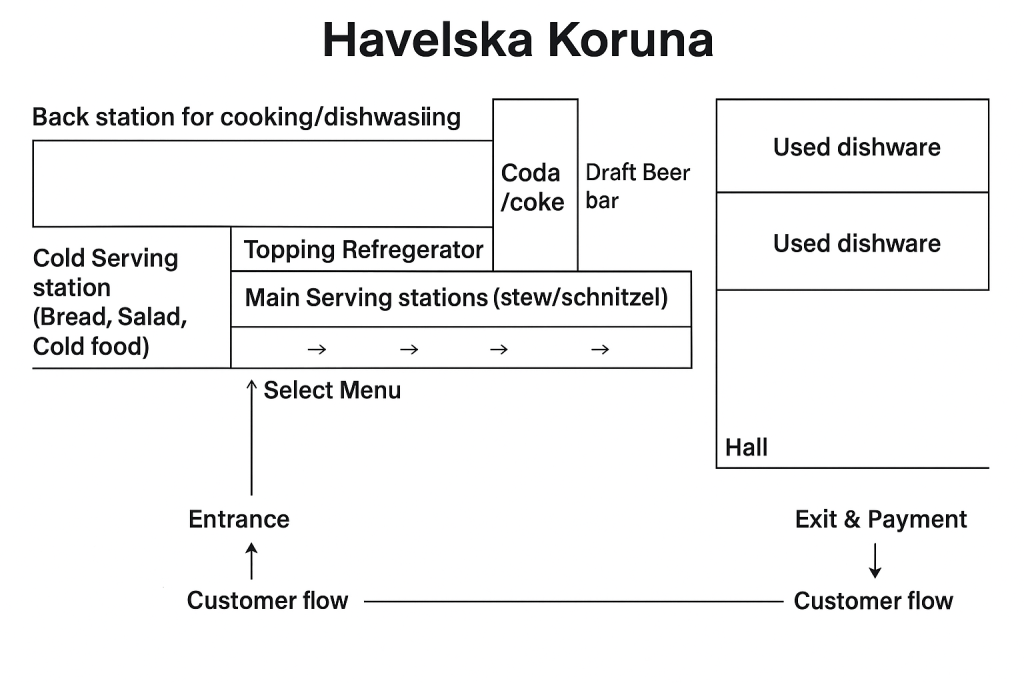
[Layout picture: A clumsy layout I drew myself. Sorry for bad picture 😂]
Havelská Koruna uses separate entrance and exit doors. Once inside, a menu board with numbers (e.g. 1. Svíčková, 2. Chicken Paprikash) greets you. You fill out an order slip and hand it over at the serving station. From there, you move like on a conveyor belt:
- Cold dishes → Stew/Fried food → Beer
- Within 3 seconds, you’re served!
It’s not fast food like burgers or hot dogs — it’s authentic Czech cuisine. After eating, place your tray at the return counter, show your slip to the exit-side cashier, and pay.


[Photo: Authentic Czech food I ordered with order slip]

[Photo: Customers receiving their food]
(2) Isn’t This Just a Buffet or Cafeteria?
Nope. Havelská Koruna is very different:
- Buffets offer variety but cause slowdowns from indecision and customers walking around.
- Institutional cafeterias (e.g., schools) offer no choice — you just eat what’s given.
Koruna offers 30+ menu options, but no customization. That means:
- No back-and-forth questions.
- No delay from “uhhh… what should I get?”
- No time wasted wandering.
And since the layout flows entrance → serving line → exit, your body naturally keeps moving like a parcel on a conveyor belt. Even beer refills require going back through the line — which deters lingering. So you finish eating, drink one beer, and leave. Efficient.
(3) Modular Station System (Like a Factory Line)
The whole restaurant is structured into fully independent modules:
- Entrance Station
- Kitchen (Back Station)
- Serving Station
- Cashier Station
- Dining Area
This modularity means there’s no cross-dependency. Each unit focuses only on its task → local optimization leads to system-wide optimization.
The most genius part? The cashier is completely separate from the servers. You just show your order slip to the woman at the exit and she rings you up — done in under 10 seconds per customer, even with Dutch pay.
Compare with a Typical Setup
In typical restaurants:
- One server handles 2–3 tables
- Takes orders → Explains menu → Brings food → Brings bill → Takes card → Returns receipt
This non-modular setup creates major bottlenecks:
- Server gets tied up in payment, kitchen gets annoyed: “Hey! Pick this up!”
- Delays in kitchen cause server to panic
- Servers constantly walk back and forth = wasted labor
In contrast, Havelská Koruna serves 200+ seats (1000~2000 person/day):
- No FOH staff
- Only one cashier
- Zero tipping
- No server bottlenecks
(4) No FOH = No Emotional Labor, No Tip Drama
No front-of-house means:
- No awkward tipping
- No one hovering over you with fake smiles
- No “you didn’t tip enough” guilt
Customers pay 20% less than a typical sit-down restaurant, get served real food, and leave happy. Also, no one gets into emotional conflicts over service — because there’s no service interaction at all. You just grab your tray and go.
(5) Food System That Maximizes Speed
What makes their food so fast?
- Menu Variations = Same Structure
- Almost every dish = Protein (beef/chicken/pork) + Gravy + Carb (rice/bread/potato)
- Example:
- Chicken Paprikash = chicken + paprika sauce + rice
- Svíčková = beef + creamy gravy + knedlíky (dumplings)
- Think Lego-style combinations. Easy to prep, fast to serve.
- Heat-to-Serve System
- No made-to-order dishes like burgers or pasta
- All dishes are pre-cooked and either reheated or served warm
- Even fried items are kept warm in small rotating batches to avoid sogginess
Result? Faster than Burger King, but feels like a home-cooked meal — no buzzers, no apps, no FOH staff, and no chaos.
3. Historical Roots: The Soviet Stolovaya System
Havelská Koruna’s model actually traces back to the Soviet Stolovaya system.
Watch these:
- Cheapest Restaurant in Russia, Stolovaya
- What Is A Stolovaya?
(1) Stolovaya = Socialist Mass Dining
These were state-run cafeterias located in factories, schools, hospitals — designed to:
- Deliver calories efficiently
- Encourage equality in meal access
- Minimize waste
Their flow was identical:
- Entrance → Menu → Serving line → Payment → Eating → Tray return → Exit
Even better: Payment happened before eating (via ticket submission), making dine-and-dash impossible. Many Soviet ones relied on microwaves instead of induction — keeping the heat-to-serve idea intact. It is interesting that a socialist country implemented a model with a faster turnover rate than capitalist Burger King.
4. Downsides of the System
Let’s be honest — it’s not perfect.
- No Human Warmth
- Staff don’t smile or greet you.
- They just do their job — cook, serve, charge.
- For cultures that expect “hospitality,” this feels cold.
- Low Prestige
- Not ideal for business dinners or special dates.
- Hard to imagine bringing your boss and making them carry their own tray 😅
- Minimal Customization
- No lingering
- No fancy plating
- No “can I get that with extra cheese and no onions?”
It’s a “survival-first” food system, not a “let’s enjoy a 2-hour lunch” one.
5. When Is This System Ideal?
I ate at Havelská Koruna every day for 6 days in Prague. At lunchtime, it felt like all the workers downtown gathered there. This system works best when the priority is:
- Fast
- Cheap
- Filling
Where this could work in:
- Urban lunch spots with high turnover needs
- Areas with staff shortages (e.g. small towns)
- Worker-focused restaurants (e.g. construction zones, warehouse areas)
- University areas with “no tipping” culture
6. Final Thoughts
Havelská Koruna is an extreme-efficiency model that eliminates FOH labor. It turns dining into:
- Not experience + ambiance
- But fast, cheap, survival-level eating (Really delicious, though. You should go if you visit Prague.)
It modularizes everything — prep, service, payment — into separate flow stations. And though it’s not fast food, it beats fast food in speed. This system aligns with my vision for the “Toyota Pub”:
- Minimal emotional labor
- Maximum flow efficiency
- Profit-first structure with zero fluff

If you enjoyed this article, you can support the project – thank you!