
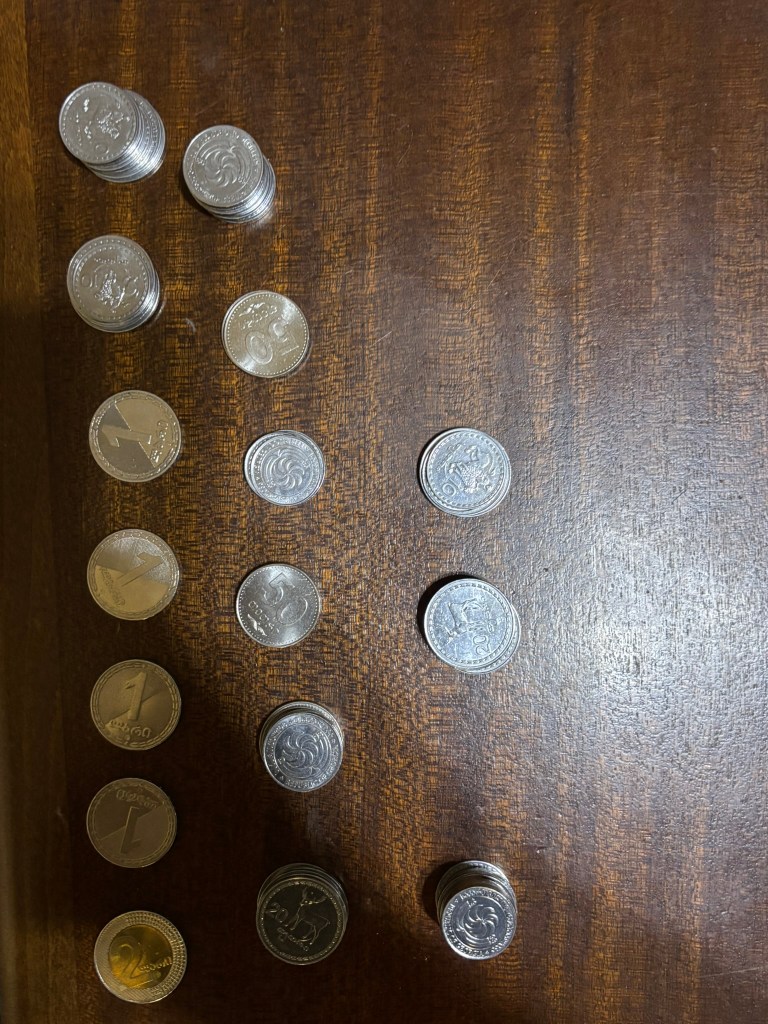
[Photo: Look how much Georgia Coin I have, Source: Myself]
1. Observation: The “Cash Rhythm” You Can’t Find in Seoul
In Korea, cash is almost extinct. Every payment is made by card, or faster yet, with Samsung Pay or Apple Pay. The very feeling of handing something over has disappeared from daily life.
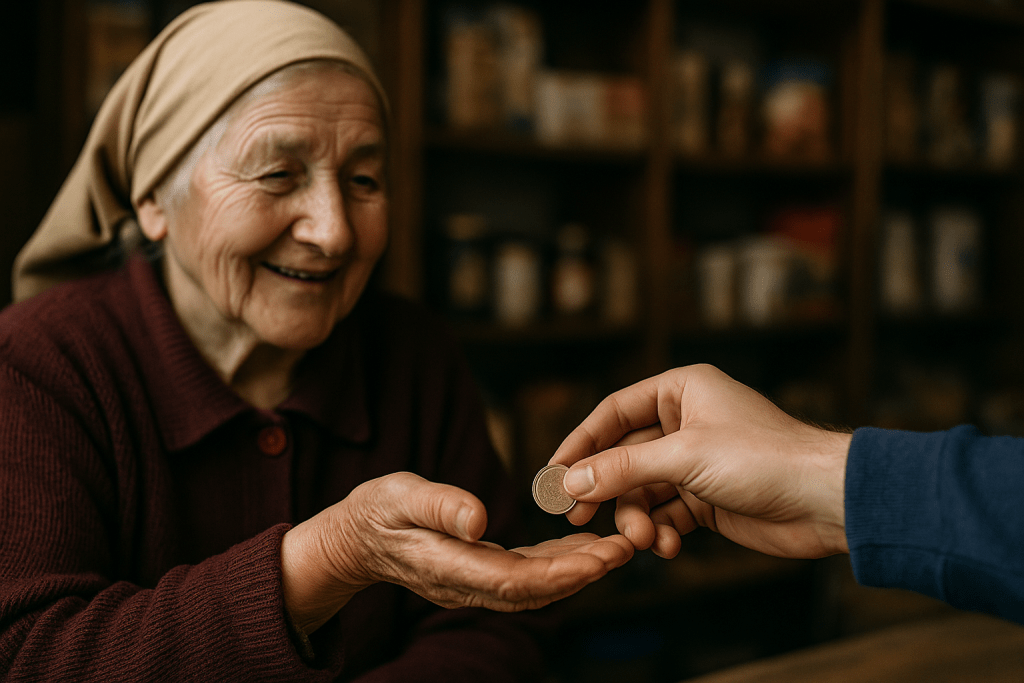
But Gori is different. Here, cash is still alive as a kind of textural reality in everyday transactions. Heavy coins pass from hand to hand, paper bills with a faint musty smell fold and unfold, and shopkeepers pour loose change into your palm. In that clumsy physicality, I feel myself taking part in the exchange. A sense of relationship. And here’s the interesting part: Even if the price tag says 3.39 GEL, the actual price you pay is not fixed.
- Some days, 3.39 → 3.5
- Other days, 3.39 → 3.0
- And if there’s no change available, the shopkeeper simply smiles: “Tomorrow, ok?”
In Seoul, this level of looseness would be unthinkable. In Gori, it’s just the everyday norm.
2. From the Owner’s Perspective – The Economics of Sustainability
In Korea, small business owners obsessively match their cash register totals. CCTV monitoring. POS reconciliation. Receipt verification. The work continues long after the last customer leaves. Gori is the opposite. Here, the flow of the shop matters far more than precise cash totals. Why?
- There aren’t many banks in Gori
- To restock coins, you must walk all the way to city hall
- 0.2 GEL = about 100 KRW (0.07 USD)
- Spending labor, emotion, and time to fix a tiny discrepancy is net inefficient
In other words, this is a culture that favors overall optimization over partial optimization. If the shop loses 0.2 GEL today, it will naturally gain 0.2 GEL tomorrow.
- In Seoul logic: “Cash register mismatch = big problem.”
- In Gori logic: “So what? It’ll balance out anyway.”
And this flexibility protects owners and workers from burning out. Endorphin-based sustainability isn’t a skill — it’s an attitude.
3. From the Customer’s Perspective – The Small Pleasure of the Unexpected
For customers, this loose change culture creates surprising little joys.
- If I receive +0.2 GEL, I think: “Nice, lucky day.”
- If I pay –0.2 GEL, I think: “That’s fine — fewer coins to carry.”
Some days, my pockets feel too heavy, and I purposely stop by a random store just to get rid of the coins. After paying, I think: “Finally emptied them. That feels good.”
Gori doesn’t have many attractions or flashy distractions like Seoul. So these tiny episodes create small ripples in an otherwise quiet day. In Seoul, a 10-won coin never gives you this experience. But in Gori, 0.1–0.2 GEL can actually shift your perception. It’s just like a daily fortune cookie.
4. A Zhuangzi Perspective – If You Want to Change the Phenomenon, Change the World Around It
Zhuangzi tells this story:
A hat seller from Song went to Yue to sell hats. But the people of Yue shaved their heads and tattooed their bodies — they had no need for hats.
A Seoul-style interpretation would be:
- Lack of market research
- Poor customer analysis
- Failed marketing
But Zhuangzi meant something entirely different:
“If you want to see the world differently, go to a place where your old framework no longer works.”
I understood this only after coming to Gori. In Seoul, a 10-won coin is the symbol of uselessness — a burdensome piece of metal you never know what to do with. But here, the same coin becomes a sensory event that shifts your mood and the rhythm of your day.
The coin (the object) didn’t change. What changed was the world the coin exists in — and therefore the meaning of the object. Frameworks don’t change through willpower or clever thought. Change the place, and the frame changes on its own.
5. Conclusion
A few coins can change your emotional landscape. A tiny shift, but one that softens your entire day. New perception isn’t realized through effort. It’s something a new environment naturally teaches you. And here in Gori, I’m learning that lesson in units of 0.2 GEL at a time.
#Gori #Gori life #Georgia #Endorphin Life #Saltnfire #Phenomenology

If you enjoyed this article, you can support the project – thank you!