

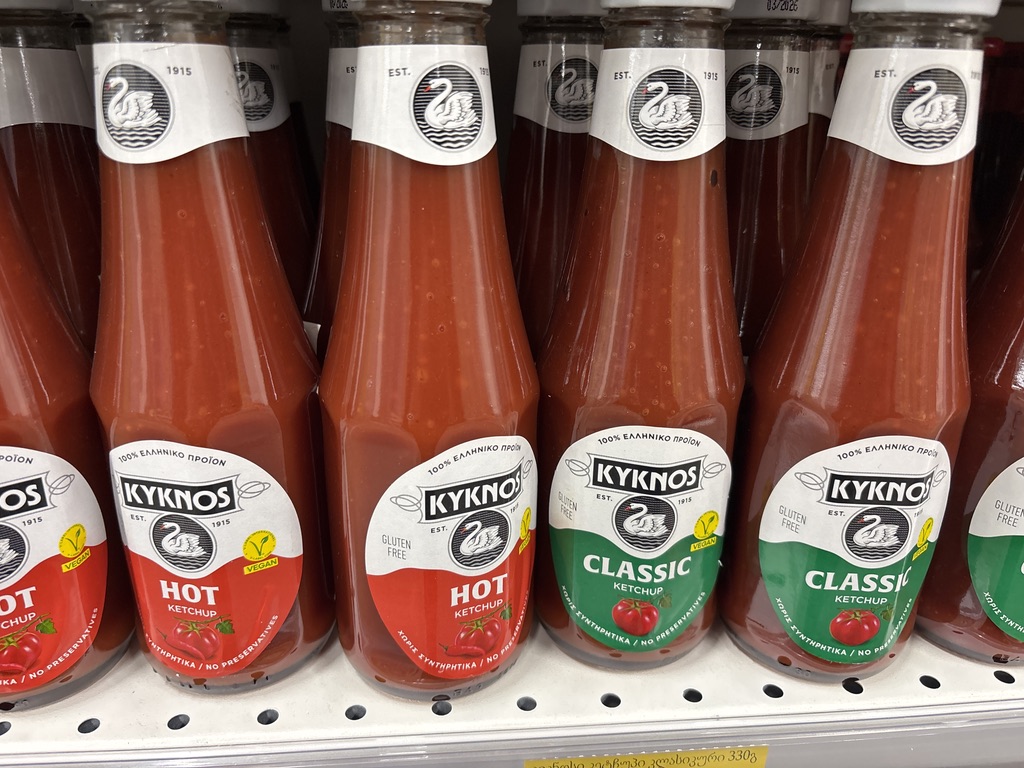
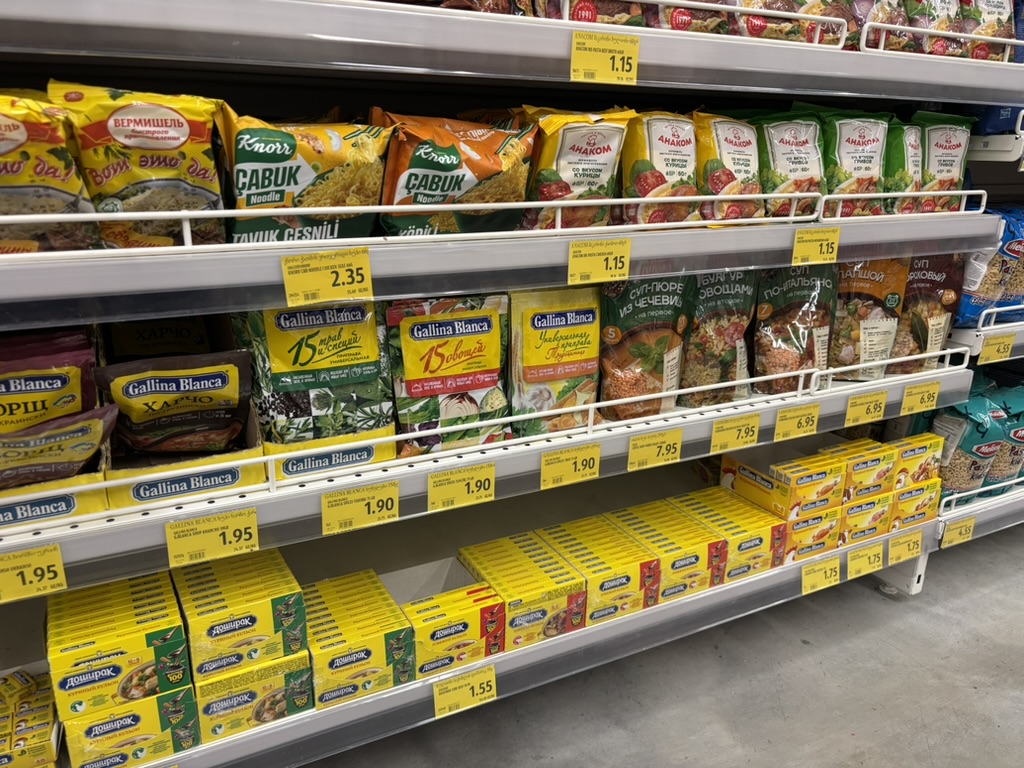
[Photo: Gori-mall , Source: Myself]
Although the Aura branding posts have been quiet lately, what I’ve actually been observing in Gori is a world that operates in the exact opposite way from the “aura economy.” Back in Seoul, the formula we analyzed looked like this: “Guru’s lifestyle → mise-en-scène (space) → object (food/product)”
When these three align, an aura forms. Customers see the world they want to see in that space. That was participatory perception. The theoretical foundation came from Brillat-Savarin’s famous line:
“Tell me what you eat, and I will tell you who you are.”
This became the starting point of my model. But in Gori, this aura-based logic does not work at all. In fact, this town reveals a society where an aura is completely unnecessary.
1. In Gori, people don’t pay for “specialness.” They pay for function.
All the restaurants are similar:
- similar menus
- similar recipes
- similar “Georgian family home” atmosphere
Most places are run by families across generations—grandmother → mother → children. There’s no reason for “concept competition” like in Seoul. In Seoul, businesses implicitly tell customers:
“I’ll give you a special experience, so pay more.”
But in Gori, this formula collapses instantly. Here, the logic is:
“No need to be special. Just be cheap, fast, familiar, and tasty.”
That’s why restaurants, cafés, and bars in Gori operate not as “aura businesses,” but almost like supermarket-style utility hubs.
2. Why American fast food fails here
The KFC in the Gori mall is always empty. As a Korean, it’s bizarre—only a few kids are there from time to time. But once you understand the consumption pattern of this city, the answer is obvious.
- KFC price: $10
- Gori residents’ mental benchmark: $0.50 kidney-bean bread (Lobiani)
KFC’s real competitor in Gori is not Burger King— it’s the $0.50 local bread that people buy 2–3 pieces of after work. KFC is a Daily & Casual Concept, but if a burger set costs $10, it’s too expensive for Gori. Bread is the staple. Every home has a pantry full of fermented foods, cheese, and homemade wine. The dining table is where the whole family sits together. So imagine putting a KFC box on that table. Culturally, it feels… off. 😭 Selling American-style “daily food” for $10 does not match the economic rhythm of this town.
3. “Special foods” do sell — but their definition is different.
Even in Gori, foods that are hard to make at home sell well. But the criteria for “special” here is very different from Seoul.
- Not this: ✘ visual flair , ✘ photogenic plates , ✘ aura branding
- But rather: ✔ technically difficult dishes that people can’t make at home
This isn’t a Seoul-style “today you’re a special version of yourself” upsell. This is purely functional specialness.
4. So where is the real commercial center of Gori?
The answer: Supermarkets + street markets. Behind the Gori Fortress, the street market is packed all day. Mini-markets like Libre & Daily are hidden in every neighborhood, and they’re always crowded. But not so many fancy restaurants. The reason is simple:
People cook at home. Why pay expensive rent for a storefront?
This is a quote I read in a book by economist Christopher Coyne, which stated that as any country grows wealthier, the division of labor and exchange expand, making people dependent on others’ production for their livelihoods. Because I am currently poor, I source raw ingredients and cook for myself like this. Yet, there is a subtle joy in poverty. I hunt through discount sections wondering, “What’s cheap today?” and occasionally sip wine and cognac given to me by my elderly landlady. Regardless of my efforts to become wealthy, I will not choose a consumerist lifestyle. That wild instinct of hunting to produce is the very engine of creativity.
Conclusion: Gori runs on the Supermarket Model
There is no aura competition. No branding competition. No SNS-driven emotional economy. The winners here are the places that are:
✔ cheap
✔ fast
✔ familiar
✔ functionally rational
Gori’s entire infrastructure is built on:
- home cooking
- street markets
- supermarkets
That’s why supermarkets dominate this city’s economy.
#Gori #Gori life #Georgia #Endorphin Life #Saltnfire #Phenomenology

If you enjoyed this article, you can support the project – thank you!