
The city I now live in, Gori, is the birthplace of the man who built the foundations of the Soviet Union — a dictator, a control-obsessed tyrant, a man who killed countless others: Iosif Stalin.
I still remember what the immigration officers asked me when I landed in Georgia: “What will you do here?” I told them, “I’m going to visit the Stalin Museum in Gori.” They smiled once, then frowned. Georgia yearns to escape Russia’s shadow. Yet, ironically, its most famous son became the god-like figure of the Soviet Empire. This irony still lingers on every street corner.
1. The Museum and the Square
Let’s begin with the first room of the Stalin Museum. Finding it is easy — it stands right in the center of Gori. That’s because the entire city was designed and completed under Soviet planning. At its heart spreads a wide square, leading to the museum. Communism loves squares. Red Square in Moscow. Tiananmen Square in Beijing. Heroes’ Square in Budapest. And now — Stalin Street in Gori.
The emperor’s power rises from the palace, but the people’s power rises from the square. The palace hides; the square exposes. If the sole source of power were lineage, a public square would not be necessary. However, people’s democracies centered around the Communist Party are different. They must gather the masses, deliver speeches, win support, and flaunt their legitimacy. This is why all dictators think about constructing public squares. They derive great satisfaction from looking down upon the crowd. Yet, nothing comes free. Paradoxically, this also leads to pressure from the crowd on the ruler, prompting the state to cultivate a powerful police force and military to counter it.
Consequently, countries that prioritize the rule of law and freedom do not place public squares at the center of their capitals. Democratic nations with public squares at the heart of their governing facilities are easily exposed to populist pressure. In the past, South Korean President Lee Myung-bak also confessed that during the peak of the protests against U.S. beef imports, he could not fall asleep due to the roaring sounds of the masses gathered in the square.
2. The Statue of Steel
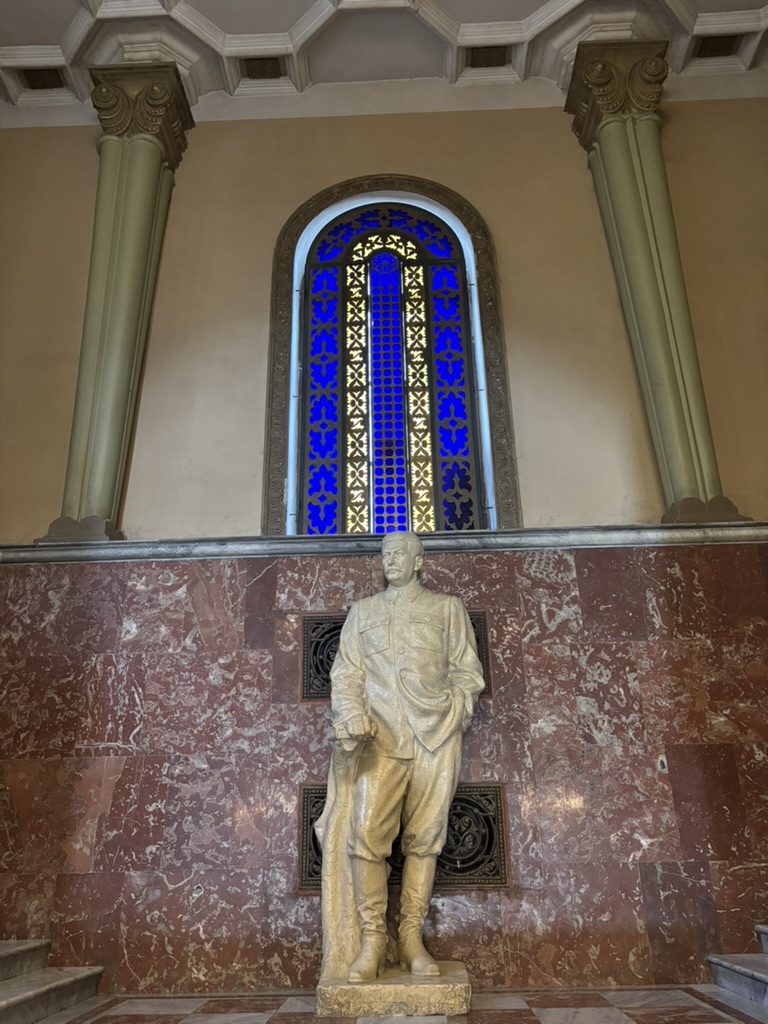
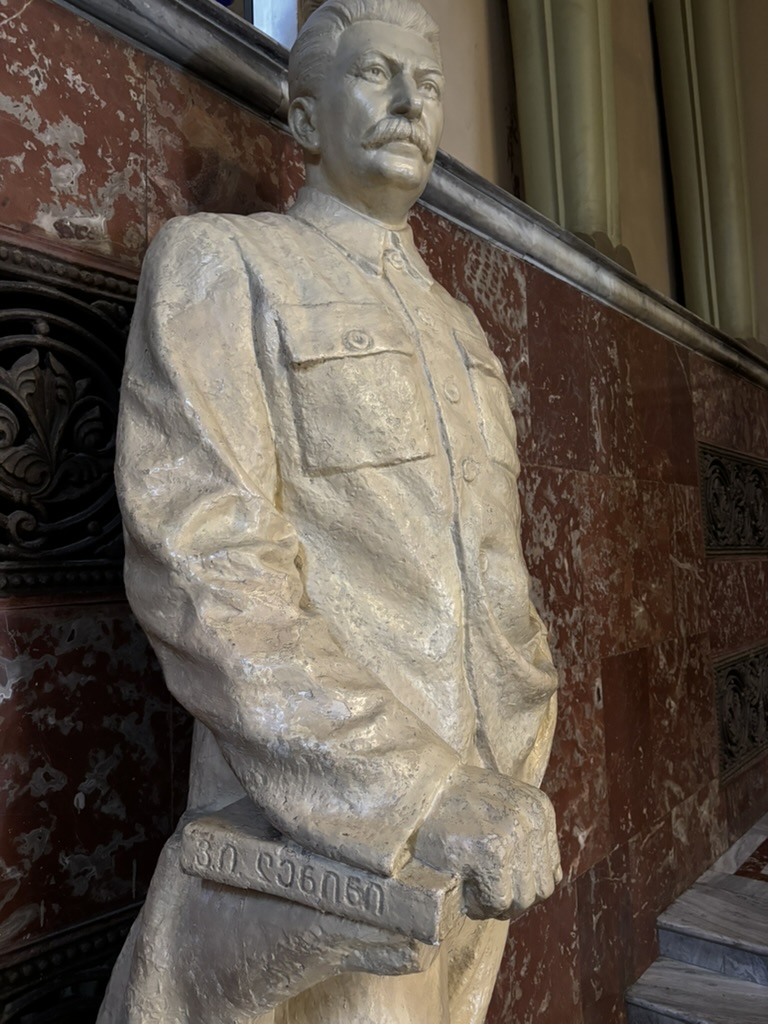
[Photo: Stalin Museum, Gori. (Source: myself)]
Ticket: 15 GEL (about $5). Climb the stairs and you meet him —Stalin, frozen in bronze. He stares upward at a thirty-degree angle, careful not to meet your eyes. Even statues can’t afford to lose their poise. One hand buried in his pocket, the other clenched tight — a strong man, made of steel. His name even means steel. He holds a book. Stalin owned around 20,000 volumes, a voracious reader who fashioned himself as the intellectual heir to Marx and Lenin. But reading never guarantees wisdom or morality. He remains the finest proof that a man can devour libraries and still be empty. He didn’t live by the grain of paper — he lived by the grain of metal.
3. A Theology of Power
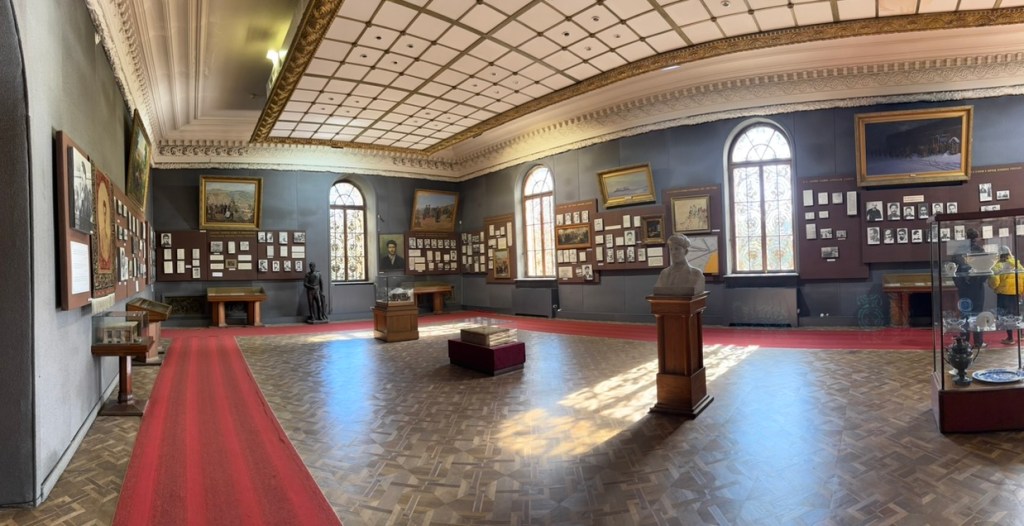

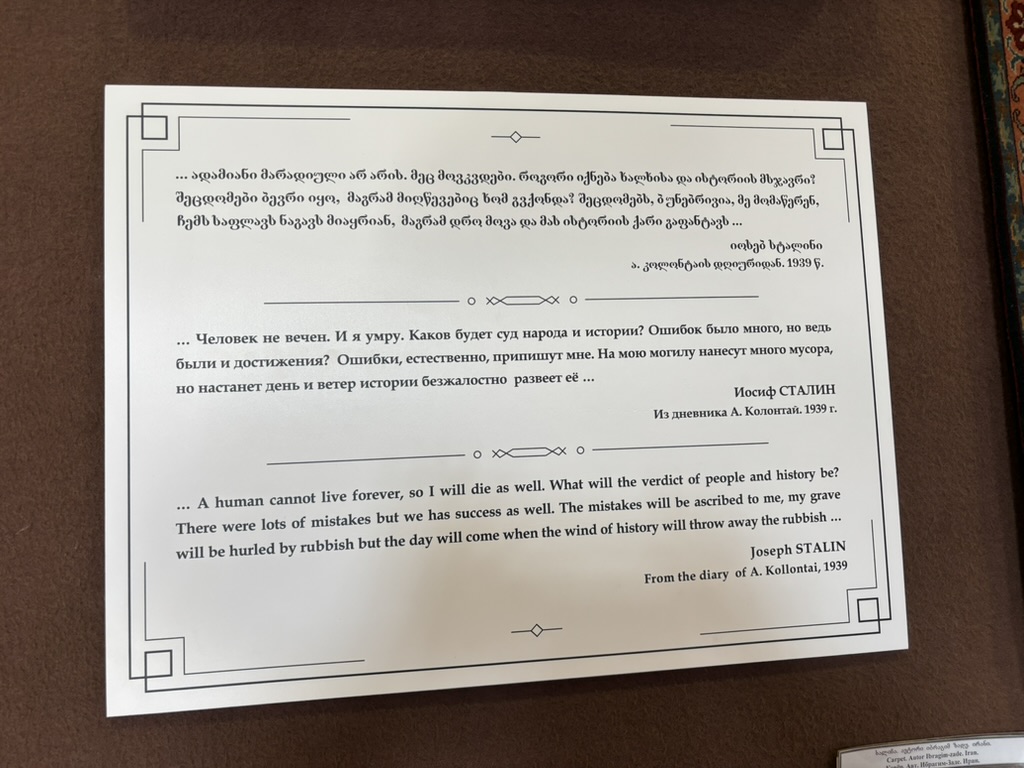
[Photo: 1st room of the Museum, Stalin house, 1939 diary. (Source: Myself)]
The first room on the second floor shows Stalin’s childhood and youth. One glass case displays his 1939 diary — written when he stood at the summit of Soviet power. Even there, you sense unease and self-justification: a man hoping history will absolve him.
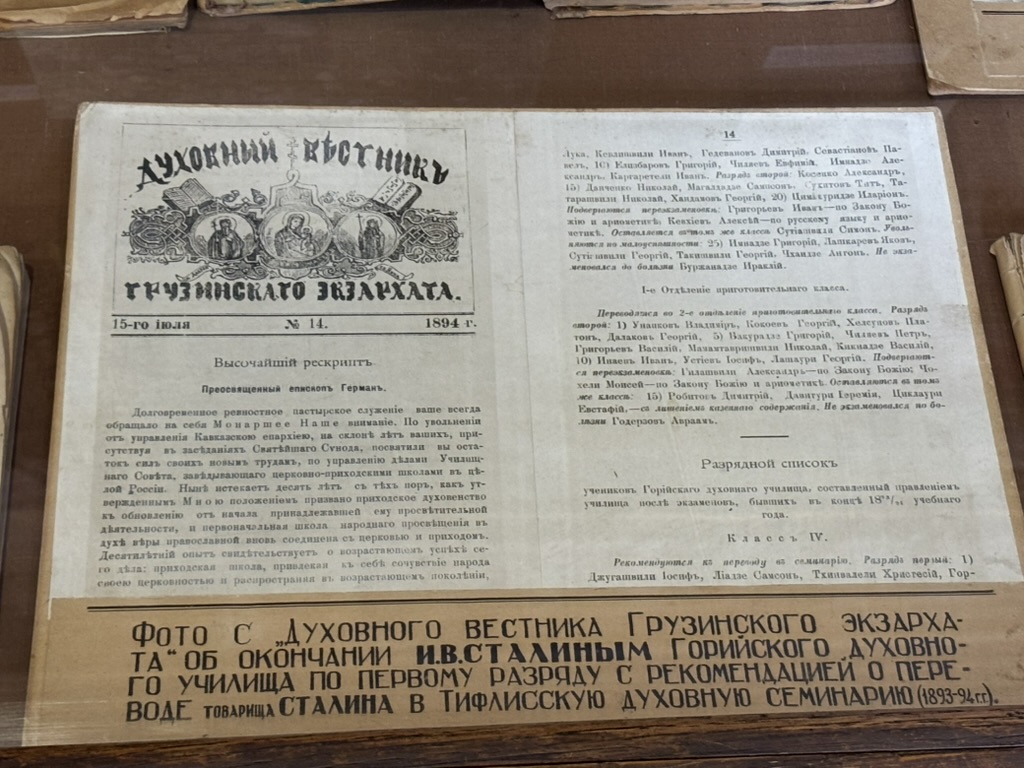
Another exhibit reveals that Stalin graduated with honors from the Gori Theological Seminary. Hitler was a painter. Stalin, a seminarian. Both tried to reshape the world—one with a palette and brush, the other with the Bible and theology. Neither foreknew where their road would lead. But life is often like that.
4. The Meeting in Gorki, 1922

[Original Source: wikipedia]

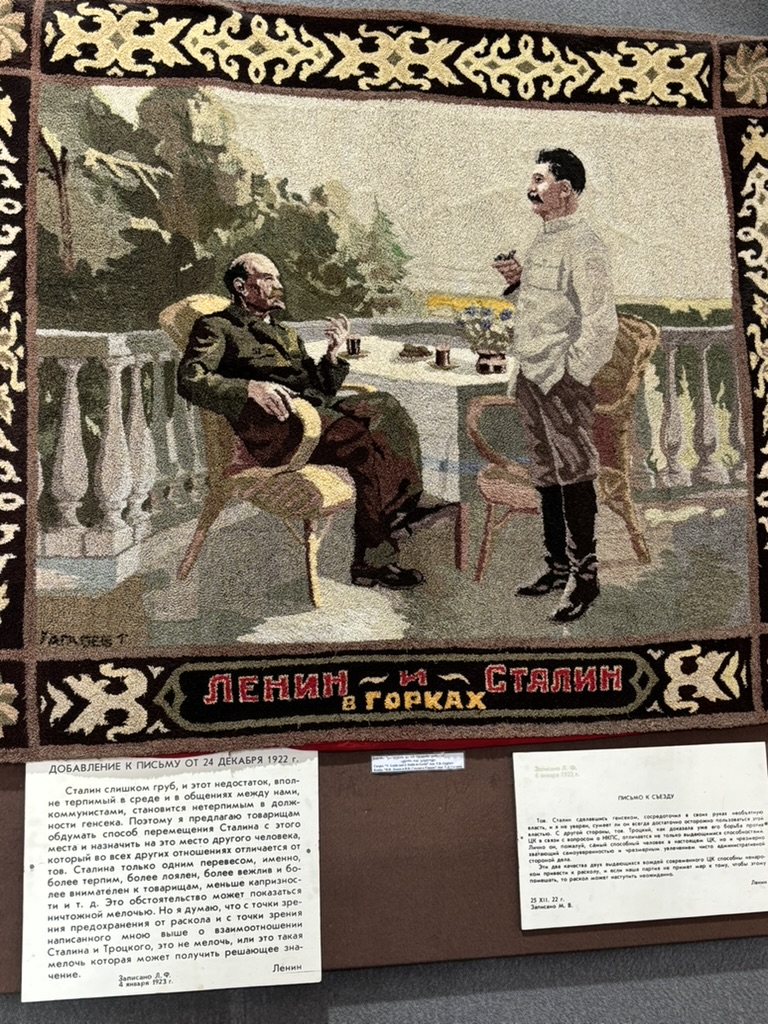
Among all the artifacts, one image caught my eye — a woven carpet depicting Lenin and Stalin meeting in Gorki, 1922.(Left one) It was such a historic encounter that they immortalized it in tapestry. The composition reminded me of Raphael’s School of Athens. A philosopher’s dialogue on what kind of world to build — Plato points to the heavens (ideal), Aristotle to the earth (reality).
Here, Lenin points upward — his hand frail, his face pale. Stalin stands firm, tall, one hand in his pocket, his dark hair and moustache cutting sharp lines against the light. Lenin gestures toward the sky. Stalin looks down at the ground. The theorist meets the realist. And the realist will win. Follow the golden ratio line through the frame — Stalin stands at the center axis; Lenin fades into the shadow.
5. The Testament Below
![[Photo: Lenin's final testament]](https://saltnfire.net/wp-content/uploads/2025/10/Lenin-statement.jpg)
[Photo: Lenin’s final testament]
Beneath the image lies Lenin’s final note — his testament. In it, he warned that Stalin’s temper and authoritarian instinct were dangerous for the Party. He urged that Stalin be removed from the post of General Secretary. It’s strange, isn’t it? Even inside Stalin’s museum, Lenin’s warning still whispers from under his feet. Lenin saw the cruelty inside him. He, the revered architect of revolution, feared his own disciple —the man who would out-Soviet the Soviets.
6. Faith, Power, and the Machine
As the leader of the Russian Revolution, Lenin may have possessed a touch of romanticism. This is often true for all founding pioneers. However, just as a disciple in a corporation organizes the predecessor’s ideology into a structured system, Stalin—Lenin’s disciple—bore the responsibility of inheriting Marxist-Leninism ideologically while simultaneously finalizing the state structure of the Soviet Union. In other words, he had to prove that communism was systematically superior to capitalism when it came to industrialization. To achieve this rapid industrialization, he was prepared to tolerate any form of violent means.
(To be continued in Gori Note 14 —“The Museum’s Second Room: The Making of a God.”)
#Gori #Gori life #Georgia #Endorphin Life #Saltnfire #Phenomenology

If you enjoyed this article, you can support the project – thank you!