
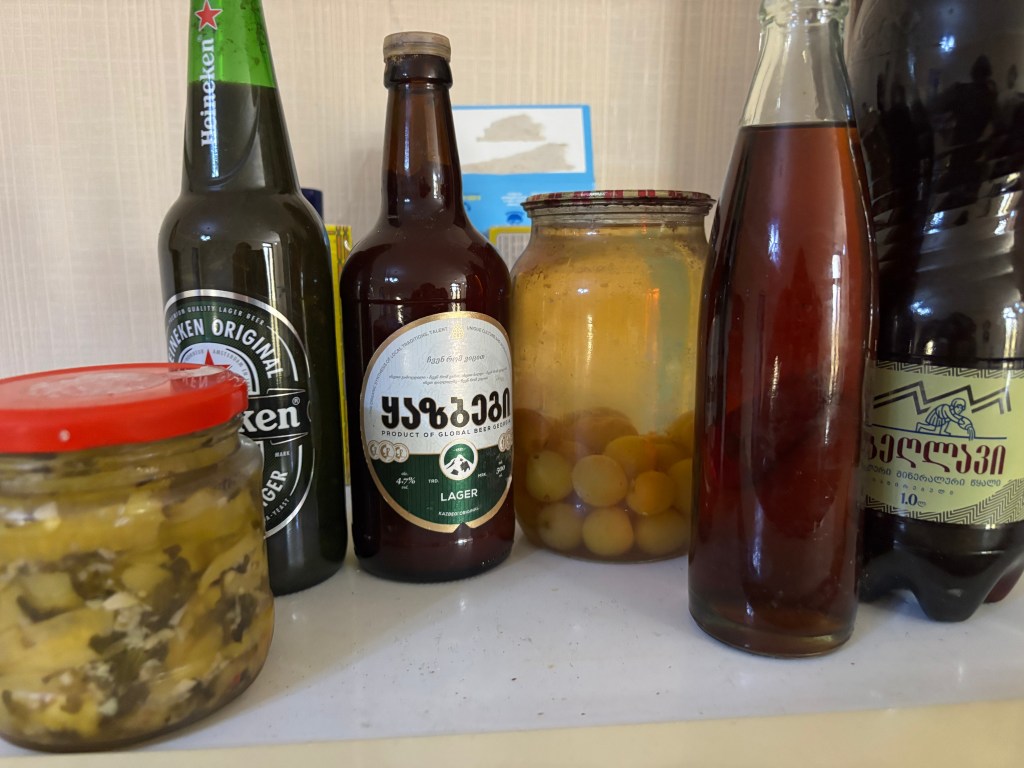
[Photo: Cognac, tomato paste, and pickles obtained from the underground warehouse]
Today, I did nothing. I didn’t have the energy to write or read, so I drifted through the day. The rhythm I learned in Seoul—“burn out on weekdays, collapse on weekends”—was still burning in my body. Guilt and impatience pressed in, a hangover from years of productivity anxiety. Only my thumb, scrolling through webtoons(Korean Manga), kept moving.
Then the landlady and her grandson invited me for tea. The living room was dim. Most Soviet-era homes aren’t brightly lit. It felt like a room gently removed from the world’s fast rhythm, a place where time slows down.
The grandmother poured two cups as if performing a slow ritual. The first was strong black tea; the second, a fragrant Earl Grey. Dessert was Tatara, a jelly-like food made by simmering grape juice for a long time. Cold, soft, and trembling—its condensed sweetness seeped out with each bite.
Next came Medovik, a honey cake layered with dense, sticky cream— a sweetness completely different from Korean cakes. Korea’s rhythm is “salty, spicy, fried.” Georgia’s is “sweet, simmered, fermented”— a rhythm of accumulation, not impact. It forms the foundation of their taste.
Then came the alcohol. All homemade: wine, cognac, liqueur— all made from grapes. (It was my first time trying home-brewed alcohol !) Strong, yet gentle going down. Sweet, but not tiring. Eating Tatara alongside it made the grape aroma bloom even more. My first experience of a “united front of sweetness.”
Georgians treat guests with extraordinary generosity. Even strangers are offered a full glass without hesitation. The first toast was for everyone’s health. The second was for the warriors and ancestors who made this gathering possible.
That part struck me. In Korea, the culture of honoring ancestors has almost disappeared. Chuseok and Lunar New Year have turned into travel & shopping seasons. I don’t even know my grandparents’ names.
But in Georgia, ancestors are always present in daily life. The finiteness of individual life is replaced by collective memory. Children are named after their forebears. Their photos and belongings are preserved. Maintaining the house and land handed down by past generations is both a job and an obligation. It is continuity—something that comes before money. Money is good. But Memories are precious.
The grandson said, “People in Gori are actually curious about East Asians. They just don’t show it well.” I laughed. “No wonder everyone looked so cold.” They hide their curiosity behind blank faces. If you look familiar, people might ask: “What are you doing in Gori?”, “Where do you sleep?” Instead of expressions, they offer alcohol. Instead of words, they offer food.
We went down to the cellar. Cherry preserves, wine, tomato paste, cheese, brandy, pickles— stacked like small mountains. They say the cellar stays cool in summer and doesn’t freeze hard in winter, so food keeps for years. A storage room where time itself seems to settle.
When the jar lid opened, the smell of fully fermented grapes rose sharply. The grandmother handed me a few bottles—homemade cognac, tomato paste, pickles—stored in Heineken bottle, Damashni Doktor (Home doctor in Russian) bottles, and old Georgian glass jars.
Evenings in Gori pass like this. Life here is not hurried. Time accumulates slowly— like grapes, like apples, like the wine resting in the cellar— an endorphin rhythm where meaning deepens in the process, not the result.
#Gori #Gori life #Georgia #Endorphin Life #Saltnfire #Phenomenology

If you enjoyed this article, you can support the project – thank you!