

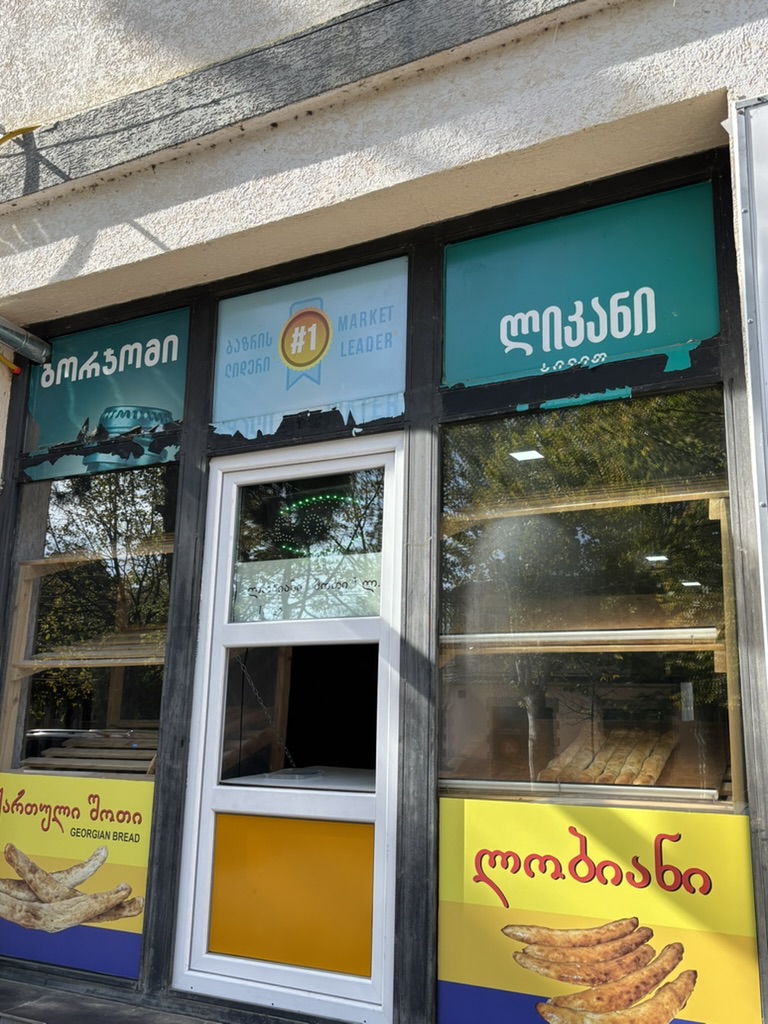
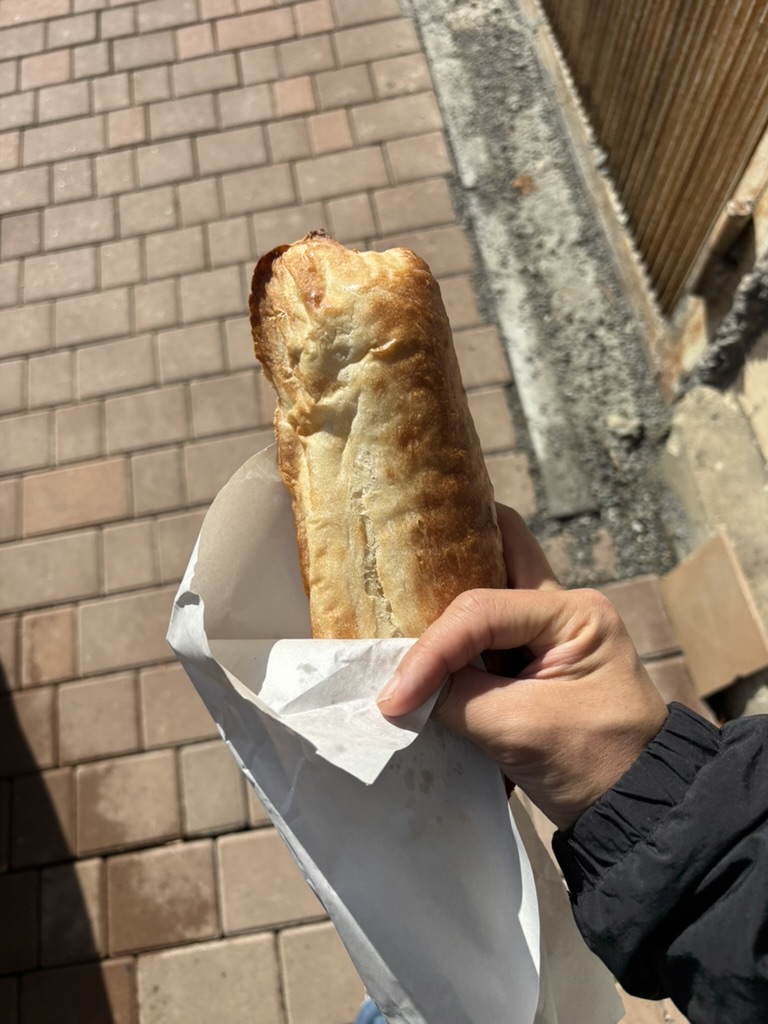
(Photos: ipkli.ge bread packaging, a backstreet lobiani bakery, and the loaf I bought there)
The smell of lobiani — the Georgian bean bread — still lingers in the streets of Gori. Every morning, men pull dozens of loaves out of the traditional clay oven, and kids tear off a piece of the hot bread with both hands. But one by one, those bakeries are disappearing. Cold tandoor ovens, shutters pulled down, “for rent” signs taped to glass doors. Meanwhile, trucks race toward the supermarkets, loaded with thousands of factory-made loaves branded ipkli.ge.
1. The battlefield of bread in Gori
Traditional bakeries in Gori make only two kinds of bread — Lobiani (bean-filled bread) and Tone Puri (flat clay-oven bread). Once the oven heats up, they bake in batches of dozens at a time. Price: 1 lari (about 50 cents) — one loaf and a glass of milk, and you’re full.
But that’s exactly the problem — it’s too cheap. Even if they sell a few hundred a day, there’s no real profit. From the consumer’s perspective, this deflationary price competition among producers is highly favorable, yet it leaves one wondering how these shops manage to keep their doors open. After all, in modern democracies, inflation is the baseline reality everywhere. However, these producers do not rely on the state, nor do they care about the digital illusions of YouTube or the high-priced consumer goods driving social media into a frenzy. In a community where everyone is separated by just a few degrees of kinship, what is the point of flexing?
They live in inherited homes, transact exclusively in cash, and bake in decades-old ovens, maintaining a capital depreciation rate of zero. With virtually no tax burden (at a mere 1%) and cellars stocked with wine, cognac, and cheese, inflation becomes someone else’s problem. The ambitious youth who crave serious wealth simply migrate to Germany or Poland to send remittances back home; they do not waste their energy trying to change the system.
2. Is Traditional Bread is losing ?
Traditional bread wins in taste. Chewy texture, perfect crumb, crisp crust—it’s pure bread minimalism: no butter, no milk, no sugar. The beauty of raw ingredients. Traditional bread, on the other hand, is immediate. Baked today, shared today. It belongs to the rhythm of agrarian life — communal, ephemeral, warm.
Nevertheless, shifts are occurring. Conglomerate bread brands, like ipkli, are beginning to flood the supermarkets. Yet, traditional bread remains cheaper than ipkli’s mass-produced alternatives—this is the raw price competition engineered by local producers. To survive, small business owners are diversifying their offerings with items like Khachapuri and cakes, while doubles down on customer relationship management. Ultimately, consumers enjoy a wider matrix of choices, navigating between the fluffy, mass-manufactured sandwich loaves of major corporations and the rustic, baguette-style traditional breads of local bakers.
3. Baking Cakes In-House is Cost-Prohibitive in Gori
Bakeries in Gori do not boast extensive menus packed with dozens of varieties of cakes, sandwiches, or fried breads. Nor do they overstuff their pastries. It’s not about recipes; Wi-Fi and YouTube work perfectly fine here. The issue lies in infrastructure and culinary culture.
In Korea, bakeries rely heavily on butter. But butter is sensitive to temperature—it melts above 20°C. Gori lacks stable refrigeration. Even many new apartments have no air conditioning. So bakeries can’t maintain the environment needed for butter-based or cream-based products.
The capital expenditure for equipment, such as commercial ovens, is also prohibitively expensive. Consequently, rather than baking cakes from scratch in-house, most establishments source third-party OEM products and sell them by the slice.
So if you crave cake in Gori, don’t be surprised — you’ll find it in a side-dish store. (🎩 Tip : I recommend Mag Bakery, Gori — surprisingly good!. They have a side-dish, too)
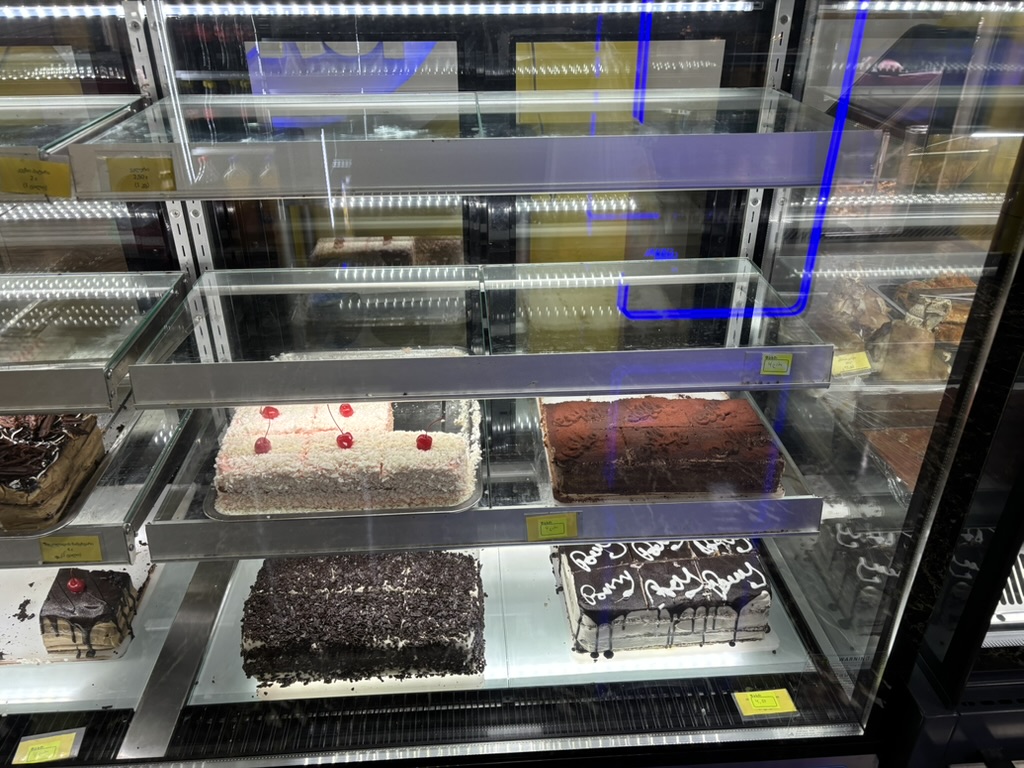
[Photo: Location of Mag Bakery and Cake]
4. The rhythm of bread — and the direction of survival
Walk through Gori and you’ll see it clearly: one side closing tandoors, the other unloading supermarket bread. Both make “bread,” but their rhythms are worlds apart. I still root for the small bakeries, for the men in white aprons slapping dough onto the clay walls. That’s where the aura lives — in the gesture, the heat, the sound. That’s the reality of The Bread War. And perhaps, the smallest version of every industrial story we live through.
The informal economy, operating entirely free from state intervention, is in fact a fiercely competitive battleground. Yet, it remains vastly more dynamic than a distorted system where capital is bled dry by non-productive marketing expenditures, inflation, heavy regulation, and extortionate taxation. Under this raw market order, consumers enjoy the sovereign right to choose without being forced to pay for inflated hype. Perhaps this Hobbesian “war of all against all” is precisely what keeps both producers and consumers awake and alert—a relentless war waged to sell and to buy. The very moment we comfortably surrender everything to the state and lie down, our individual freedom is ground to dust in the mills of bureaucracy.
Some youths resent the fact that the state provides absolutely nothing for them. However, if the state does take responsibility for your life, it never comes free. In exchange, they plunder your assets, mortgage your descendants’ future, and dismantle the family unit. One must realize that it is precisely because the state does nothing that you are able to be free.
Life is something that not even your parents can take ultimate responsibility for. Therefore, the duty to compete with others and to strive to become a better, more affordable bread lies solely upon your own shoulders.
#Gori #Gori life #Georgia #Endorphin Life #Saltnfire #Phenomenology

If you enjoyed this article, you can support the project – thank you!