
This is part of a fictional series inspired by reader discussions. All names and quotes are anonymized and partially fictionalized. To read the full series > Visit “Where to Start” on saltnfire.net
Dear Saltnfire.net,
“Buldak Ramen is popular on YouTube and TikTok, but why are Korean restaurants so hard to find in the U.S.?” , “Why are there so few real Korean restaurants compared to Japanese or Thai ones?”
This question reflects a common cognitive dissonance: “If K-food is globally popular, why don’t I see many Korean restaurants around me?”
1. The lack of Korean restaurants abroad is a fact.
I’ve lived and traveled across countries like Germany, Czech Republic, Vietnam, Japan, Austria, Hungary, France, Turkey, and China. In nearly all of them, Korean restaurants were rare, often requiring a long drive to find even one. Meanwhile, sushi restaurants seemed ubiquitous—even in small towns in rural Czechia.
During my time in Japan, I was surprised to see that while Korea is filled with Japanese restaurants and izakayas, the reverse was not true. In Tokyo, Osaka, and even Hokkaido, Korean restaurants were very limited. In cities like Kobe and Nagasaki, I couldn’t find a single one. Here are some numbers that back up this experience:
| Country | Korean Restaurants | Japanese Restaurants | Ratio |
|---|---|---|---|
| Germany | 336 | 1,839 | ~5.5x more Japanese restaurants |
| U.S. | ~5,200 | ~23,000 | ~4.4x more |
| Vietnam | 1,105 | ~2,500 | ~2.3x more |
| Japan | 133 (franchise) | ~60,000+ (estimated) | ~450x more |
Sources: RentechDigital, Nippon.com, Reddit, Google research.
So yes—your intuition was correct. Korean restaurants are indeed scarce globally.
2. Why are there so few Korean Restaurants, despite the K-food hype on YouTube?
(1) Korean cuisine is more dependent on raw ingredients and seasoning than on technical cooking processes.
Over 70% of Korean independent food businesses fall into four categories: barbecue, raw fish (sashimi), fried chicken, and bone soups. All rely heavily on raw materials rather than complex cooking techniques.
Techniques like emulsification, searing, deep-frying, smoking, aging, deglazing, or stabilizing—where the cook transforms ingredients using chemistry and heat—are rare in Korean cooking. Instead, most Korean dishes are made by boiling, grilling, or lightly stir-frying. Because of this, ingredient quality becomes the main determinant of taste. That’s why Korean consumers are highly sensitive about whether a product is made from domestic or imported goods, and government food regulators often focus on origin verification. However, a single-flavored raw material dish quickly becomes boring. This is where the brain says: “That’s it?”
In contrast, successful dishes in global cuisine tend to contain layered flavors—sweet, sour, spicy, salty, umami—all structured into a sensory rhythm. Generally, creating this type of flavor rhythm and contrast depends on culinary techniques rather than the mere application of seasonings or sauces. Korean dishes often lack this internal rhythm unless enhanced by strong seasonings like gochujang (red pepper paste) or soy sauce. That’s why you’ll often see dishes like bulgogi (soy-based) and spicy pork (gochujang-based) as variations built on the same meat.
Since chemical emulsification is rare, most flavors are just applied to the surface through stir-frying or boiling. To compensate, multiple side dishes are served to create a “horizontal flavor pairing” experience—this is the famous Hansang (traditional Korean full meal set).
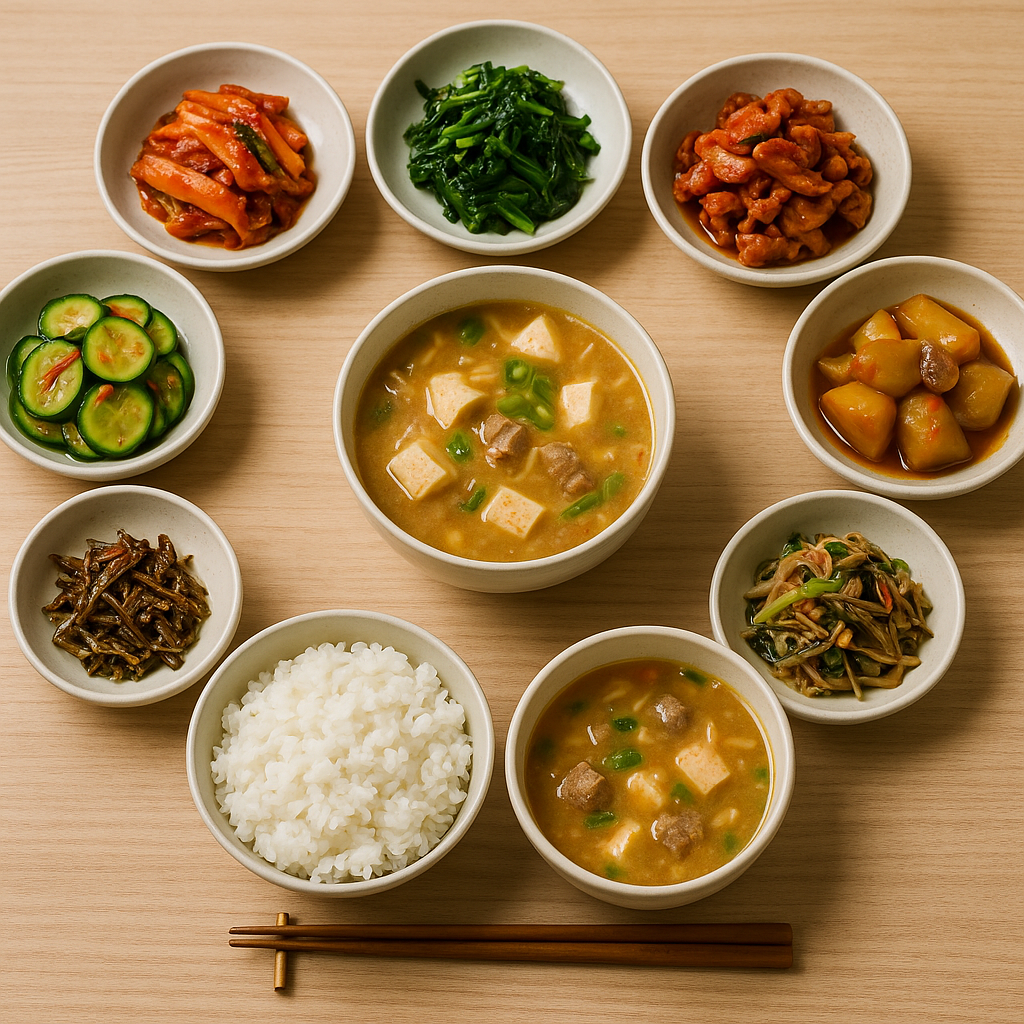
Consequently, establishing a Korean restaurant abroad depends less on the individual culinary skills of the line cook and far more on securing a stable supply of specific seasonings, sauces, flavor enhancers, and fermented ingredients. This dependency presents a significant logistical barrier. This supply chain challenge explains why, despite the high volume of content surrounding K-food on digital platforms like YouTube, authentic Korean restaurants remain relatively rare on a global scale.
(2) Korean food lacks standardization, making global expansion difficult.
Ever heard of the German Beer Purity Law (Reinheitsgebot)? Before it was enacted in 1516, people brewed beer with all kinds of unsafe additives. The law forced standardization—only hops, barley, water, and later yeast could be used. Using concise ingredients and standardized production methods significantly increases the replicability of a dish anywhere in the world. Under this operational model, the only remaining variables are technical mastery and execution experience. However, Korean food is still in a “pre-standardization” phase. Fermented staples like kimchi, doenjang (fermented soybean paste), and gochujang vary wildly from household to household.
My family, for example, uses Sprite to sweeten our kimchi. Others use pear purée or just sugar. There are no universal measurements, no agreed-upon temperatures or aging timelines. That makes industrial reproduction and franchising incredibly difficult.
Part of the reason is historical—Korea remained a rural, agrarian society for millennia and lacked an aristocratic culinary class like the chefs of France. We never had our own “Auguste Escoffier.” Even master Korean chefs often can’t explain why their kimchi tastes the way it does, or reproduce it identically. That’s the second major reason for Korean cuisine’s limited global spread.
(3) There’s a lack of industrial equipment tailored to Korean cooking.
Cuisine is more than ingredients and skill—it requires tools. Ovens, smokers, fermenters, fryers—these are how you scale cooking. Korean fermentation traditionally happens in clay jars buried underground.
Even the kimchi fridge—a dedicated refrigerator for fermented foods—only became common in the last 20 years and remains a domestically focused technology. There’s simply not enough demand or complexity in Korean cooking to justify the development of specialized industrial tools. Most dishes just need a grill pan, mixing bowl, and knife. The reliance on such simple tools indicates that the cooking process is highly labor-intensive. A lack of specialized equipment prevents the automation of core tasks, forcing kitchen staff to execute every step manually and on demand. In high-wage countries, this operational model severely limits profit margins for traditional Korean dishes. Consequently, many Korean restaurants in markets like the United States opt to sell pork belly and basic meats instead; by installing specialized ventilation systems, they shift the final cooking process to the customer or a simple grilling setup, minimizing kitchen labor requirements.
3. Then what is the K-food boom all about?
It’s not about Korean cuisine—it’s about Korea’s manufacturing prowess. Most “K-food” exports are not cooked dishes but processed goods: packaged seaweed, frozen dumplings, spicy noodles, sauces. They’re products of Korea’s powerful food manufacturing sector—not of restaurant culture.
Let’s take a look:
| Product | What it really is | Why it’s not Korean “cuisine” |
| Seaweed | Dried seaweed with salt | Raw material, not a recipe |
| Pork belly / Dumplings | Frozen or pre-grilled meat | Processed product |
| Choco Pie | Based on American MoonPie | Mass-manufactured snack |
| Buldak Ramen | Instant noodles + spicy sauce | Japanese-origin format |
| Gochujang / Soy sauce | Fermented seasoning | Limited global use outside Korean food |
Even in Korea, manufacturing dominates. Coupang, the Korean Amazon, sells 55 flatfish per minute at ~$14 each, thanks to fully automated production. A mom-and-pop shop would take 10 minutes per fish and need to charge ~$30–40 for the same thing.
The K-food boom isn’t about Korean cuisine. It’s about Korean-made food products.
4. What This means for Small Restaurant Owners
Small operators must develop at least one or two core menu items that utilize culinary techniques corporate franchises cannot easily replicate. The strategy requires leveraging efficient OEM products while maintaining a distinct, proprietary finish that serves as the establishment’s unique competitive advantage. Conversely, menus like traditional Korean dishes, which offer limited opportunities to create added value through advanced culinary technique yet demand high manual labor, are structurally unsuited for small restaurant models. Therefore, without a high-density Korean population to provide concentrated demand, the scarcity of authentic Korean restaurants in the United States remains an inevitable outcome.
From Saltnfire.net

If you enjoyed this article, you can support the project – thank you!