
Many first-time entrepreneurs dream of opening a bakery. But structurally, a bakery is one of the most failure-prone businesses you can choose. In this article, I’ll explain why — using two key ideas: portability and participatory perception.
In conclusion, highly portable objects lack ‘subjective meaning’ because they are used solely for the same function anytime and anywhere, regardless of time and space. Consequently, because they cannot create a special experience (a sense of presence) by participatory perception, it is difficult to charge a price premium. Unless their functionality is overwhelming or their price is low, they are not competitive. Small business producers cannot win if they compete against conglomerates with highly portable products.
(If you want the deeper theory behind participatory perception, see the linked articles below. I’ll also explain the core concept here, so you can follow without pre-reading.)
- 🔥 Wabi-Sabi Is Not Interior Style — It’s Experience Design: The Hidden Logic Small Businesses Miss
- Perfect Products Create Spectators — Imperfect Ones Create Followers (Case Study: Michelangelo & Steve Jobs)
- Wabi-Sabi as Personal Spiritual Technology — Designing Perceptual Shifts in Daily Life
1. Why Is There So Much Social Pressure for Bread to Be Cheap?
(1) The ShukaWorld Case
In September 2025, a popular Korean YouTuber named ShukaWorld opened a pop-up store selling bread for 990 KRW, which is about 70 cents. The reaction was split right down the middle. Local bakery owners protested that it destroyed market prices, while consumers cheered that bread was finally being sold at a fair rate. This friction is not unique to Korea. Even in places like France and the U.S., people constantly complain about the rising cost of bread. Across different cultures, there is a stubborn expectation that bread should always be cheap.
(2) Bread as a Functional/Convenience Good
For most people, bread is not an experience. It is a functional product meant for quick calories, a simple snack, or basic survival. When people look at it this way, expensive bread does not feel premium; it feels offensive.
Compare two different scenarios. In one, you are eating house-special buffalo wings at a local pub, enjoying the owner’s style, the music, the lights, and the conversation. In the other, you are sitting alone at home, chewing on a standard red-bean bun. The wings exist inside a specific worldview, but the bun does not. Bread rarely connects to a larger lifestyle. It simply fills a biological need, which is why people demand that it remain cheap.
(3) How Portability Drives Price Pressure
When people tell me they want to start a bakery, they usually point out that bread is portable, easy to package beautifully, and perfect for Instagram. They think this means location matters less and the brand can scale quickly. I see it the exact opposite way. The fact that bread is portable is precisely what kills its charm.
Because people can eat bread anywhere, they judge it everywhere purely on value for money. Once you enter that price war, independent owners lose to franchises every single time.
Real business charm happens when three elements align: the owner’s lifestyle, the atmosphere of the space, and the product itself(Aura Branding Theory). In a restaurant, the food does not have to be perfect. When time, space, and a story wrap around it, even ordinary food becomes meaningful. Take Café Bazar in Salzburg, for example. The food is not amazing, but the atmosphere is overwhelming.
Bread does not get that protection. You buy it in one place and eat it in another, stripping away the context. Once the atmosphere is gone, you are left with a naked product judged only by price and taste. This means bread can only survive if it is either shockingly good or aggressively cheap. Anything in the middle gets torn apart.
Imagine waiting in a long line at a famous bakery to buy a 20-dollar loaf of bread. To you, that bread is special. But if you bring it home to a family member who did not experience the wait or the shop, they will probably tell you it is not worth the money. Had they eaten it inside the bakery, surrounded by its design, it might have been worth every bite. The moment that bread hits an ordinary kitchen table, the magic vanishes. It is just dough, and 20 dollars feels like a waste.
2. Portability and the Mechanism of Harsh Cost-Value Evaluation
(1) A Closer Look at Portable Objects
From a practical standpoint, a portable object is complete in itself. It is not tied to a specific time or place, and it works anywhere. In contrast, context-bound experiences are incomplete. They only make sense inside a particular moment and space. If you remove them from that environment, their meaning collapses.
Portable objects slide smoothly into daily life, but that is exactly the problem. They do not interrupt your routine or force you to pause and think. Meaning often appears when something is imperfect or unstable because that gap forces us to pay closer attention. Masters of modern art like Monet, Van Gogh, or Picasso move us because their work is imperfect, using distorted forms and rough strokes to break reality. This means it is incomplete when viewed purely from the perspective of factual verification or functional analysis—asking, ‘What is this?’ While it is easy to draw something exactly as it appears in a photograph, creating a piece in a way that stimulates imagination and emotion is a realm of mastery that even Michelangelo only achieved in his later years. This imperfection forces us to participate in making sense of the piece. Being imperfect does not mean being flawed; it means having a way to view ordinary things from a deeper perspective.
Consider a live performance by Eric Clapton. A guitar is a portable object, but it remains incomplete until it connects with human emotion and the unrepeatable energy of that specific night. Its true meaning is revealed only within that exact time and place. On the other hand, bread must satisfy hunger and be safe to consume, no matter when or where it is eaten. Consequently, because it is difficult to intentionally introduce imperfections that stimulate the imagination—as one might with a guitar—it easily falls prey to cost-effectiveness evaluations.
Generally speaking, a mass-manufactured, portable commodity is designed to be a closed object. By working perfectly anytime and anywhere, it removes the need for human imagination. It refuses to disrupt the consumer’s daily routine, which causes it to fall instantly into a cold calculation of cost versus value.
(2) Why Beginners Shouldn’t Start with a Bakery
This creates a trap for new entrepreneurs. A beginner cannot beat franchises on price, cannot easily beat industry veterans on taste, and cannot easily inject artistic meaning into the product.
Painting allows for infinite variables like brush density, color saturation, and layout. Bread has far fewer levers to pull—just dough, fermentation, and heat. Because of this, the priority for bread must always be safety and nutrition rather than self-expression. It has to be either cheap or incredibly delicious, and both are very difficult to achieve. That is why opening a bakery is a dangerous first business.
3. Survival paths of Bakery
Let’s look at the main survival paths.
(1) Path One — Master-Level Technical Skill
While restaurants can hide behind their atmosphere, service, or interior design, bread has nowhere to hide once it hits the dining table. At home, every flaw is exposed instantly—the texture, the fermentation, the sweetness, and the bake level. Consumers will immediately compare it to what they can buy in bulk at Costco.
Because of this, personal-brand bakeries must be able to win blind taste tests. The reaction has to be an immediate realization that this is fundamentally different. This is why elite bakeries are dominated by pâtissiers trained in France or Japan, long apprenticeships, and guild-style networks. It is a slow, expensive path that is incredibly hard to scale.
(2) Path Two — Brand the Purchase Experience
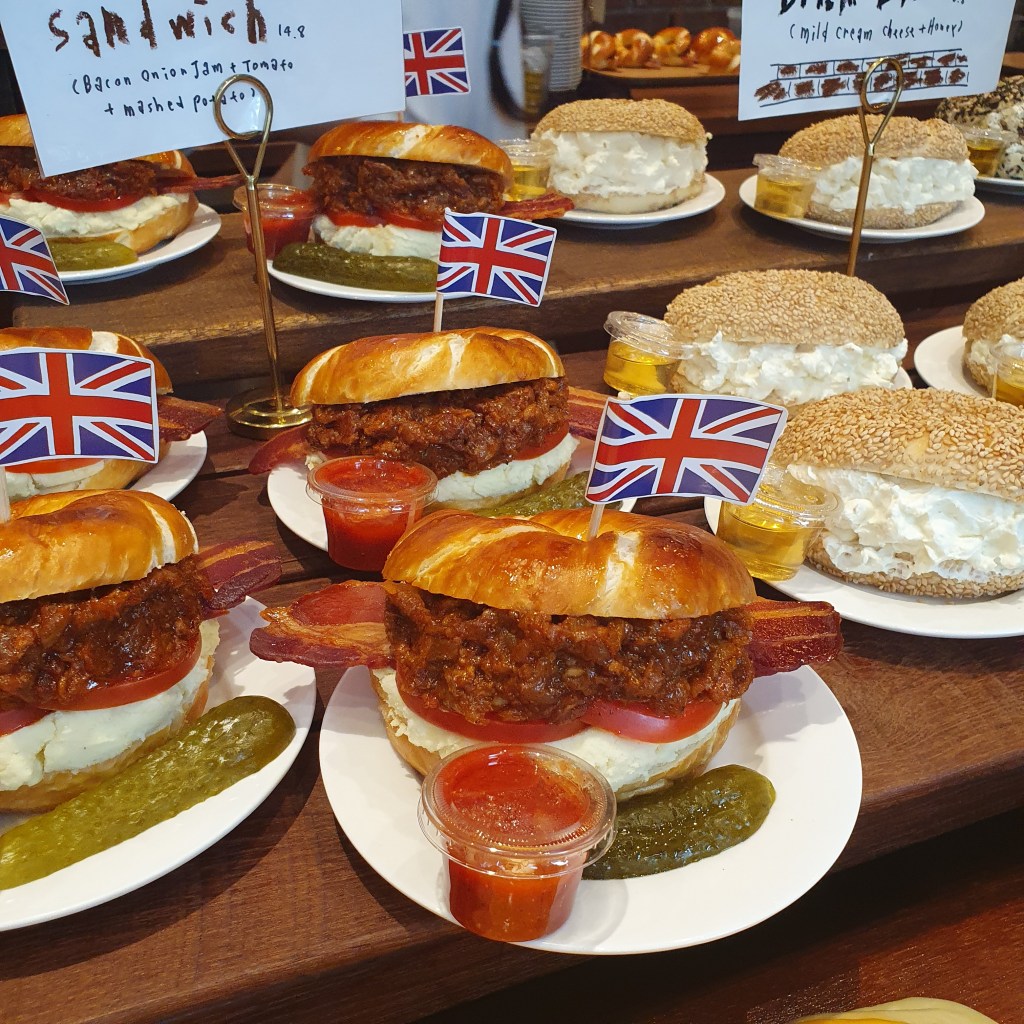
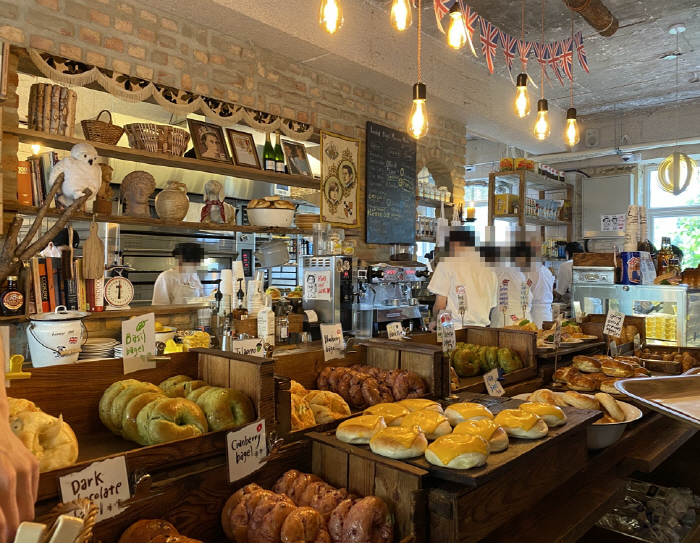
The second path is the bakery-as-a-theme-park model, seen in places like the London Bagel Museum or Café Les Parisiens. These places do not actually sell bread; they sell the experience of buying it. They lean heavily on national imagery, themed interiors, borrowed cultural authority, and social media amplification.
The taste of the bread might be entirely average, often relying on factory-made, pre-processed dough. However, the experience itself is theatrical. Customers are buying a mini-vacation, not just baked goods. Because the technical mastery path is too slow, many entrepreneurs choose this highly scalable branding model instead.
[Source 1: By 찐요미 – Naver blog, CC BY 2.0 kr, ] [Source 2 : 이하린]
👉 Google Photo: London Bagel Museum introduction
(3) Path Three — Ideologize Bread
The third strategy relies on ideology. This means wrapping the bread in concepts like organic ingredients, natural yeast, sustainability, or slow-food morality. There is nothing wrong with this approach, but using morality to sell a product comes with a hidden cost. The moment you sell moral positioning, you invite intense public scrutiny. Small owners often find themselves unprepared for the backlash that comes when they are accused of hypocrisy or when they face ordinary labor disputes. It introduces a level of reputational risk that is incredibly difficult to manage.
4. Practical Examples: Portability & Cost-Value Evaluation
This phenomenon is not unique to bread. Almost any portable object gets pulled into a ruthless price war.
(1) Evian Bottled Water
Evian was not always just water. It was originally marketed as a sacred Alpine spring water from France, famous for its history of helping people with medical issues. That narrative created a powerful sense of place. Drinking it felt like a healing ritual, and people traveled across the world to experience the source. The physical journey broke the routine of daily life, and meaning was created through that participation.
Everything changed when Evian put that water into ordinary plastic bottles. Once the product became self-contained and portable, consumers began to look at it at their desks and ask why they were paying so much for plain water. The water inside did not change, but the framework did. The healing environment vanished, and Evian entered a cold cost-performance comparison. Today, it relies on luxury fashion collaborations just to keep its premium image alive.
(2) Wireless vs. Wired Headphones
Consider wireless and wired headphones. On paper, wireless headphones should be more expensive because they offer more technology, portability, and convenience. Yet, high-end wired headphones cost significantly more.
Wireless headphones go everywhere with you—while commuting, walking, or multitasking. They are incredibly convenient, but that convenience turns music into background noise. Once a product fades into the background, it is judged purely on value for money, which pushes prices down.
Wired listening is different. It requires extra equipment like DAC, amplifer, cables, and setup time. This inconvenience creates a deliberate break from daily life. Listening becomes an intentional, foreground experience rather than background wallpaper. In high-end audio communities, this friction is exactly where the value lies. Manufacturers compete on depth and resolution, not convenience. Portability leads to background use, which leads to price pressure. True commitment, not convenience, sustains a premium price.
(3) Counterexample — Luxury Bags and Watches
An objection might be luxury bags and watches, which are both highly portable and incredibly expensive. But in this case, consumers are not paying for the physical object; they are paying for the brand machine. Luxury houses invest heavily in identity, symbolism, and status signaling. From their perspective, the actual object is secondary. The logo could sit on almost anything.
People are buying distinction, not leather. If you remove the luxury trademark, that same bag instantly falls into a basic cost-value evaluation. Luxury goods escape the price pressure of portability because the brand acts as an external meaning generator.
If you can elevate your bread into a luxury ‘brand,’ you can overcome the limitations of portability. However, given that bread offers a transient, one-time experience that ends once consumed, it remains questionable whether one can bestow a sacred aura upon a logo, short of selling a spatial experience. To be sure, establishing the brand as a local specialty or attaining a respected status within the community are viable strategies for evolving into a luxury confectionery enterprise. Yet, it is highly debatable at this point whether expanding the product line into non-bread merchandise to represent a specific lifestyle aligns with the intrinsic function of a bakery, or if it stands as a feasible alternative for small business owners.
5. Conclusion
The structural chain is this:
Portability → Functional completeness (no perception crack) → No participatory perception → No phenomenological meaning → Immediate cost–value competition
We see this exact pattern in bread, bottled water, and headphones. Portable goods are absorbed into daily life too easily. When a product fails to disrupt a consumer’s routine, it loses its magic, and when the magic is gone, the only thing left to talk about is the price.
- Part 2, I examine [See: Portability and Participatory Perception Part 2: Why Musicians Need to Step Out of the Studio, and the Lessons for the F&B Industry]

If you enjoyed this article, you can support the project – thank you!